The Ultimate Solar Installer Interview: Four Phases of Questions to Ask
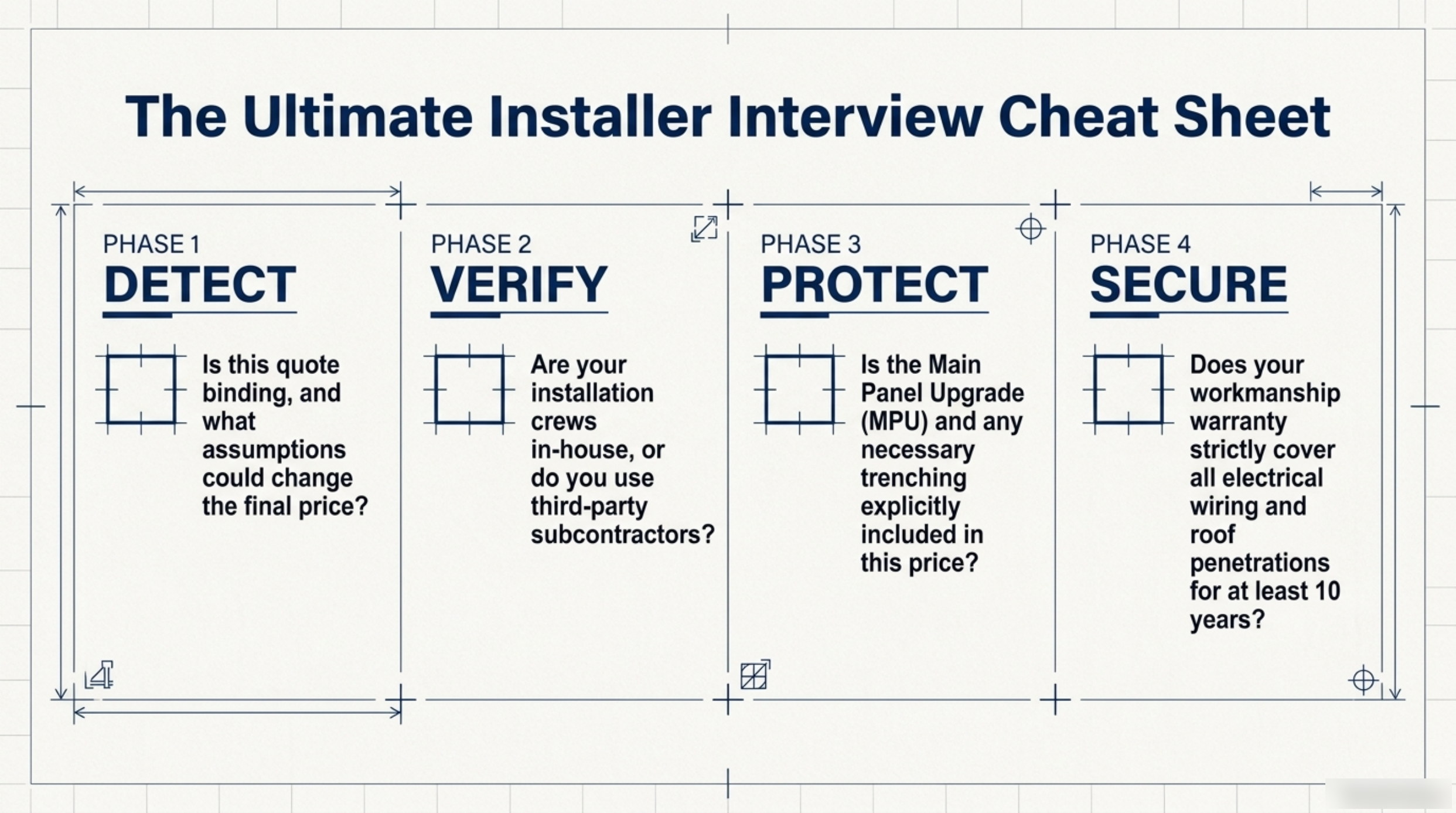
Most homeowners go into a solar appointment without a question set, and that is the structural disadvantage the slide is designed to fix. It presents itself as a cheat sheet, laid out in four phases — Detect, Verify, Protect and Secure — with one question per phase. Four questions is a small ask for a decision that runs for decades.
The value of the set is that each question targets a specific place where a proposal can quietly disagree with itself. Not "do you do good work," which nobody answers honestly and nobody can check, but "is this quote binding, and what assumptions could change the final price," which is answerable, checkable, and revealing.
The short version
- The slide is built as an interview cheat sheet with four phases: Detect, Verify, Protect, Secure.
- Detect asks whether the quote is binding and what assumptions could change the final price.
- Verify asks whether installation crews are in-house or third-party subcontractors.
- Protect asks whether the main panel upgrade and any necessary trenching are explicitly included in this price.
- Secure asks whether the workmanship warranty strictly covers all electrical wiring and roof penetrations for at least 10 years.
- Four questions, four answers you can hold someone to.
Phase one — Detect: is this quote binding?
"Is this quote binding, and what assumptions could change the final price?"
This is the first question because everything else depends on the answer. A quote is a set of assumptions as much as a set of numbers, and the assumptions are where the price moves. An array size. A roof plane count. Whether the main panel is adequate. Whether the conduit run can be routed inside the structure. Whether the service can carry the load without an upgrade.
Listen for the word assumptions being used openly. An installer who can name their own assumptions is describing a design. An installer who says the price is firm without qualification is either certain about your house in a way nobody can be before a site visit, or is not planning to honour the number. Either answer is informative, and that is the purpose of the phase: detection, not persuasion.
Phase two — Verify: who is actually on your roof?
"Are your installation crews in-house, or do you use third-party subcontractors?"
This question is about accountability, not craftsmanship. When the crew installing the array works for the firm that sold you the job, the salesperson, the designer, the installer and the warranty holder are all the same organisation. When the crew is a subcontractor, the chain has a seam in it, and the seam sits exactly where problems appear: at the roof penetration, at the wiring termination, at the point where one party says the other party's work caused the leak.
Subcontracting is not automatically a defect, and many reputable firms use it. The information you need is which model you are buying and how the warranty behaves across the seam. If the workmanship warranty is issued by the firm that sold you the system, ask how that warranty is honoured when the crew that did the work is not theirs.
Phase three — Protect: is the electrical scope inside the price?
"Is the Main Panel Upgrade (MPU) and any necessary trenching explicitly included in this price?"
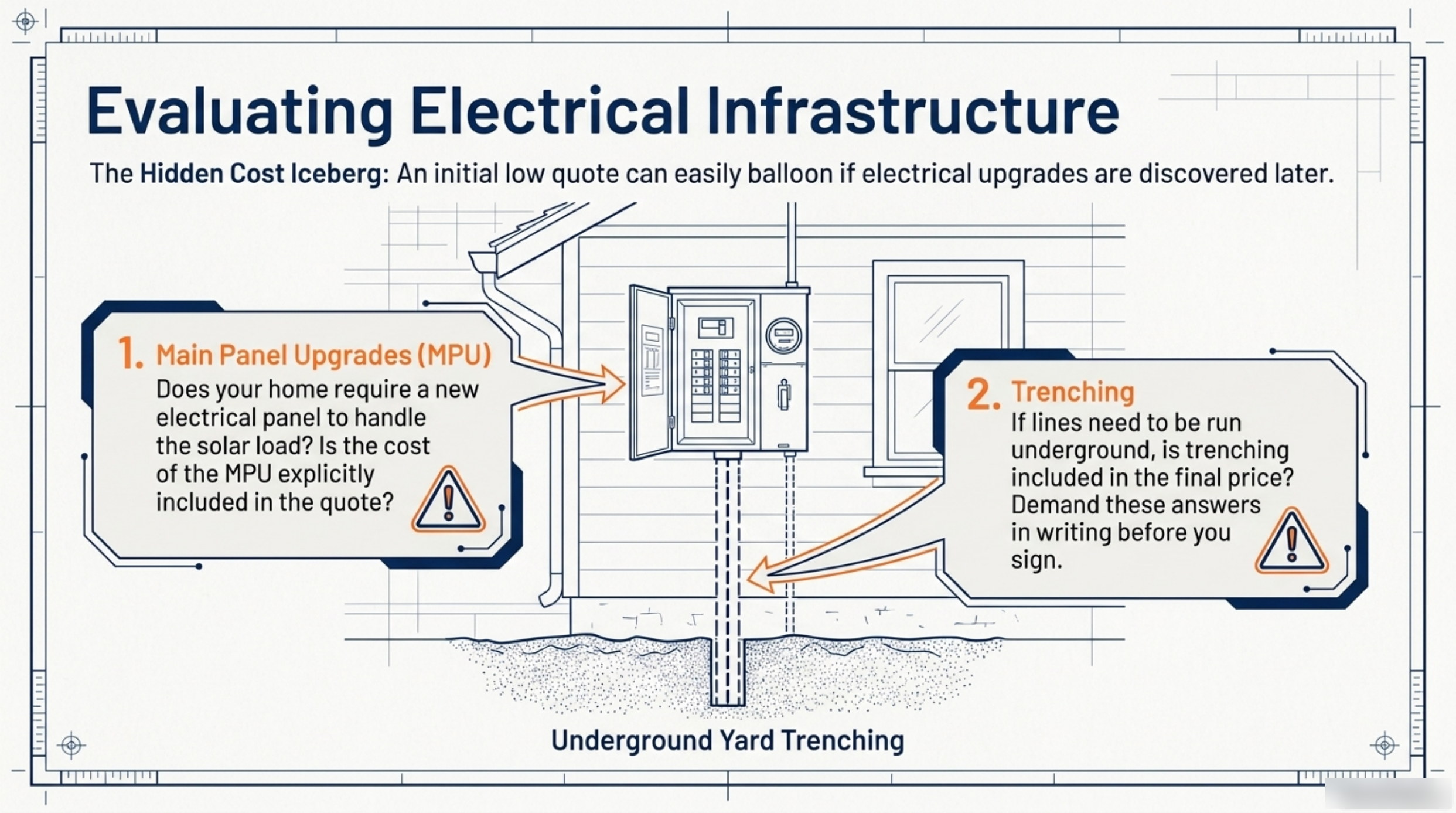
This phase is the one with the clearest money attached. These are the two items that turn a low quote into a larger one after signature, and the slide's wording is deliberately exact: explicitly included in this price. Not "usually needed," not "probably fine," not "we will let you know." Inside the price, or outside it.
Both halves of the question matter. The main panel upgrade is about whether your service can carry the generation at all; the trenching is about the route the conductors take to get there. Neither is exotic, and both are entirely absent from proposals written before anyone looked. The full mechanics of why these two line items balloon a quote are set out in The Hidden Cost Iceberg: Main Panel Upgrades and Yard Trenching in a Solar Quote.
Phase four — Secure: what does the warranty actually cover?
"Does your workmanship warranty strictly cover all electrical wiring and roof penetrations for at least 10 years?"
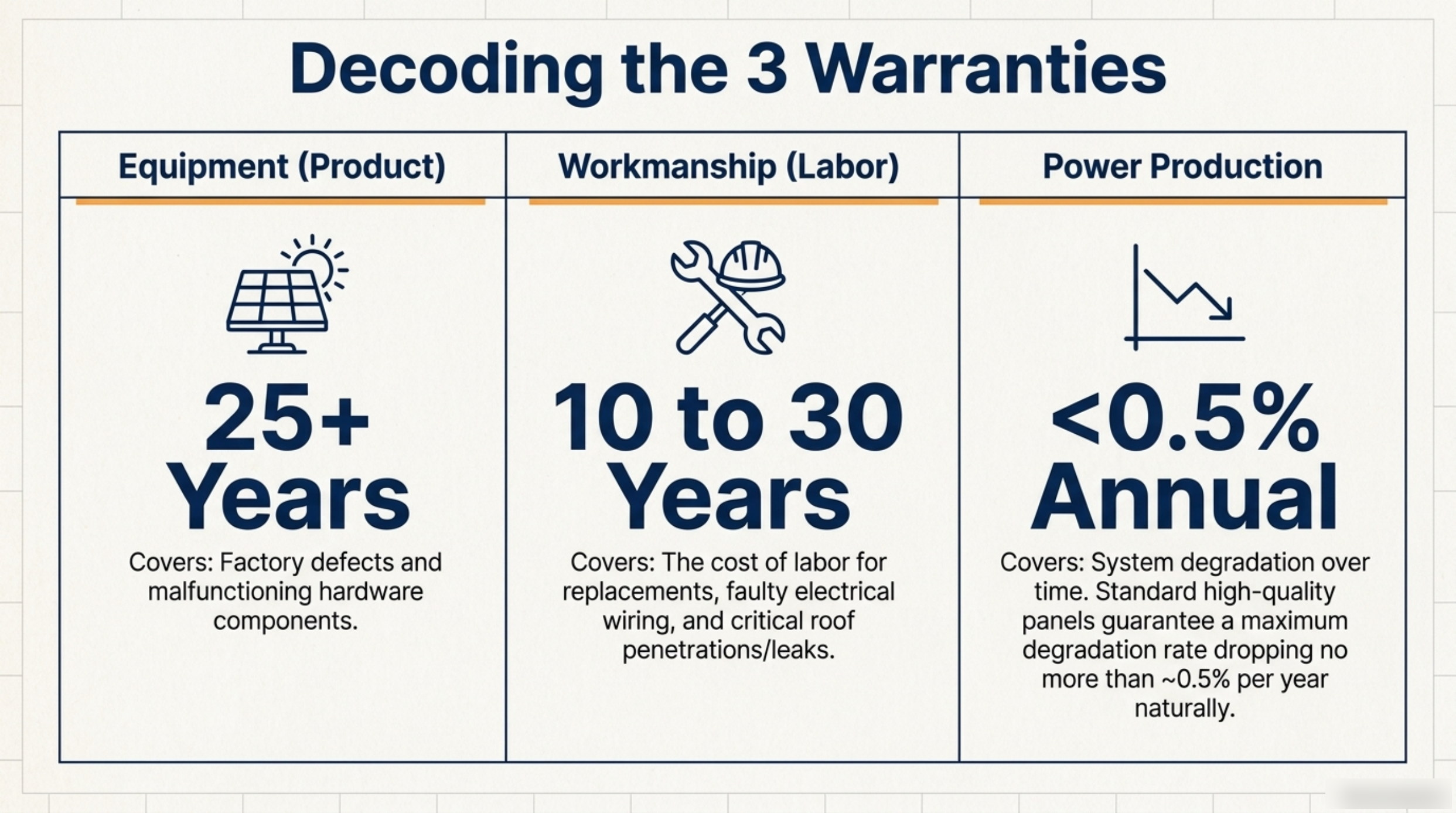
The final phase converts the whole conversation into a term you can compare. Three components are bundled into one question, and each is load-bearing. All electrical wiring means the coverage reaches the parts of the installation that carry current. Roof penetrations means the coverage reaches the building envelope, which is the only part of the system attached to your house in a way that can cause damage the system itself will never show. At least 10 years sets a floor on the term, and the floor matters because the workmanship layer is the one whose term varies most between installers.
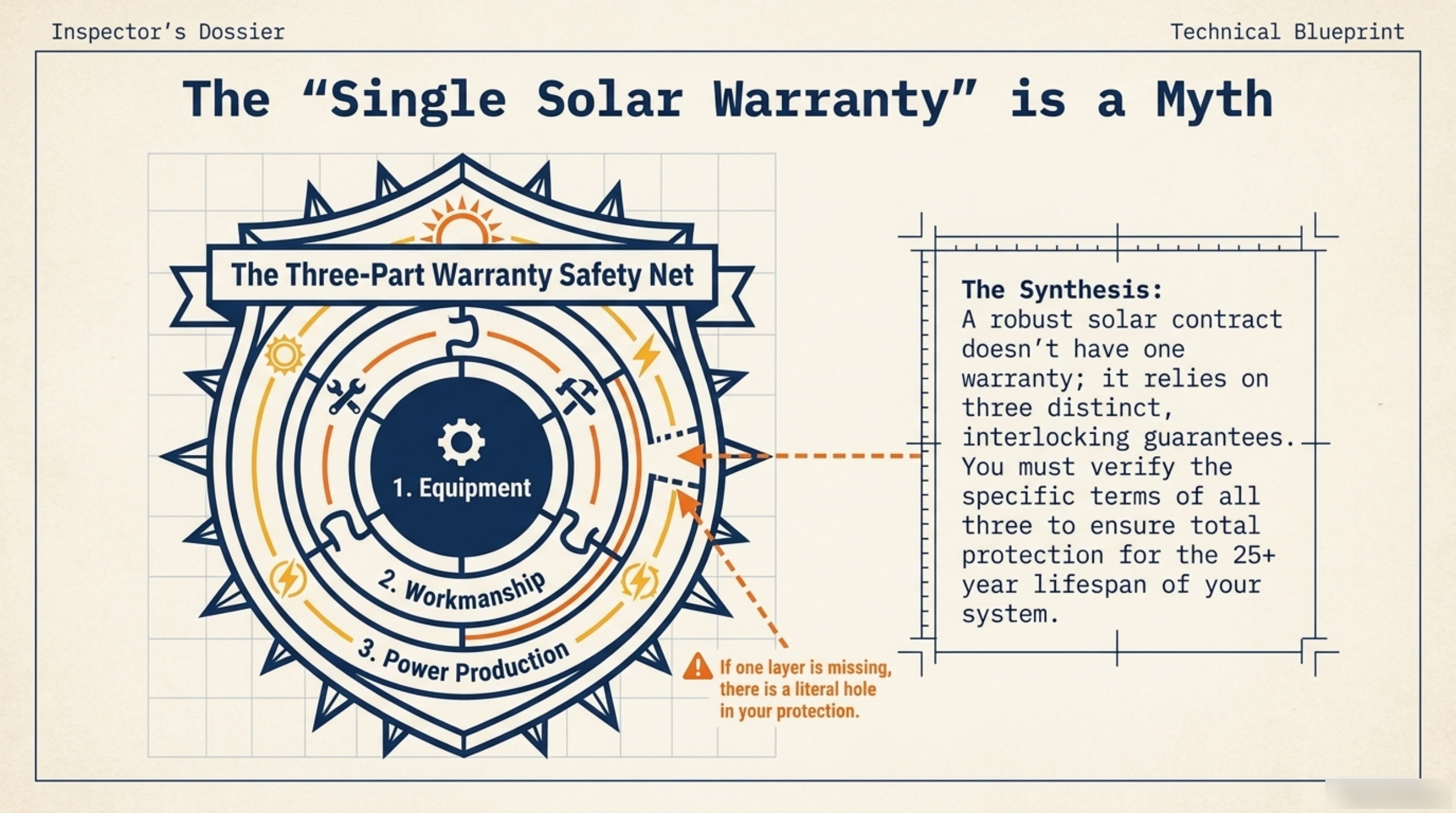
Note the word strictly. It is there to defeat the answer that sounds like agreement but is not: "our warranty covers workmanship." You want the scope named, the wiring and the penetrations included, and the duration stated in years. The relationship between that workmanship term and the equipment and production layers is the subject of Decoding the Three Warranties: 25+ Years, 10-30 Years and the 0.5% Degradation Cap, and the case for the three layers existing separately at all is in The ‘Single Solar Warranty’ Is a Myth: The Three-Part Safety Net.
How to score the answers
| Phase | Question | What a solid answer contains |
|---|---|---|
| Detect | Is this quote binding, and what assumptions could change the final price? | A named list of assumptions and a written price effect for each one. |
| Verify | Are your installation crews in-house, or do you use third-party subcontractors? | A clear statement of the crew model and how the workmanship warranty crosses it. |
| Protect | Is the main panel upgrade and any necessary trenching explicitly included in this price? | Both items either priced inside the quote or formally excluded with a price attached. |
| Secure | Does your workmanship warranty strictly cover all electrical wiring and roof penetrations for at least 10 years? | The term in years, with wiring and roof penetrations named inside the covered scope. |
Used as a set, the four questions do something a price comparison cannot. Two quotes a few hundred dollars apart may be entirely different products — one binding with the electrical scope inside it and the roof covered for decades, the other an estimate with the expensive parts left out and a workmanship term that expires while the system is still young. The four phases make that difference visible before signature instead of after installation.
Ask them in order, write the answers down in the meeting, and compare the written answers rather than your recollection of the meeting. Where an answer is vague, the follow-up is always the same: put the specific version of that sentence in the contract, and read it there before you sign.
Frequently Asked Questions About Interviewing Solar Installers
Why these four questions and not questions about equipment brands?
Equipment names are checkable and largely comparable; they are not where projects go wrong. The four phases target the places where a proposal can change after signature — assumptions, subcontracting, electrical scope and warranty scope.
What if the installer refuses to answer one of the phases?
A refusal is an answer. The question set asks for facts the installer already knows about their own business, so reluctance to state them in writing is a signal about how the contract will read.
Should I ask these questions of every installer I speak to?
Yes, and in the same order, so the answers line up side by side. The comparison is only meaningful if every proposal is measured against the same four questions.