The ‘Single Solar Warranty’ Is a Myth: The Three-Part Safety Net
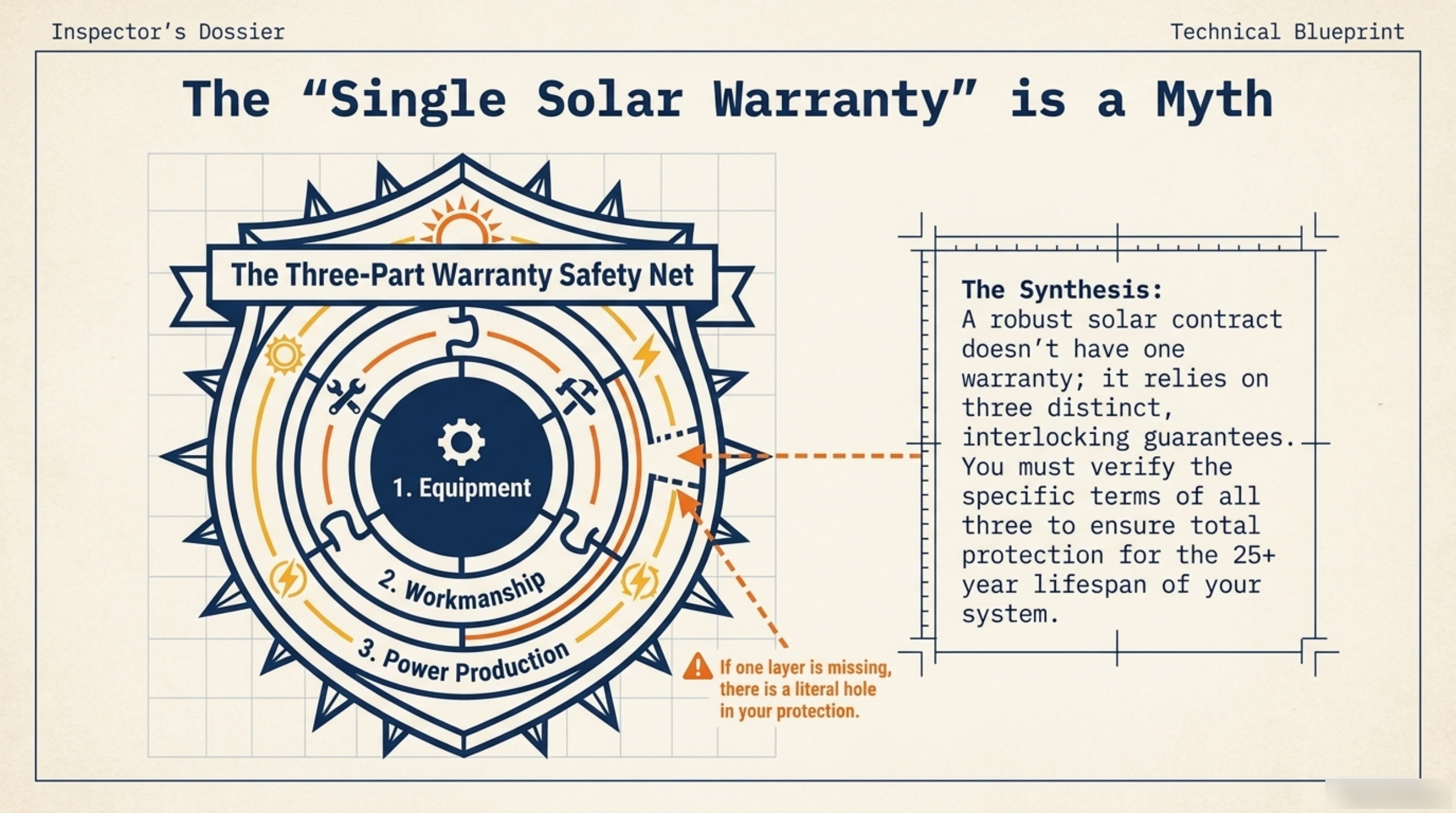
Ask a homeowner what warranty their solar system came with and the answer is usually a number: twenty-five years. That single number is the myth the slide sets out to break. "The 'Single Solar Warranty' is a Myth" is the headline, and the explanation underneath is the part worth keeping: "A solar contract that actually protects you doesn't have one warranty; it relies on three distinct, interlocking guarantees."
Three, not one. And the reason the distinction matters is in the slide's closing line: "If one layer is missing, there is a literal hole in your protection." A hole in a warranty is not a cosmetic problem. It is the place where the cost lands on you.
The short version
- There is no single solar warranty. The slide calls the idea a myth outright.
- A contract that protects you relies on three distinct, interlocking guarantees rather than one document.
- Layer one covers equipment: factory defects and malfunctioning hardware.
- Layer two covers workmanship: the labour, the wiring and the roof penetrations.
- Layer three covers power production: the system's output over time.
- If one layer is missing, there is a literal hole in your protection — that is the slide's own phrasing.
Three promises, three different parties
The confusion starts because the word “warranty” is singular in ordinary speech but plural in a real contract. Each layer answers a different question, and each layer is typically backed by a different party.
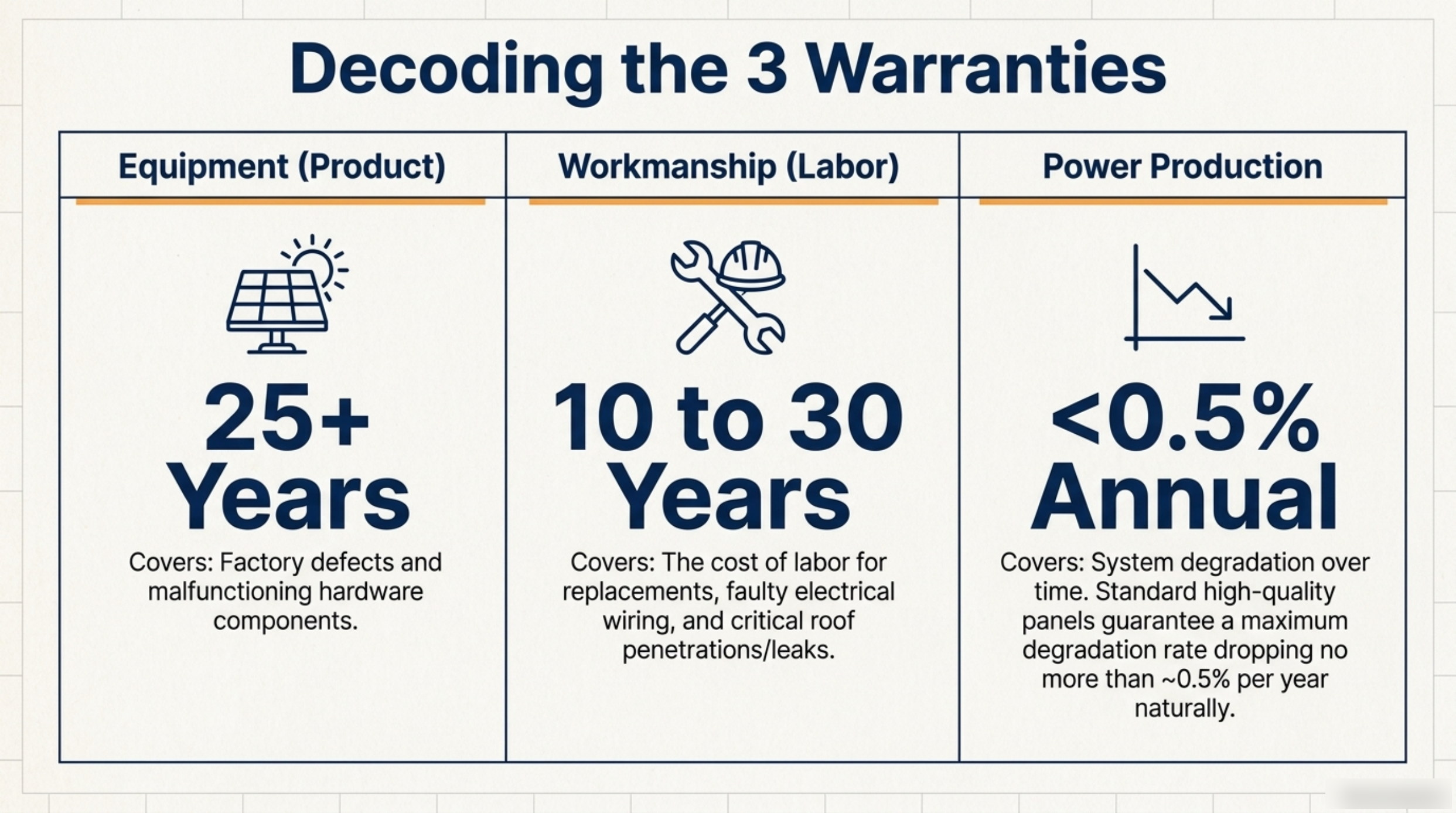
Equipment coverage answers: what if the hardware fails? That promise usually comes from a manufacturer. Workmanship coverage answers: what if the installation fails? That promise comes from the installer, and it is the only layer that covers labour and the roof. Production coverage answers: what if the system generates less than it should? That promise is about output over time, and it is measured rather than inspected.
Because the three promises come from different parties, they can also be lost separately. A homeowner can hold a flawless equipment warranty and still have no remedy for a leaking roof penetration, because the manufacturer's document was never about the roof.
Layer one: equipment
The slide's diagram labels this first layer “Equipment.” It is the manufacturer's promise that the hardware will not fail through factory defect or malfunction, and it is generally the longest-lasting of the three, because hardware is designed to run for decades. It is also usually the narrowest in scope. Equipment coverage replaces a component. It does not pay to remove the failed component, does not pay to install the replacement, and does not pay for the labour in between.
That gap is why the first layer alone is never enough, no matter how long its term runs.
Layer two: workmanship
The second layer is the installer's own promise, and it is the one that covers everything the manufacturer's document leaves out. The wiring. The terminations. The mounting. The flashing and sealing around every roof penetration. The conduit. If water comes in at a penetration, the module manufacturer owes you nothing, because the module did not fail. The installer owes you the repair — if the contract says so.
The slide's diagram names this layer as workmanship and the accompanying duration slide gives it a range that is far shorter than the equipment term. That asymmetry is normal, and it is also the layer that most directly protects the building rather than the system.
Layer three: power production
The third layer is the least discussed and the most useful when something is quietly wrong. It covers the system's output over time. Instead of promising that a component will not break, it promises that the array will keep producing at or above a stated level, so a system that is technically running but underperforming still has a remedy attached to it.
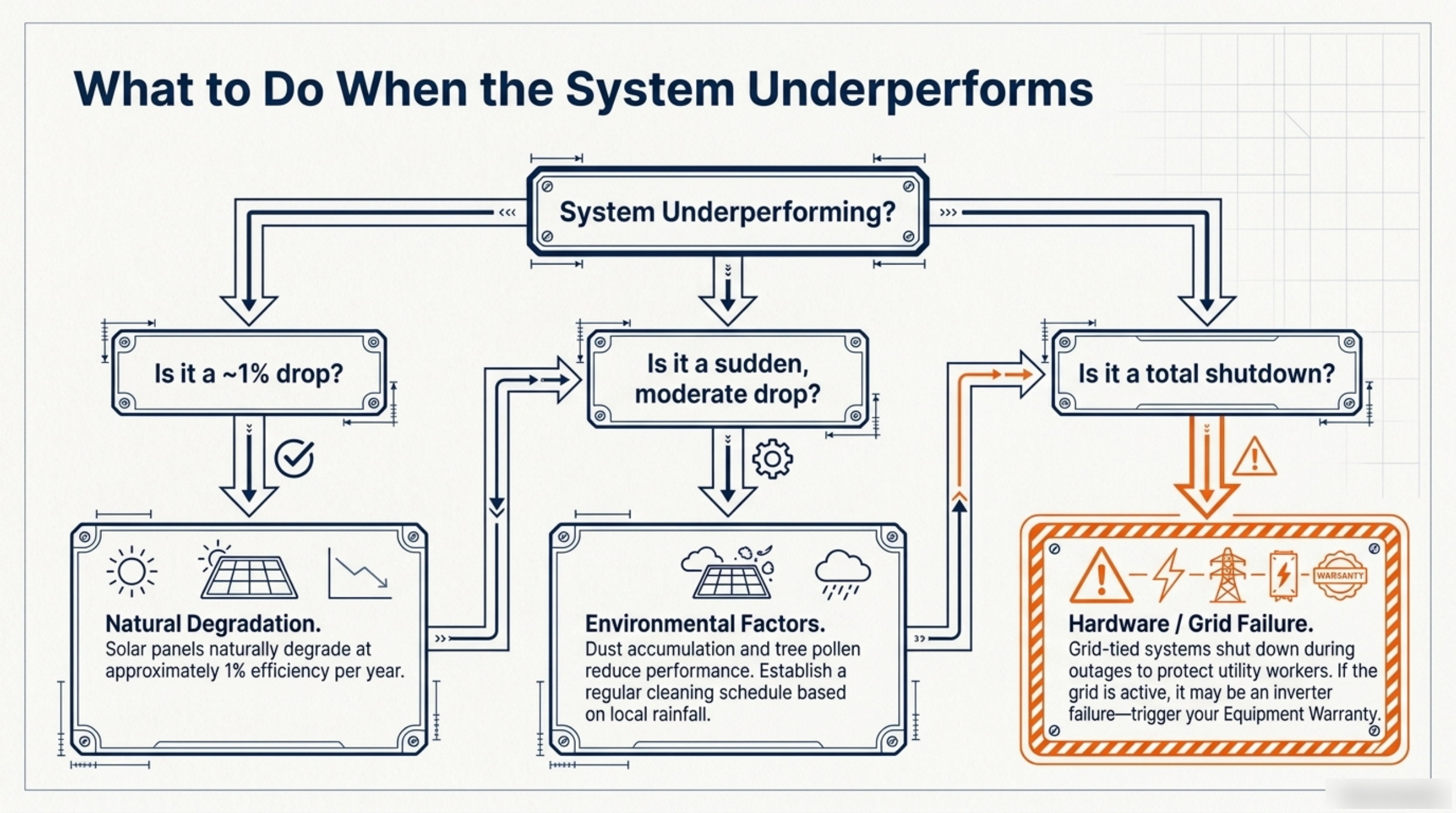
This is the layer that makes a monitoring app meaningful. Without a production guarantee, a slow decline in output is a fact you observe. With one, it is a claim you can make.
What a hole looks like from the homeowner's side
The slide's phrasing is precise, and it is worth translating into outcomes, because a missing layer does not announce itself. It announces itself at the moment you need it.
| Missing layer | What it covers elsewhere | What it costs you here |
|---|---|---|
| Equipment | Factory defects and malfunctioning hardware components | A failed module or inverter is replaced and re-installed at your expense, including the labour. |
| Workmanship | The cost of labour for replacements, faulty electrical wiring, and critical roof penetrations and leaks | A leak at a roof penetration or a wiring fault is a repair you arrange and pay for yourself. |
| Power production | System output over time, with a stated degradation limit | No remedy when the system runs but generates less than promised, because nothing has technically failed. |
The pattern in that table is the same in every row. The layer you are missing is the layer that happens to be the one you need, and the cost lands on the homeowner at the least convenient moment — during construction, in the middle of a storm season, or years later when the system is no longer new.
Verifying three layers before you sign
The slide is presented as a dossier rather than a brochure, and that is the right way to use it. Treat the contract like a file you are assembling, and require one document per layer: the manufacturer's equipment document, the installer's workmanship document, and the written production guarantee. For each one, capture the term, what is excluded, who pays labour, how a claim is started, and what happens if the installer is no longer trading.
Three documents that name three different covered things are normal. One document that gestures at "the warranty" is the myth, and the way to defeat it is simply to ask for the other two. When you have all three, the next question is how long each one lasts and what it excludes — the terms, durations and degradation cap are set out in Decoding the Three Warranties: 25+ Years, 10-30 Years and the 0.5% Degradation Cap, and the questions that force an installer to state them in the sales meeting are in The Ultimate Solar Installer Interview: Four Phases of Questions to Ask.
Frequently Asked Questions About Solar Warranties
Why do sales conversations collapse three warranties into one?
Because one number is easier to quote than three documents. The slide's claim is that the single warranty is a myth, not that installers are dishonest about it — the single number describes only the equipment layer, which is the longest and narrowest of the three.
Which layer protects my roof?
Only the workmanship layer. It covers the labour and the critical roof penetrations, which means leaks at a mounting point are inside it. Equipment coverage never applies to the roof, because the failure is not a hardware failure.
Can a homeowner buy protection for a missing layer afterwards?
It is far easier to require the layer in the contract than to add it later, because the workmanship layer is written against work the installer performed. Ask for all three before signature, in writing, in the same document.