The Hidden Cost Iceberg: Main Panel Upgrades and Yard Trenching in a Solar Quote
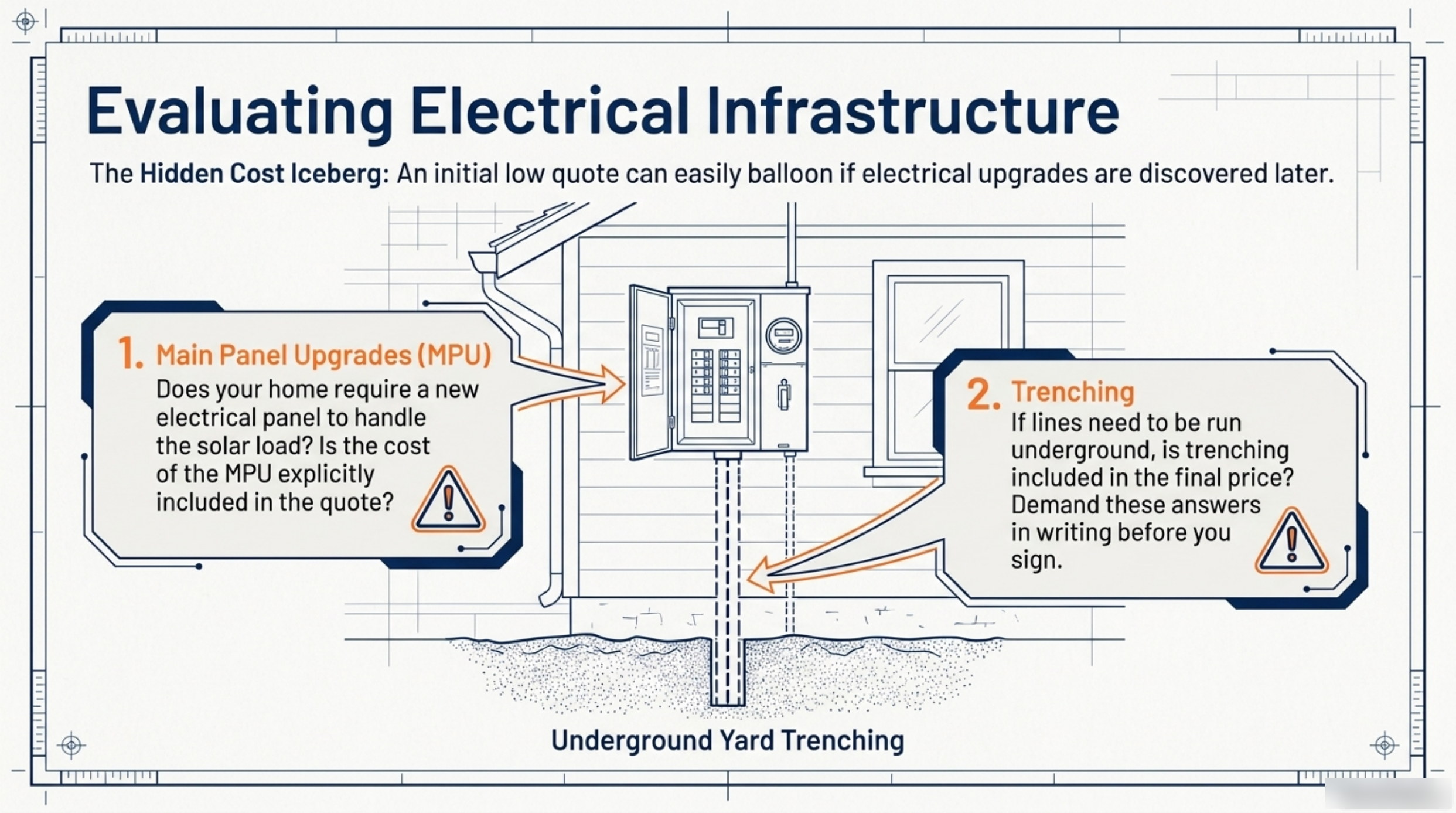
Most solar quotes are priced as if the array were the whole job. It is not. A rooftop system is a new electrical load attached to infrastructure that was sized long before anyone in the house thought about panels, and the slide this article is built on names the two places where a tidy low number quietly grows: "The Hidden Cost Iceberg: An initial low quote can easily balloon if electrical upgrades are discovered later."
That slide is titled "Evaluating Electrical Infrastructure," and the title is the frame worth borrowing. Solar shopping usually starts with modules, inverters and dollars per watt, but the electrical work behind the array decides whether the number you agreed to is the number you pay. Two line items carry most of that weight — the main panel upgrade, and trenching for lines that run underground.
The short version
- Two line items cause most quote creep: the main panel upgrade (MPU) and underground yard trenching.
- Ask directly whether your home needs a new electrical panel to carry the solar load.
- Ask whether the cost of that panel upgrade is stated inside the quote rather than estimated later.
- If conductors must run underground, ask whether trenching is inside the final price.
- The slide's instruction is simple: demand these answers in writing before you sign.
Why an “initial low quote” grows
A low quote is not automatically a dishonest quote. It is often an incomplete one, because the parts that make it low sit outside the scope that was written down. An array has to connect to your home's main electrical panel, and that panel has to be able to accept the connection. The conductors have to travel from the array to the point where they enter the house, and if that path runs through dirt, somebody has to open the ground and close it again.
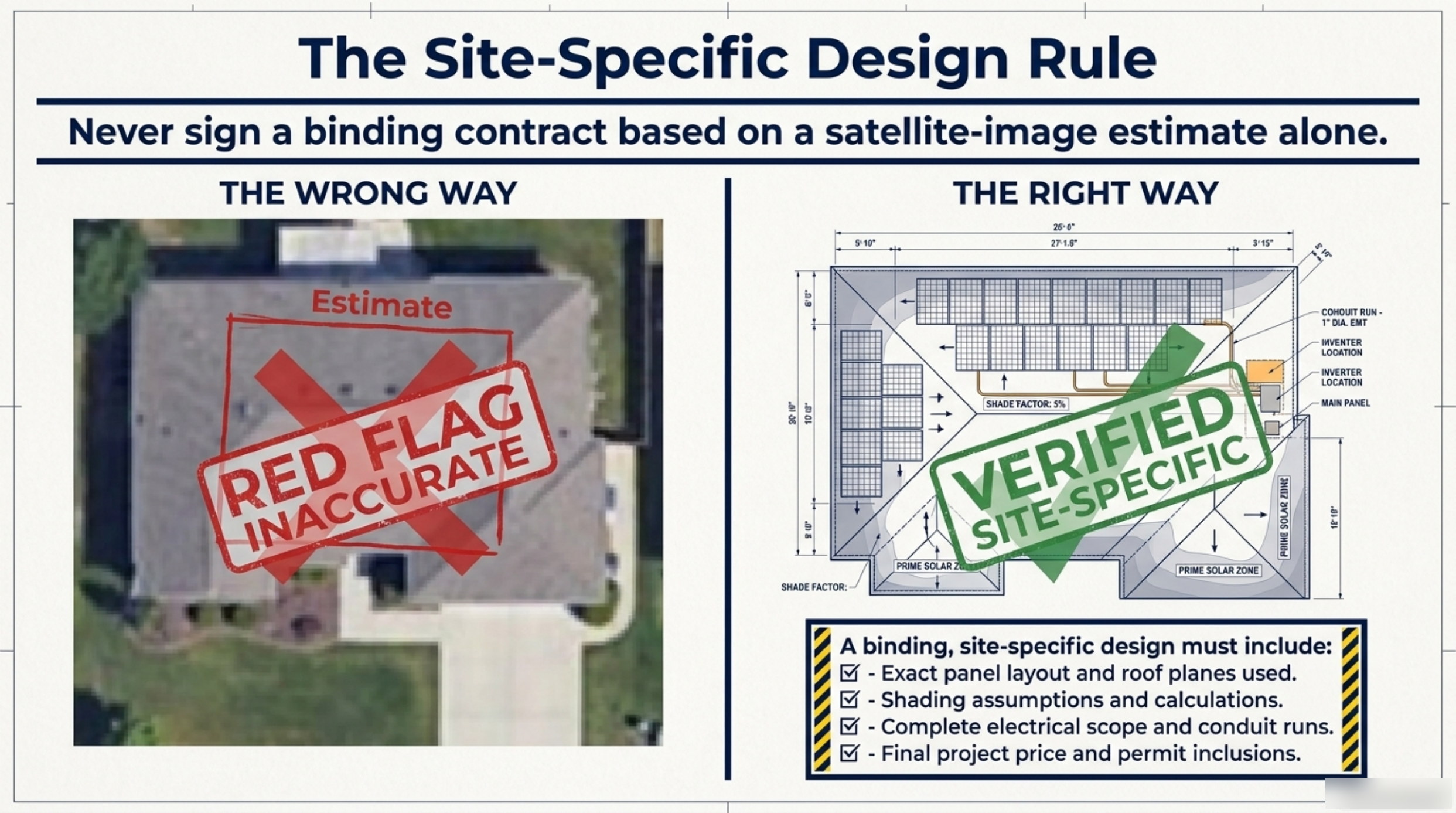
Both of those are construction items. Both get confirmed on site. Both can be left out of a contract that was drafted from a satellite view and a conversation — and both come back as change orders after the paperwork is signed. The quote looks small because it is describing a smaller job than the one that will actually be built.
The first question: does your home need a main panel upgrade?
The slide puts the question plainly: "Does your home require a new electrical panel to handle the solar load?" A main panel upgrade, usually shortened to MPU, is the replacement of the home's main service panel with one that can carry the added generation. Where the existing panel cannot accept the connection, the upgrade is not an optional accessory; it is a prerequisite. The solar system cannot be energised until the electrical infrastructure behind it is right.
The slide's second half of the question is the one that protects your budget: "Is the cost of the MPU explicitly included in the quote?" Read the word explicitly carefully. A quote that is silent about the main panel has not agreed to pay for one. Silence in a contract is not a promise; it is a gap, and the gap is filled by whoever is holding the change-order form.
The second question: who pays for the trench?
The slide's second numbered item is labelled "Trenching," and its question is just as direct: "If lines need to be run underground, is trenching included in the final price?" The slide's own caption beneath the illustration reads "Underground Yard Trenching," which is exactly what it is — excavation for the run between the array, the inverter and the main panel when the path cannot be made overhead or through the structure.
Trenching is priced by length and by what it crosses. A clean run across open dirt is one thing. A run that has to pass under a walkway, follow a driveway edge, avoid irrigation lines, or be hand-dug where machinery cannot reach is another. Because it is priced per foot and per obstacle, it is the easiest line item in the whole project to leave out of an initial number and add later.
Why “discovered later” always costs more
An upgrade found during construction is not the same purchase as an upgrade planned before it. Discovered later means the design has to be revised, the permit scope changed, the schedule re-sequenced around an electrician's calendar, and the homeowner has no competing proposals left to compare. You are no longer shopping. You are buying a required part from the only party who can supply it in the sequence the job needs.
There is a utility step on top of that. Any grid-connected system has to pass interconnection review, which is the utility's check that what is being connected to its wires is what was submitted. An application built around the existing service no longer matches the equipment when the service changes mid-project, and the mismatch shows up as delay rather than a line on the invoice.
That is the iceberg shape the slide is describing. The visible quote is the array. The hidden mass is the electrical scope that supports it: the panel, the wiring, the conduit, the excavation, the inspection.
What to demand in writing
The slide's instruction is unambiguous: "Demand these answers in writing before you sign." In practice, "in writing" means the signed document should state, in the body of the contract rather than in an email or a verbal aside:
| What the contract must state | Why it matters |
|---|---|
| Whether a main panel upgrade is required, and the upgrade’s cost if it turns out to be needed | Silence in a contract is a gap, and the gap gets filled by whoever holds the change-order form |
| The panel that will be installed: make, model and rating | Turns the scope into a specific object rather than an allowance |
| Whether trenching is included, the assumed run length, and the per-foot price beyond it | Priced per foot and per obstacle, it is the easiest line item to leave out |
| Which licensed party performs the electrical work, and who pulls the permit | The inspection and the warranty both depend on who signed off |
| Whether permit and inspection fees sit inside the stated figure or are billed at cost on top | Fees added at cost are change orders waiting to happen |
If a salesperson tells you the panel "should be fine," ask for that sentence with the word estimate attached to it, plus a price for the case where it is not. An assumption that costs nothing to state is worth nothing if it is never written down. Cross-check the electrical lines against an itemised breakdown of the whole job — the module, inverter, balance-of-system, soft-cost and labour split is set out in Where Does Your Money Go? Itemizing Turnkey Solar Installation Costs. For a first read on overall budget before you get that far, How Much Does Solar Cost in Flagstaff? and the calculators at /tools/ are useful starting points.
Frequently Asked Questions About Solar Electrical Upgrades
Do I always need a main panel upgrade for solar?
No. Many homes have a service panel that can accept the added generation, and no upgrade is required. But that is a determination made by looking at your panel and your service, not by assuming. The slide's question — whether your home requires a new electrical panel to handle the solar load — should be answered for your address in writing, with the cost of that answer stated explicitly if the answer is yes.
Is trenching ever avoidable?
Sometimes. Where a run can be made overhead or routed through the structure, there is no excavation to price. Where it cannot, the conductors go underground and trenching is part of the work. The correct answer is a statement of which route your project uses, not a promise that the question will not come up.
Should the panel upgrade or trench ever appear as a rough estimate?
If the site visit is complete, no. Once someone has seen the panel and walked the run, both items become scope, and scope is priced. An estimate for work that has already been surveyed is a signal that the quote was drafted before the survey.