Empowered and Protected: The Flagstaff Solar Buyer's Final Checklist
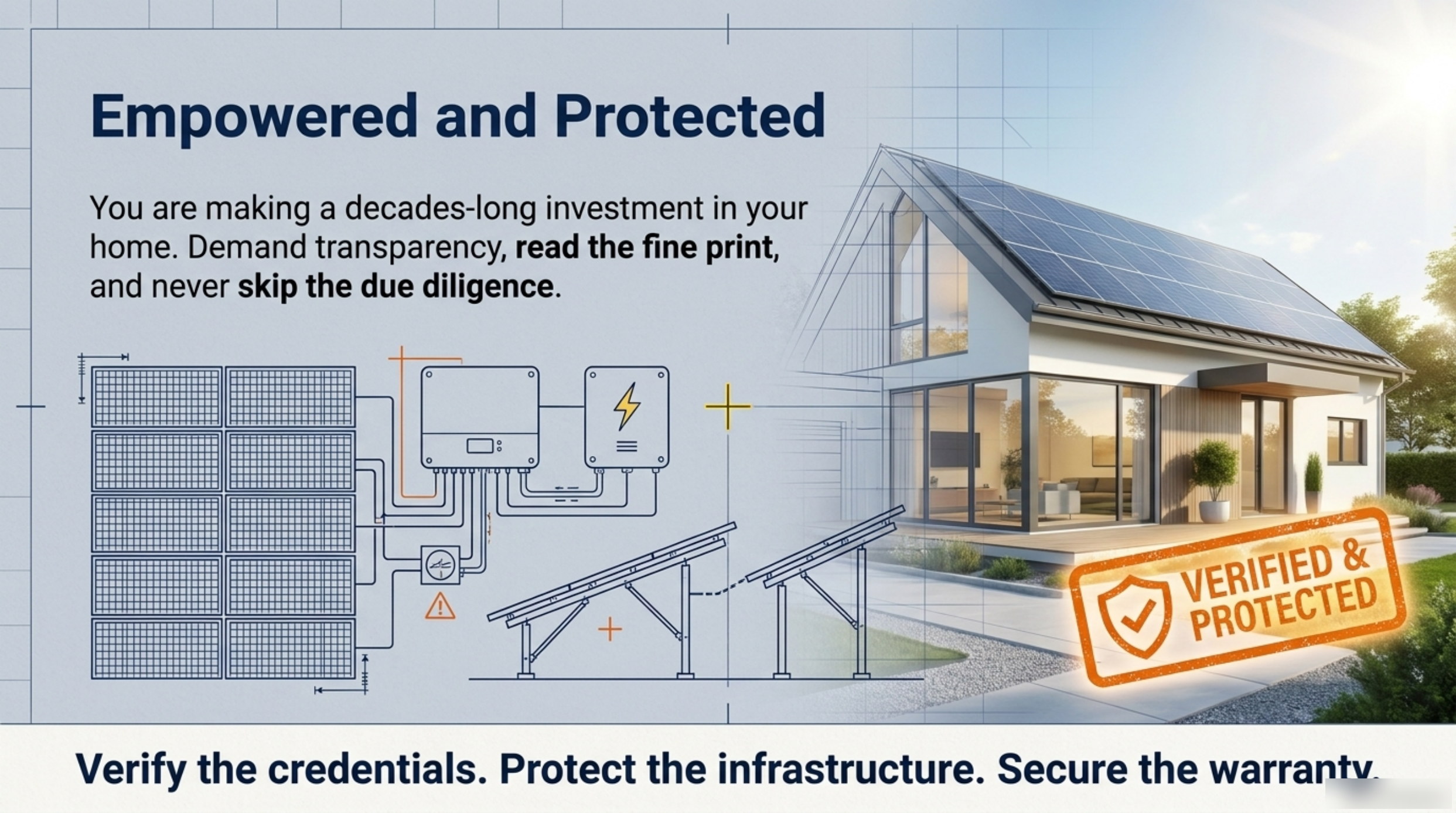
The last slide of the deck is a closing statement rather than a new argument, and it makes the scale of the decision explicit: "You are making a decades-long investment in your home. Demand transparency, read the fine print, and never skip the due diligence." Underneath it sits the deck's badge word — VERIFIED & PROTECTED — and a single line that compresses everything before it into three instructions: Verify the credentials. Protect the infrastructure. Secure the warranty.
That line is a workable checklist, because each of its three parts maps to a specific set of documents and answers you can collect before you sign. This closing article walks through the three, in the order the slide gives them.
The short version
- The slide's closing message: you are making a decades-long investment in your home, so demand transparency, read the fine print, and never skip the due diligence.
- Its summary line is a three-part instruction: verify the credentials, protect the infrastructure, secure the warranty.
- Verify means licensing, insurance and a local track record you can check.
- Protect means the electrical scope, the roof penetrations and the design that were actually surveyed.
- Secure means three warranties, not one, with the terms written into the contract.
Verify the credentials
Verification is the phase that happens before any technical conversation matters, because everything else in the contract is only as good as the firm standing behind it. A warranty term, a binding price and a documented design are all promises made by an organisation, and the first question is whether that organisation is verifiable.
What verification looks like in practice: a licence number you can check rather than a licence claim you take on trust; insurance coverage stated in the contract, which for work of this scale should include general liability cover and workers' compensation; and a record of completed local installations you can actually see rather than a reference list that reads the same on every proposal.
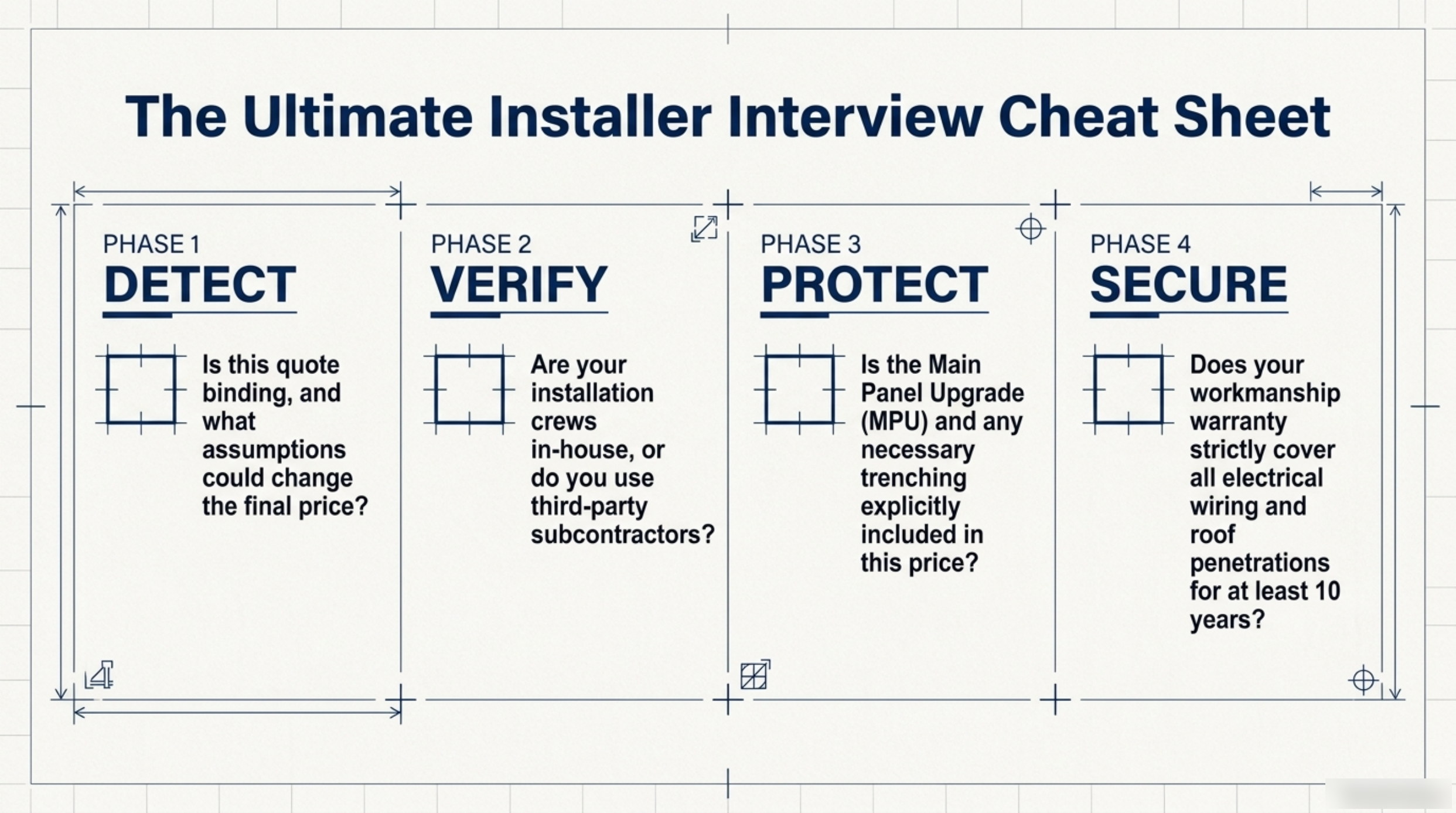
None of that is unusual information to ask for, and the response tells you as much as the documents do. A firm that produces them without friction is a firm that expects to be checked. The interview questions that surface the same facts in a sales meeting are set out in The Ultimate Solar Installer Interview: Four Phases of Questions to Ask.
Protect the infrastructure
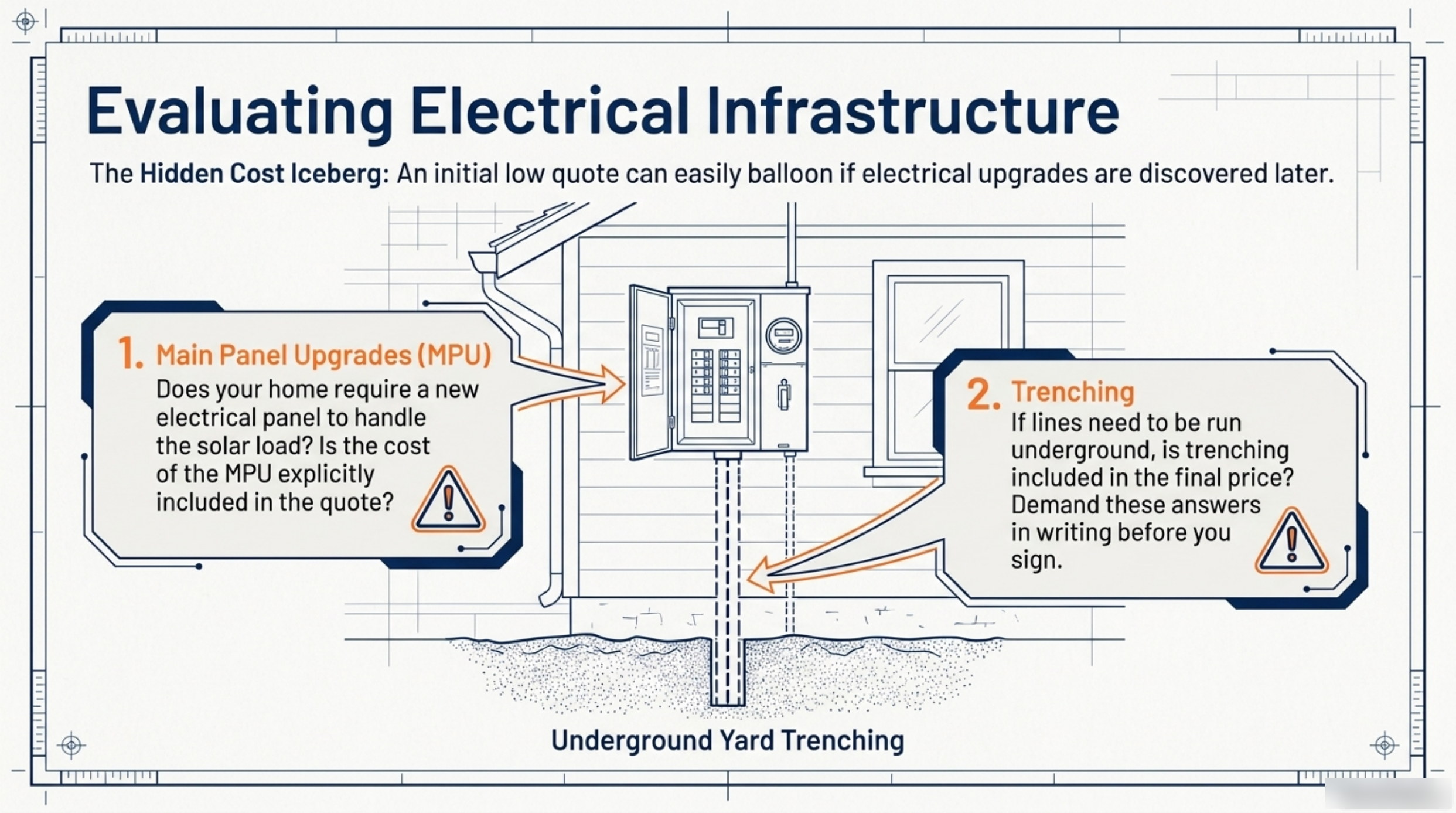
The middle third of the slide's instruction is about everything that is not the array: the electrical service, the wiring, the conduit runs, the roof penetrations and the ground the conductors travel through. It is the part of the project that a low quote leaves out and the part that causes damage when it goes wrong.
Protecting the infrastructure means three things are settled in writing. First, the electrical scope: whether your home requires a new main panel to carry the solar load, whether that upgrade is explicitly inside the quoted price, and whether any required trenching is inside it too. The mechanics of how those two items inflate a quote that did not account for them are set out in The Hidden Cost Iceberg: Main Panel Upgrades and Yard Trenching in a Solar Quote. Second, the design: exact panel layout, the shading assumptions and calculations behind it, the complete electrical scope and the final price with permit inclusions all present before signature. Third, the envelope: the wiring and the critical roof penetrations named as covered items rather than left to interpretation.
The common thread in all three is specificity. Infrastructure is protected by written scope, not by confidence.
Secure the warranty
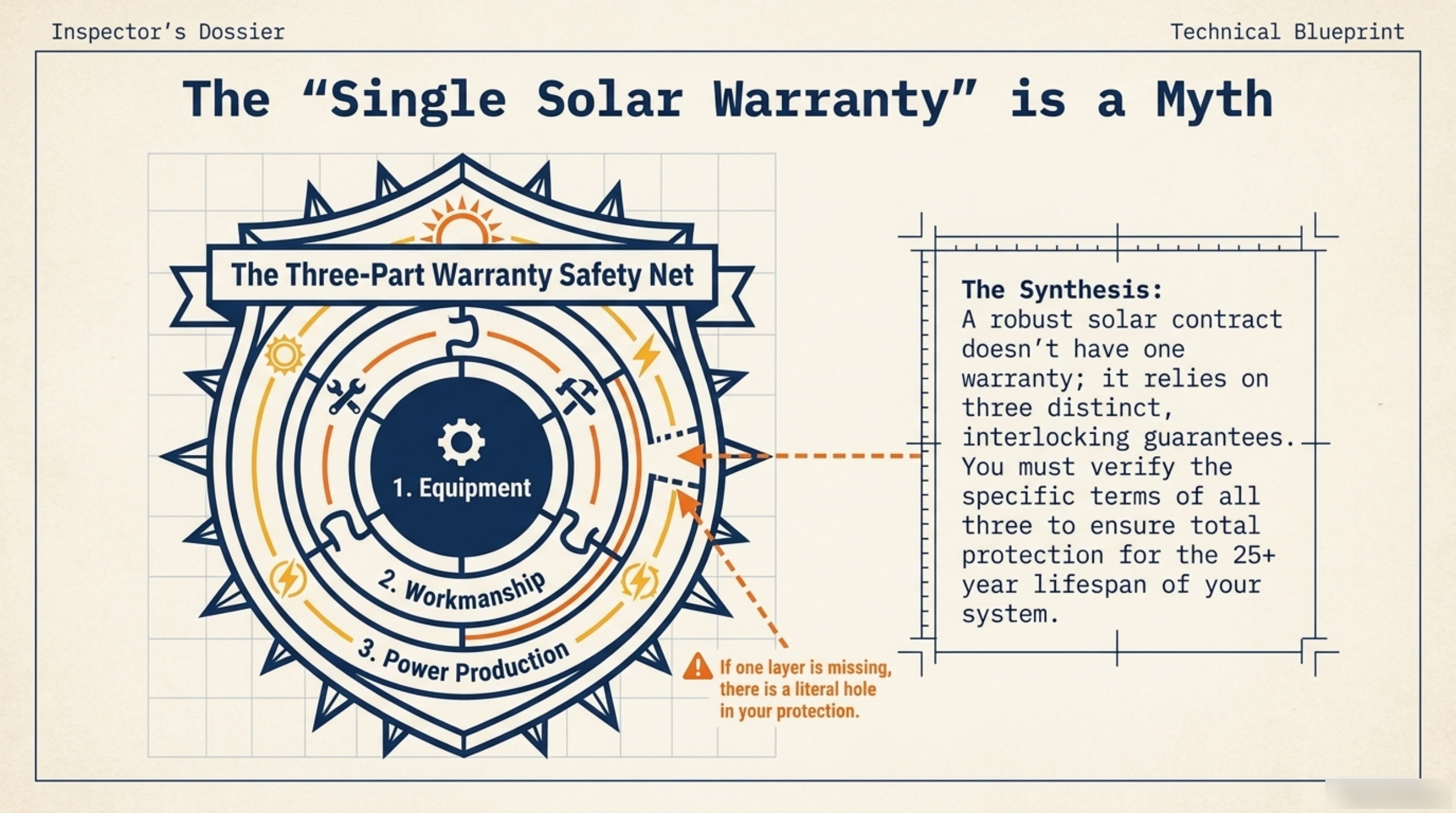
The final third is the one most often resolved with a single number in a sales conversation, and the one worth slowing down for. There is no single solar warranty. Coverage comes in three layers that answer three different questions: equipment, workmanship and power production. Each is generally backed by a different party, and each can be lost independently of the others.
Securing them means holding three terms rather than one. Equipment coverage runs long and covers the hardware. Workmanship coverage covers the labour, the wiring and the roof penetrations, and its term can range widely between installers. Production coverage deals in output over time, expressed as a degradation cap rather than a period of years. The middle layer is the one to interrogate hardest, because it is the layer that protects the building, and its duration is the number that varies most.
The checklist
Read as a single list, the slide's three instructions produce something you can carry into every meeting.
| Verify | Protect | Secure |
|---|---|---|
| Licence number you can check independently | Main panel upgrade requirement and cost stated explicitly in the quote | Equipment warranty: term and covered hardware items |
| General liability and workers' compensation cover stated in the contract | Trenching included or excluded with a price attached | Workmanship warranty: wiring and roof penetrations named, term in years |
| Local completed installations you can inspect | Site-specific design with panel layout and shading calculations | Production warranty: maximum annual degradation rate stated |
| Written answers to the four interview phases | Permit and inspection inclusions named in the price | Claim process, counterparty and labour terms for each layer |
If you work through that list with more than one installer, the comparison is straightforward, because each row is a fact rather than an impression. That is the practical meaning of the deck's closing word, empowered: not enthusiasm for solar, but a set of answers you already hold before the pressure of a decision arrives.
A decades-long investment deserves a slow week
The slide frames the decision as long-term, and the framing is worth taking literally. A solar system is expected to serve the house for decades, which means the questions that matter are not only about this year's kilowatt-hours but about who will still be available if something fails in year twelve.
There is a policy layer to that too. Under net billing in Arizona, exported energy is credited at a lower rate than the retail price you pay for power you import, which shifts the value of a system toward the energy your home uses on site rather than the energy it exports. That does not change the case for solar; it changes the shape of the return, and it makes the accuracy of the design — the panel layout, the shading calculation, the size of the array — more consequential than a rough estimate can carry. A design built from a satellite image cannot price that reality. A design built from a site visit can.
The line that closes the slide is also the right note to close on: demand transparency, read the fine print, and never skip the due diligence. If you want to check any of it against cost assumptions, Where Does Your Money Go? Itemizing Turnkey Solar Installation Costs breaks down where the money goes, and the calculators at /tools/ are a useful starting point for sizing and savings questions.
Frequently Asked Questions About Protecting a Solar Purchase
What is the single most common mistake in buying solar?
Signing something binding before the project has been designed for the actual property. Everything else — the price, the electrical scope, the warranty gaps — follows from that one decision.
Do I need all three warranties in writing before I sign?
You need to know all three exist and what each covers before you sign. Requiring the terms and covered items in the contract is the way to make sure the layers are real rather than implied.
How long should the whole process take?
Long enough for a site-specific design to be surveyed, priced and reviewed. A purchase decision that carries a decades-long horizon is not improved by being made in a single evening.