Decoding the Three Warranties: 25+ Years, 10-30 Years and the 0.5% Degradation Cap
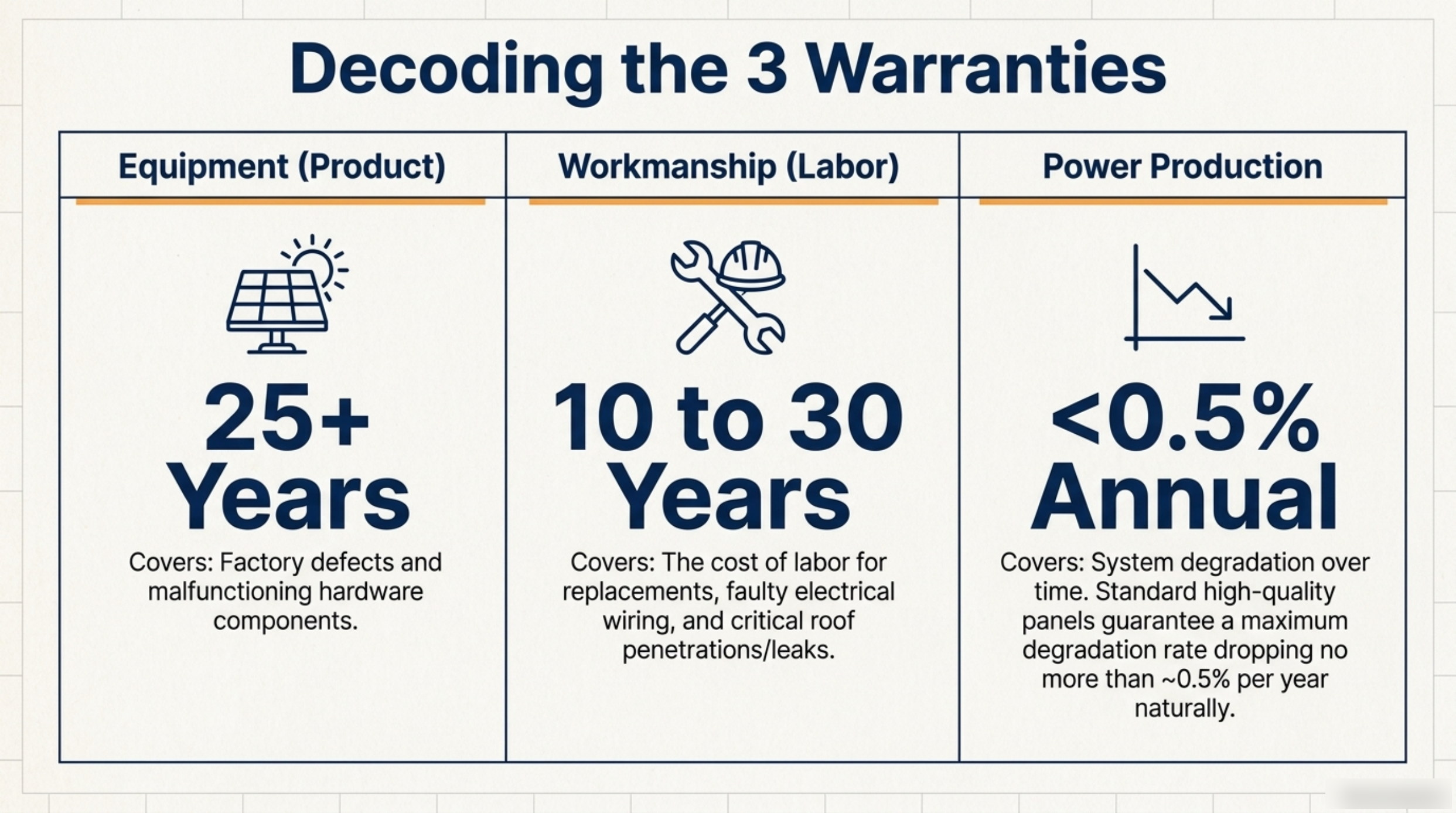
Once you accept that a solar contract carries three separate guarantees rather than one, the next question is the practical one: how long does each last, and what exactly does each one cover? The slide this article is built on answers that in three columns, and the columns are worth reading as three different kinds of promise rather than three versions of the same one.
The numbers are these. Equipment, also called product, runs 25+ years. Workmanship, also called labour, runs 10 to 30 years. Power production is expressed not as a term in years but as a cap: no more than roughly 0.5% degradation per year. Three formats, three different logics.
| Layer | Term | What it covers |
|---|---|---|
| Equipment (product) | 25+ years | Factory defects and malfunctioning hardware components. |
| Workmanship (labour) | 10 to 30 years | The cost of labour for replacements, faulty electrical wiring, and critical roof penetrations or leaks. |
| Power production | No more than ~0.5% degradation per year | System degradation over time: high-quality panels are guaranteed to lose no more than roughly 0.5% per year naturally. |
The short version
- Equipment (product) coverage runs 25+ years and covers factory defects and malfunctioning hardware components.
- Workmanship (labour) coverage runs 10 to 30 years and covers the cost of labour for replacements, faulty electrical wiring and critical roof penetrations or leaks.
- Power production coverage states a maximum degradation rate of no more than about 0.5% per year naturally.
- The three terms are different lengths for good reasons: hardware outlives hands, and output is measured rather than inspected.
- The workmanship range is the number to interrogate hardest — 10 years and 30 years are very different promises.
That range is the single most useful thing to take from the table. One installer's workmanship warranty can expire before a decade has passed while another's runs to thirty years, and both can describe themselves as fully warrantied. The term is not a detail to be discovered later; it is a specification to be compared.
25+ years: what the equipment layer actually promises
The equipment layer is the manufacturer's undertaking that the hardware will not fail through factory defect and that malfunctioning components will be covered. It is the longest of the three terms because modules are built to run for decades, and its length is why it dominates every sales conversation — a 25-year headline is easy to remember.
Read the scope as carefully as the term. The slide's description of this layer is about the hardware itself: factory defects and malfunctioning hardware components. What that phrasing does not include is the work around the hardware — getting to the failed part, removing it, and installing the replacement. A 25-year equipment warranty on a module mounted on a roof you cannot reach without scaffolding is a real benefit, but it is not the whole cost of a failure.
10 to 30 years: the workmanship layer and why the spread matters
Workmanship coverage is the installer's own guarantee of their labour, and the slide describes its scope in three parts: the cost of labour for replacements, faulty electrical wiring, and critical roof penetrations and leaks. Every one of those three sits outside the manufacturer's document. The manufacturer warrants the module; the installer warrants the work that put it there.
The term is where the spread lives. Ten years covers the period when installation faults are most likely to surface. Thirty years covers the working life of the system. If a roof leak appears in year twelve at a mounting point, an installer holding a ten-year workmanship guarantee owes you nothing on paper, while one holding a thirty-year guarantee owes you a repair. Nothing about the installation changed — only the promise attached to it.
This is also the layer most exposed to the installer's own survival. A warranty is only as good as the firm standing behind it, which is why the term should be read alongside what happens to coverage if the original installer is no longer operating.
Under 0.5% per year: the production layer
The production layer is formatted differently from the other two because output is a measurement, not an event. The slide states that high-quality panels guarantee a maximum degradation rate dropping no more than approximately 0.5% per year naturally. In other words, the guarantee is not that nothing ever fails, but that the system's decline is bounded.
The word naturally is doing careful work in that sentence. It distinguishes the ordinary, expected decline of a working module from a fault. A system whose output sits within the stated curve is behaving as promised even though its production is lower this year than last. A system whose output falls outside the curve has a claim attached to it.
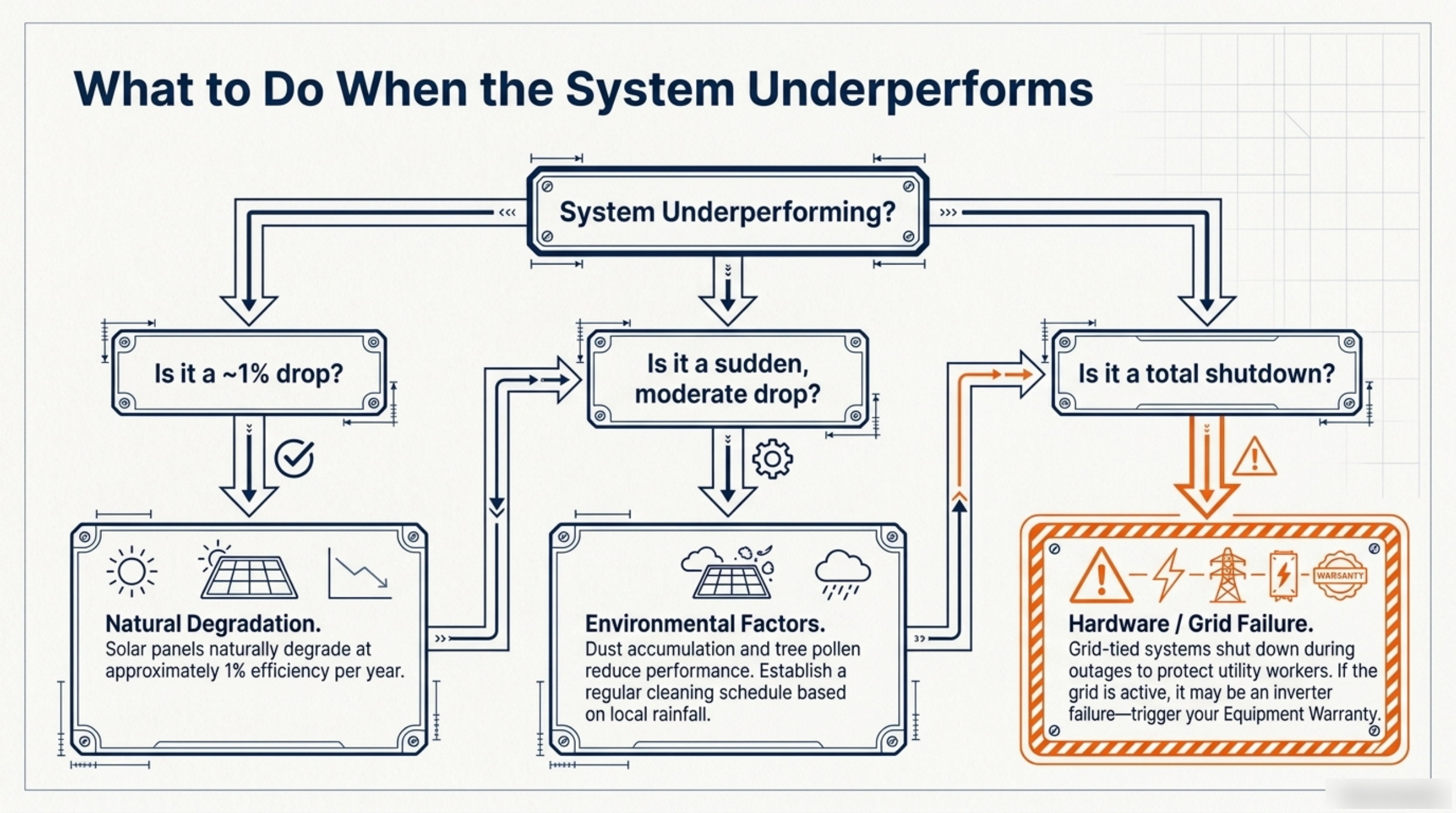
That distinction is what makes the production layer operationally useful. It converts a vague feeling that the array is not doing as well as it used to into a comparison against a stated line, and the triage steps for deciding whether a drop is ordinary or not are set out in System Underperforming? A Three-Step Triage From Natural Degradation to Inverter Failure.
Reading the three numbers together
Laid side by side, the three columns describe a system whose coverage changes character as it ages. In the early years, workmanship is the active layer: installation faults surface, and the installer's promise is what answers them. In the middle years, equipment and workmanship overlap, and both are available. In the later years, equipment and production remain while workmanship may already have expired — which is exactly when a roof penetration problem is most expensive to fix.
That progression is the argument for reading the workmanship term as a design decision rather than fine print. A quote with a stronger workmanship term may cost more, and it is not the same product as a quote with a weaker one. Comparing two proposals means comparing these three columns, not just the third-party headline.
What to put in writing
Ask for all three terms in the contract itself, in years, with the covered items named. Confirm what is excluded from each layer. Confirm who pays labour, and at what rate, when a claim is approved. Confirm how a claim is started and who the counterparty is. And confirm what happens to each layer if the installer stops trading before the term expires.
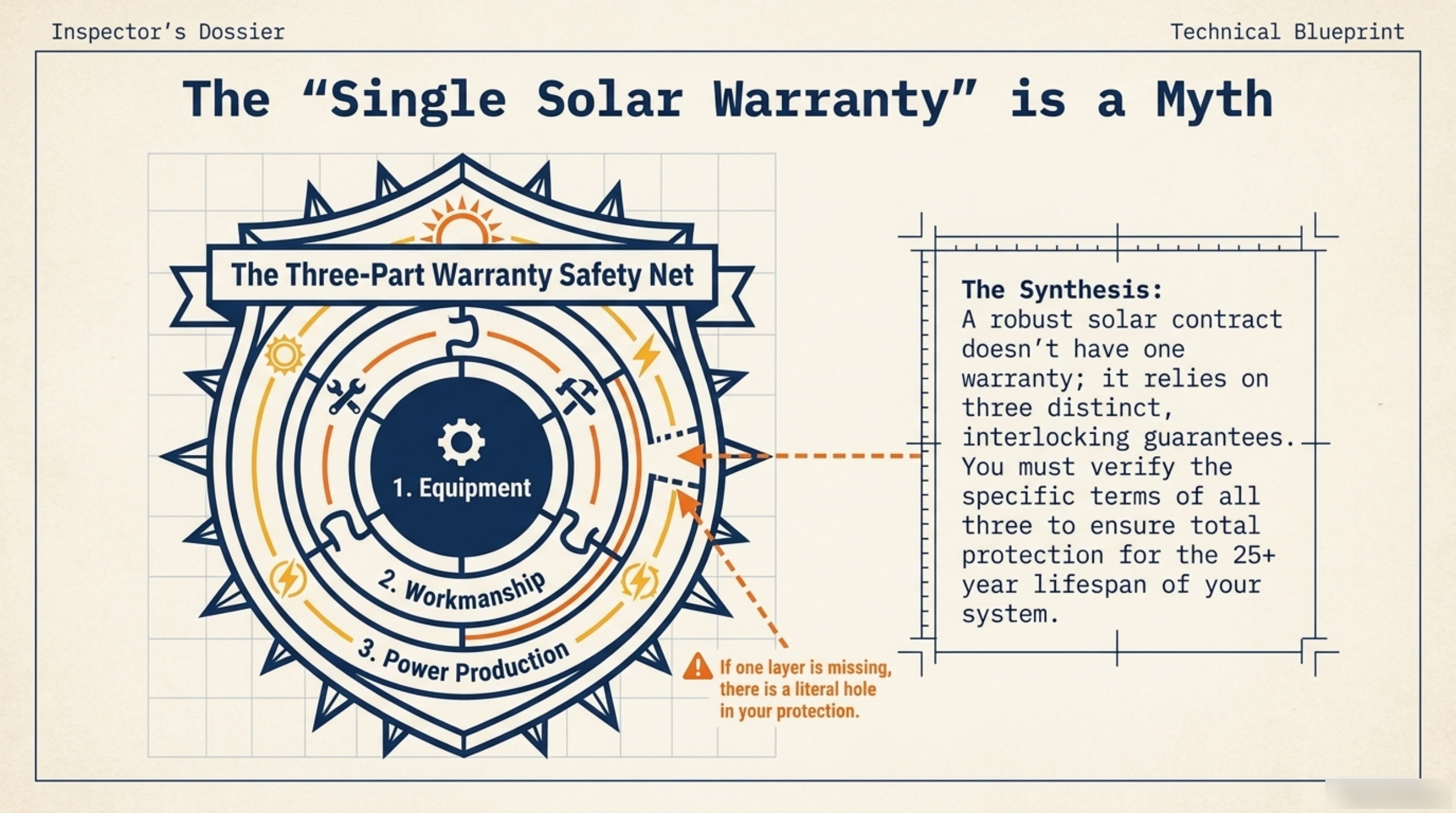
Three numbers written into a contract can be compared against another installer's three numbers. A verbal assurance of "a full warranty" cannot be compared against anything, which is the practical reason the myth described in The ‘Single Solar Warranty’ Is a Myth: The Three-Part Safety Net survives as long as it does.
Frequently Asked Questions About Solar Warranty Terms
Why is the workmanship term so much shorter than the equipment term?
Because they cover different things. Equipment coverage is a manufacturer's statement about hardware built to run for decades. Workmanship coverage is a firm's statement about its own labour and the building envelope, and firms price that risk over a shorter horizon. The gap is normal; the size of the gap is negotiable.
What does a 0.5% annual degradation cap mean in practice?
It bounds the expected yearly decline in output. A system performing inside that curve is behaving as promised. A system falling materially outside it has a claim attached to the production layer, and the first step is establishing whether the cause is natural decline, contamination, or a failed component.
Does a longer warranty always mean a better installer?
No. A term is only as valuable as the party behind it and the exclusions attached to it. Compare the covered items, the labour terms and the claim process alongside the duration.