System Underperforming? A Three-Step Triage From Natural Degradation to Inverter Failure
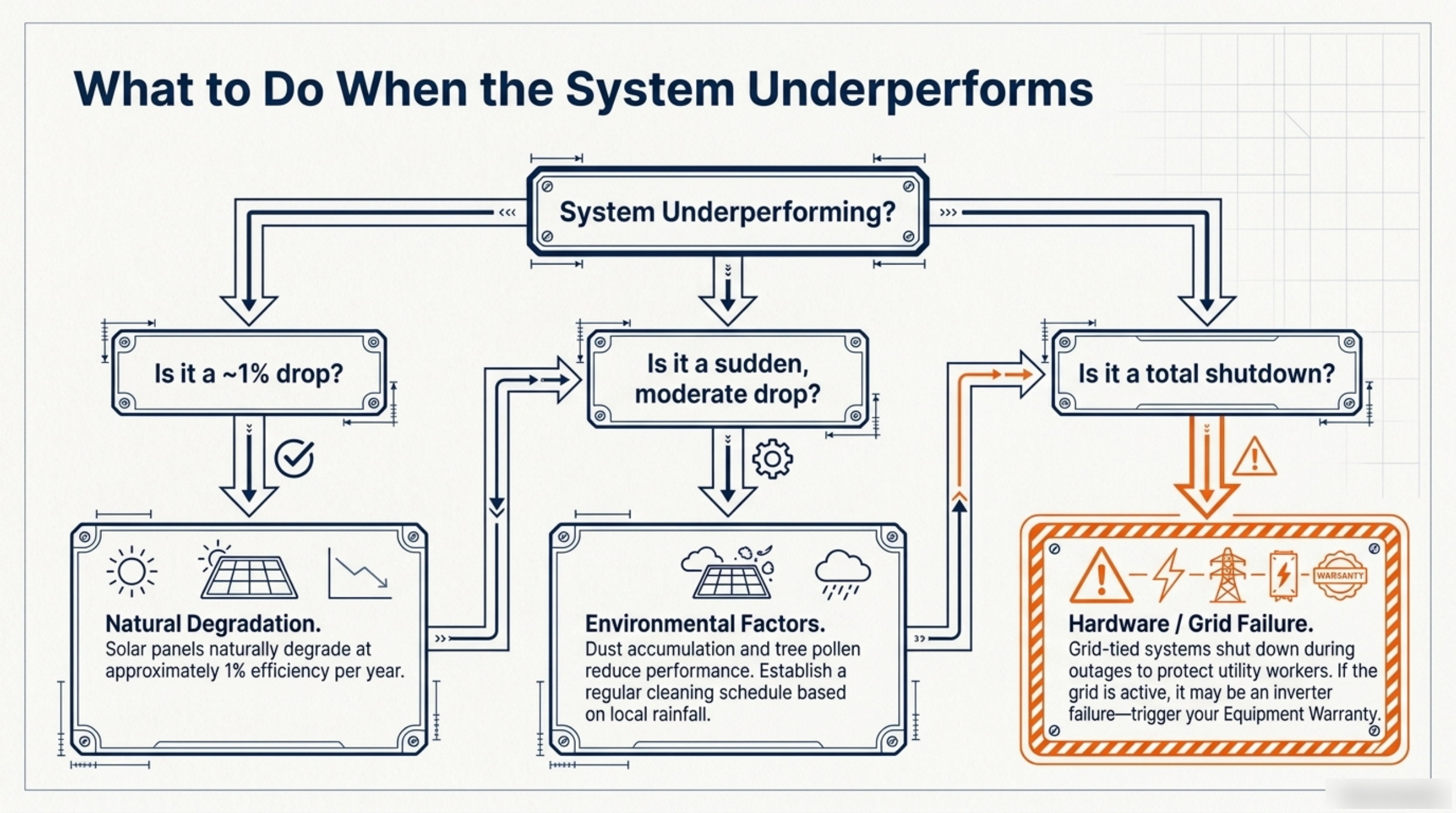
The slide begins with a question instead of an answer: System Underperforming? From there it branches three ways, and the branches are the point. A drop in output is not one condition with one cause. It is one symptom with three quite different explanations, and only one of them is a fault.
Getting the order right matters, because the wrong response is expensive in one direction and slow in the other. Treating ordinary decline as a failure means paying for a service call to be told the system is fine. Treating a fault as ordinary decline means leaving a claim unused until the evidence has aged. The triage below is the slide's own, in the order it presents it.
The short version
- The slide asks one question — is the system underperforming? — and splits the answer three ways.
- Is it a ~1% drop? That is natural degradation: panels lose roughly 1% efficiency per year.
- Is it a sudden, moderate drop? That points to environmental factors such as dust accumulation and tree pollen.
- Is it a total shutdown? Grid-tied systems shut down during outages to protect utility workers; if the grid is active, suspect the inverter.
- An inverter failure is the trigger for your equipment warranty, not a repair you arrange alone.
Question one: is it a ~1% drop?
If the shortfall is small, gradual and roughly in line with the system's age, the slide's answer is the calm one: Natural Degradation. Solar panels naturally degrade at approximately 1% efficiency per year. That is a property of the material, not a defect, and it is the reason a production guarantee carves out ordinary decline rather than promising that output never falls.
The useful thing about knowing this number is that it gives you a yardstick. A system four years old producing a few percent below its first-year figures is behaving as designed. A system two years old producing ten percent below is not, and the triage should move to the next branch rather than staying on this one.
Question two: is it a sudden, moderate drop?
The second branch is the most common real-world cause and the cheapest to fix. The slide labels it Environmental Factors: dust accumulation and tree pollen reduce performance. Neither is a malfunction. Both degrade output in a way that looks like a fault if you are only reading the numbers.
The slide's instruction here is specific: establish a regular cleaning schedule based on local rainfall. The logic is that rainfall does part of the cleaning work for free, so the schedule should be built around when rain actually arrives rather than around a fixed calendar interval. In a place with a pronounced wet season and a long dry stretch, that produces two different regimes: long dry periods where grime and pollen simply accumulate, and wet periods where the array largely rinses itself.
A moderate drop that arrives after a long dry spell, a pollen flush, or a dusty wind event belongs on this branch. Clean the array and compare again before assuming anything has broken. Where snow is part of the local picture, the response to a winter drop is a different question again, covered in Solar Panels and Snow — Flagstaff Guide.
Question three: is it a total shutdown?
The third branch is the one that looks alarming and is often not a fault at all. The slide's answer: Hardware or Grid Failure. Grid-tied systems shut down during outages to protect utility workers. That behaviour is deliberate and mandatory. Anyone working on the lines during an outage has to be able to assume the wires are dead, which means your inverter must stop exporting the moment the grid goes away. A dark array during a blackout is the system working correctly.
The slide then adds the distinguishing detail: if the grid is active, it may be an inverter failure — trigger your Equipment Warranty. That is the whole triage in one sentence. Both causes produce the same symptom — no production at all — and the difference is whether the grid is up. If it is up and the array is silent, the inverter is the prime suspect, and the correct action is a warranty claim rather than a self-funded repair.
How to tell which branch you are in
The three branches separate cleanly once you know what to look at. The slide's structure reduces to three observations: how big is the change, how fast did it appear, and is the grid up.
| Observation | Branch | Cause | Response |
|---|---|---|---|
| Roughly 1% lower, arriving gradually with age | Natural degradation | Solar panels naturally degrade at approximately 1% efficiency per year | Record it and keep monitoring; this is expected behaviour. |
| Sudden, moderate drop | Environmental factors | Dust accumulation and tree pollen reduce performance | Establish a regular cleaning schedule based on local rainfall, then re-measure. |
| Total shutdown | Hardware or grid failure | Grid-tied systems shut down during outages to protect utility workers; if the grid is active, it may be an inverter failure | Confirm the grid is live, then trigger your equipment warranty. |
Two practical notes make this easier to run. First, the change has to be measured against the right baseline — not last month, but the same month in a previous year, because output swings seasonally for reasons that have nothing to do with the equipment. Second, the duration matters as much as the size. A one-day dip that recovers is not the same event as a three-week plateau.
What to do in each case
On the first branch, do nothing dramatic. Record the figures, note the date, and keep monitoring. On the second branch, clean the array and re-measure. On the third branch, check the grid first — if your neighbours are also dark, the system is behaving properly and there is nothing to claim. If the grid is live and the array is still flat, contact your installer and start the equipment warranty process rather than booking a general repair.
There is a financial layer to this too. Under net billing in Arizona, exported energy is credited below the retail rate you pay for energy you import, so the value of what your array produces is not simply its kilowatt-hours — it depends on when the production happens and how much of it you use on site. A production dip that lands in the middle of a high-value period costs more than the same dip in a low-value one. That is one more reason to catch a moderate drop early rather than waiting for the annual total to confirm it.
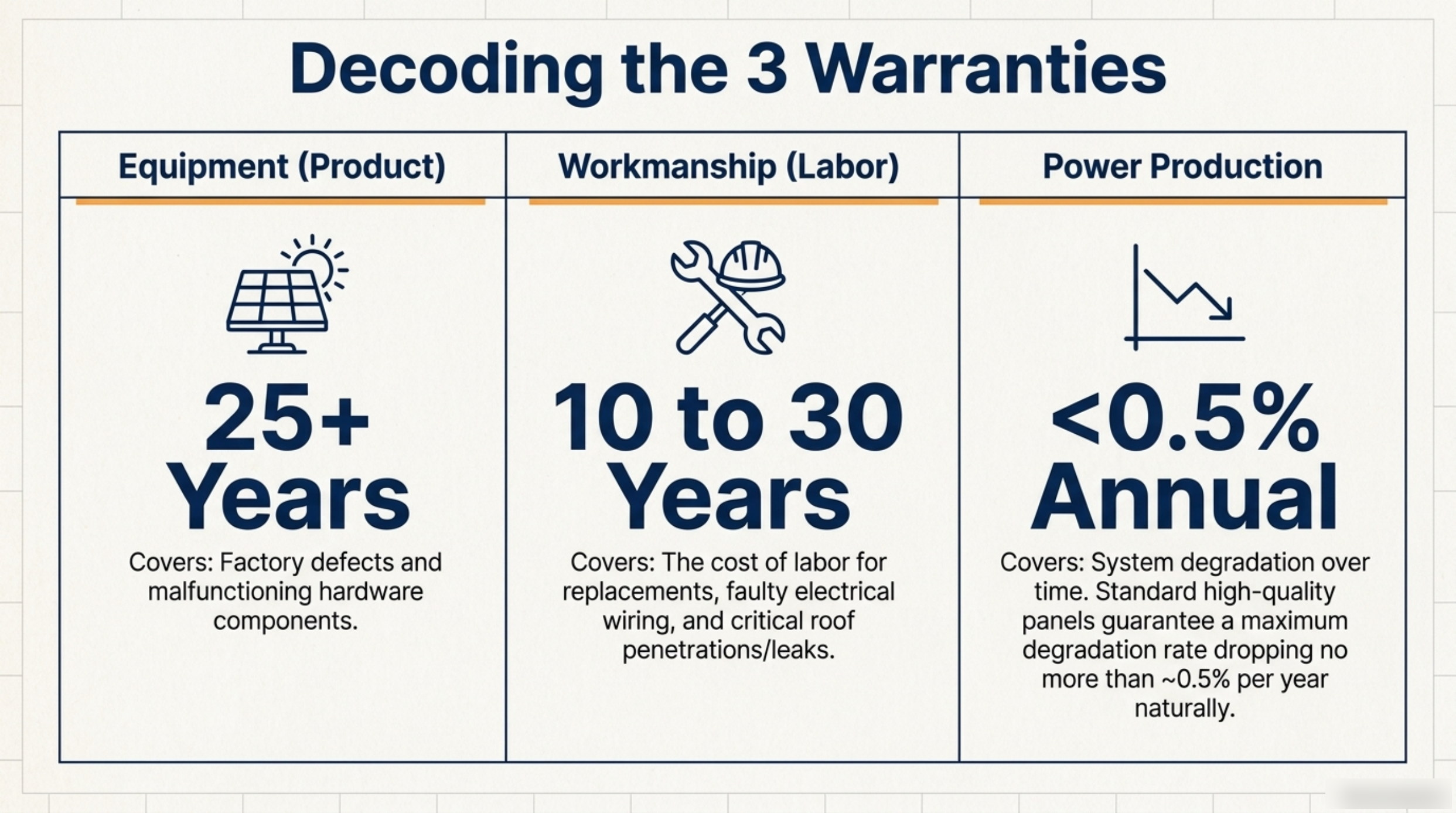
A system under warranty has a documented route for a genuine fault, and that route exists only if the three layers of coverage are actually in place. The layers and their durations are set out in Decoding the Three Warranties: 25+ Years, 10-30 Years and the 0.5% Degradation Cap. The point of triage is to make sure you use that route for a fault, and do not use it for weather.
Frequently Asked Questions About Underperforming Solar Systems
Does a solar array shut down every time the power goes out?
A grid-tied system does. The shutdown is a safety function that protects utility workers during an outage. If you want production to continue while the grid is down, that requires battery storage and the appropriate equipment, not a change to the inverter's behaviour.
Is roughly 1% annual degradation something to worry about?
No. It is the expected behaviour of solar modules and is exactly why production guarantees are written with a degradation cap rather than a promise of constant output.
How do I know whether a drop is dirt or damage?
Clean the array and compare the same period before and after. Contamination resolves. A fault does not, which is also the point at which a warranty claim becomes the right next step.