Investment Economics: A 5 kW Solar Array Plus Battery, Priced Out
Solar quotes tend to arrive as one number, which makes them easy to compare and hard to understand. The slide this article is built on does the opposite: it splits a solar-plus-storage contract into its two economic halves and prices them separately, then applies the same federal credit to both. The result is a much clearer picture of where the money goes and why a storage decision changes the size of the contract so sharply.
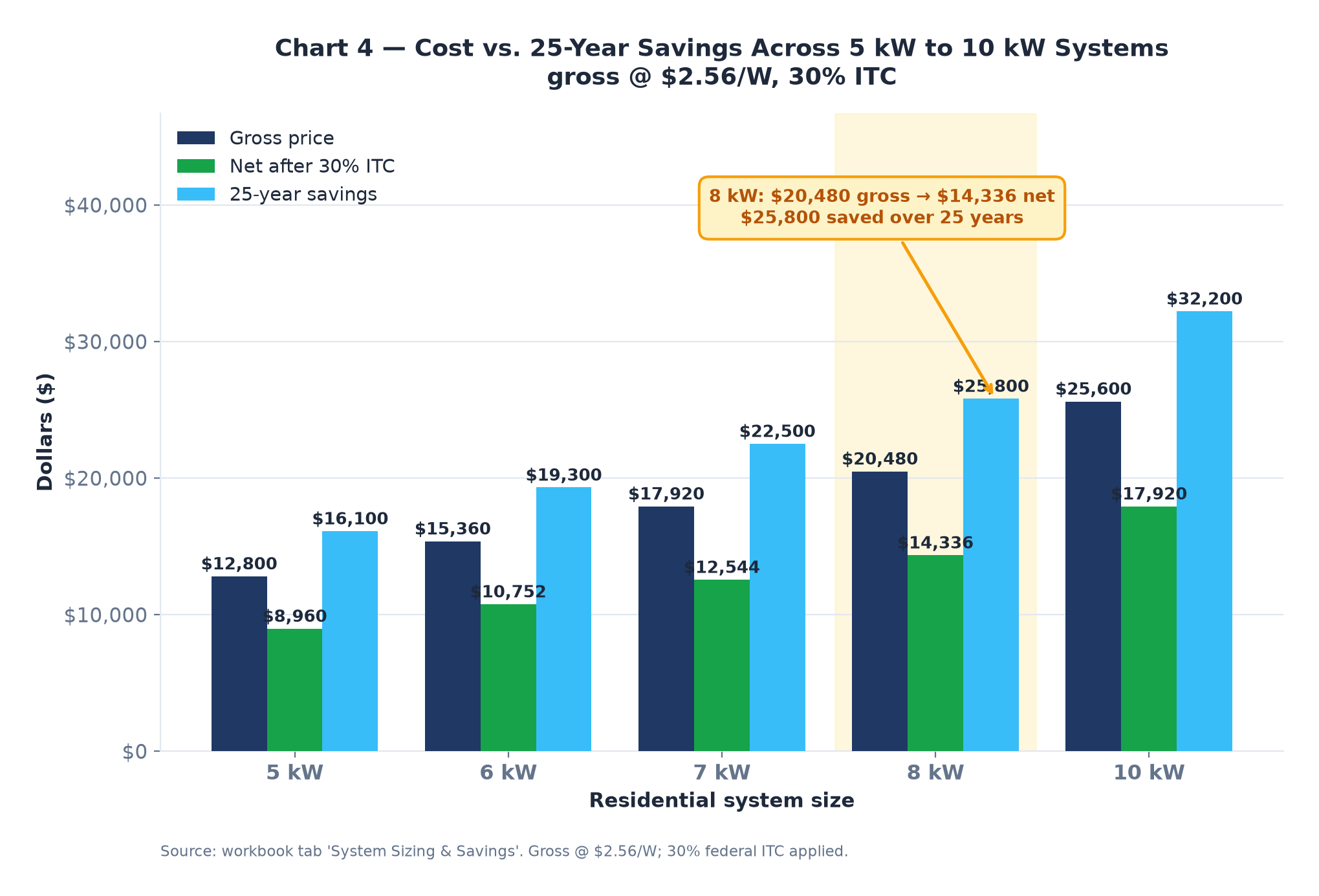
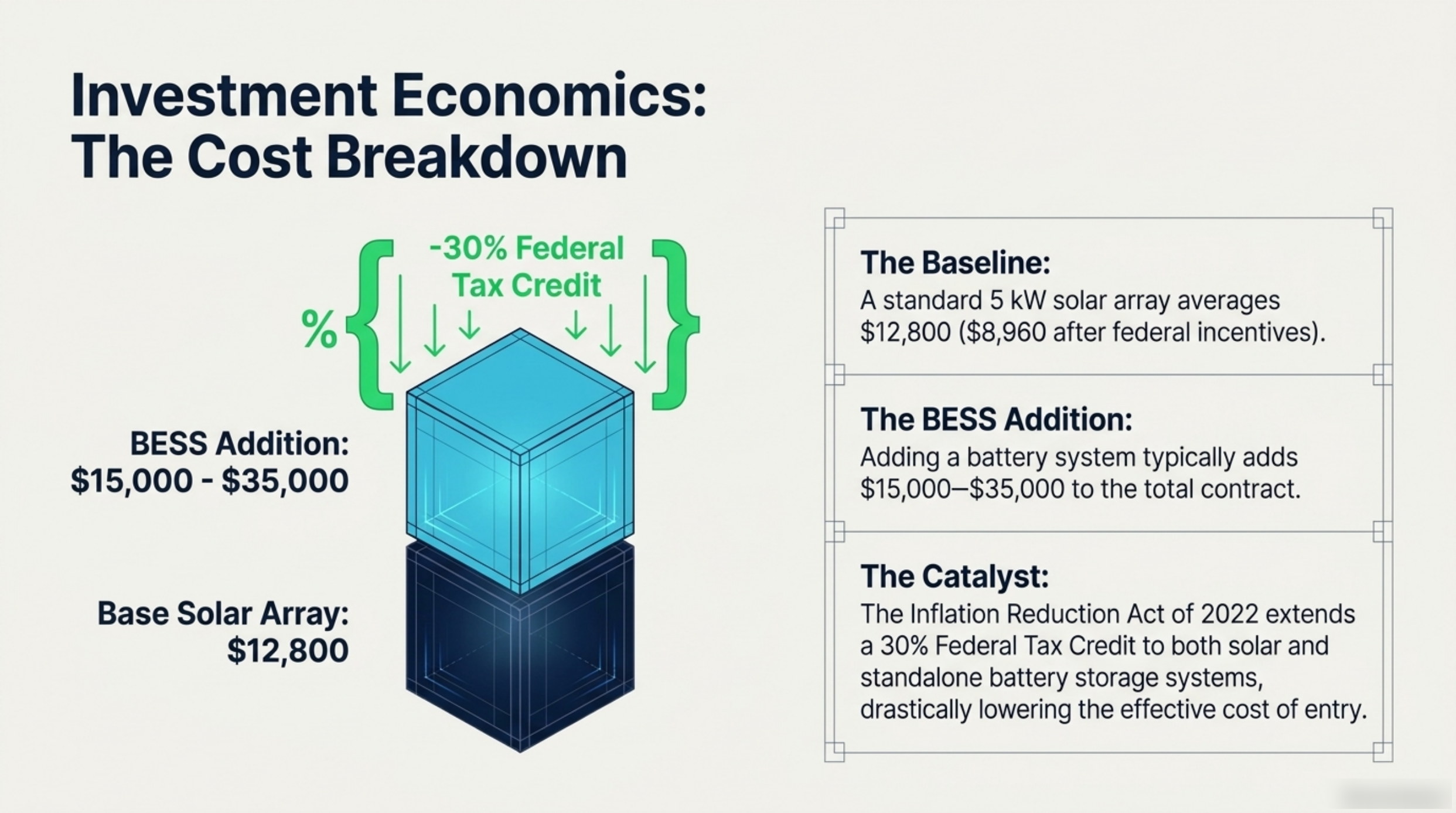
The baseline is a standard 5 kW solar array, which the deck puts at an average of $12,800, or $8,960 after federal incentives. Storage sits on top of that as a distinct line item, adding $15,000 to $35,000. Those two figures are the frame for everything else: one is the cost of generating your own electricity, and the other is the cost of being able to use it after dark.
The short version
- A standard 5 kW solar array averages $12,800, or $8,960 after federal incentives.
- Adding a battery system typically adds $15,000 to $35,000 to the total contract.
- The Inflation Reduction Act of 2022 extends a 30% federal tax credit to both solar and standalone battery storage systems.
- The credit applies to the storage side as well as the generation side, which is what lowers the effective cost of entry to a full system.
The baseline: a 5 kW array priced out
A 5 kW array is a modest system by national standards and a sensible one for many Flagstaff homes, because it is sized around a realistic share of household consumption rather than around the largest roof that will fit. At an average of $12,800 gross, the array is the cheaper half of the project by a wide margin, and after the 30% federal credit it comes in at $8,960.
That arithmetic is worth stating plainly because it is the reference point against which storage gets judged. A homeowner comparing a solar-only quote with a solar-plus-storage quote is comparing $8,960 against $8,960 plus the net cost of storage — and the second number is a different order of magnitude.
The addition: what storage does to the contract
Adding a battery system typically adds $15,000 to $35,000 to the total contract, and the width of that band is the honest part of the figure. Storage capacity, the inverter required to manage it, and the electrical work at the main panel all scale with how much of the home the battery is expected to carry. A single unit backing up essential circuits sits near the bottom of the range. A larger installation expected to carry the whole house sits at the top of it.
| Line item | Amount | Notes |
|---|---|---|
| Base solar array (5 kW) | $12,800 | Average before incentives |
| Base array after federal credit | $8,960 | 30% federal tax credit applied |
| BESS addition | $15,000 to $35,000 | Typical range added to the total contract |
| Combined contract before credit | $27,800 to $47,800 | Base array plus storage |
| Combined contract after credit | $19,460 to $33,460 | Same 30% credit applied to both parts |
Two things stand out in that table. The first is that storage, not generation, is where the money goes: on the low end of the range the battery more than doubles the contract. The second is that the two halves respond to same credit, which is the subject of the next section.
The catalyst: a 30% federal tax credit on both halves
The deck calls this the catalyst, and it is the reason the storage line item is more affordable than the raw numbers suggest. The Inflation Reduction Act of 2022 extends a 30% federal tax credit to both solar and standalone battery storage systems. Standalone is the operative word. A homeowner does not have to buy a battery as part of a solar project in order to qualify, and a homeowner buying both does not have to untangle which portion of the credit applies to which part of the work.
Applied across the whole contract, that single provision is what turns a five-figure storage addition into a decided question rather than a theoretical one. On the combined ranges above, the credit moves the entry point from $27,800 down to roughly $19,460 at the low end and from $47,800 down to roughly $33,460 at the high end. Those figures are arithmetic on the deck's own numbers rather than quoted pricing, so treat them as a way to think about the shape of the decision rather than as an estimate for a particular home.
Reading those numbers in a real quote
When a quote arrives, the useful exercise is to find the seam. Which line is the array, which line is storage, and which line is the electrical work that only exists because storage is in the project? A quote that presents a single combined total without separating those parts is harder to compare against another bid, and much harder to sanity-check against the deck's ranges.
It is also worth checking what is not in the range. A lower-priced storage line can simply mean a smaller battery, a shorter warranty, or electrical work deferred to a second visit. None of those is automatically wrong — they are different products at different prices, and the only way to compare them is to see them itemised.
Where the two numbers meet
Put the two halves together and the deck's economics become a single question: is the ability to use your own generation after sunset worth roughly double the cost of generating it? For a homeowner whose usage sits in the evening, or who wants power during an outage, the answer is often yes. For one whose load is already concentrated in daylight hours, the same storage costs the same money and earns less. That is a usage question, not a hardware question, which is why the ranges matter more than any single figure.
To sanity-check a quote against your own consumption, the site's calculators hub includes a solar savings calculator.
If you want this sized against your own roof rather than in the abstract, call (928) 698-6192 or request free quotes through the form on this page. Every provider we match is licensed and insured in Arizona, and there is never any obligation to move forward.
Frequently Asked Questions
Does the 30% credit apply if I only buy a battery and no solar?
Yes. The deck's framing is explicit that the credit covers standalone battery storage systems as well as solar, which means the storage decision can be made on its own timetable rather than as a rider on a solar purchase.
Why is the storage range so wide?
Because the range spans genuinely different products. Capacity, the inverter needed to manage it, and the main-panel work all scale with how much of the home the battery has to carry during an outage, so a critical-load installation and a whole-home installation are not variations of the same price.
The site's calculators hub includes an outage-autonomy model you can use to test a circuit list before committing to it.
Is a larger array a substitute for storage?
Not for the evening and not for an outage. More generation produces more electricity while the sun is up, but without storage there is nowhere to hold it, and a grid-tied inverter cannot deliver it at all while the grid is down.