A solar quote is one number built from five. That is the entire argument of this slide, and it is a practical one: a homeowner who cannot decompose a quote cannot audit it. When the deck's baseline 14-panel system is priced at $16,129 gross, the useful question is not whether that total is fair but where it goes.
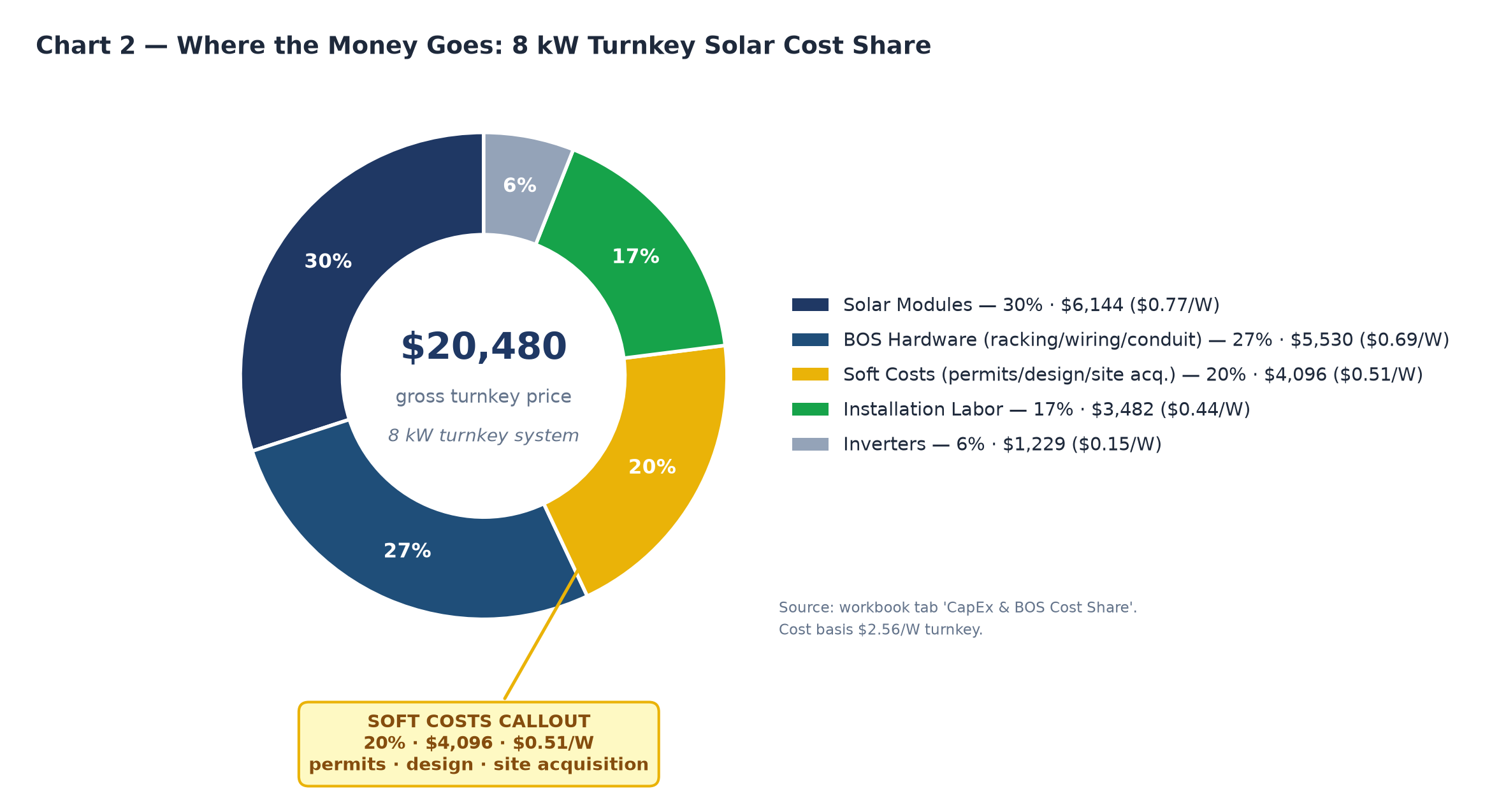
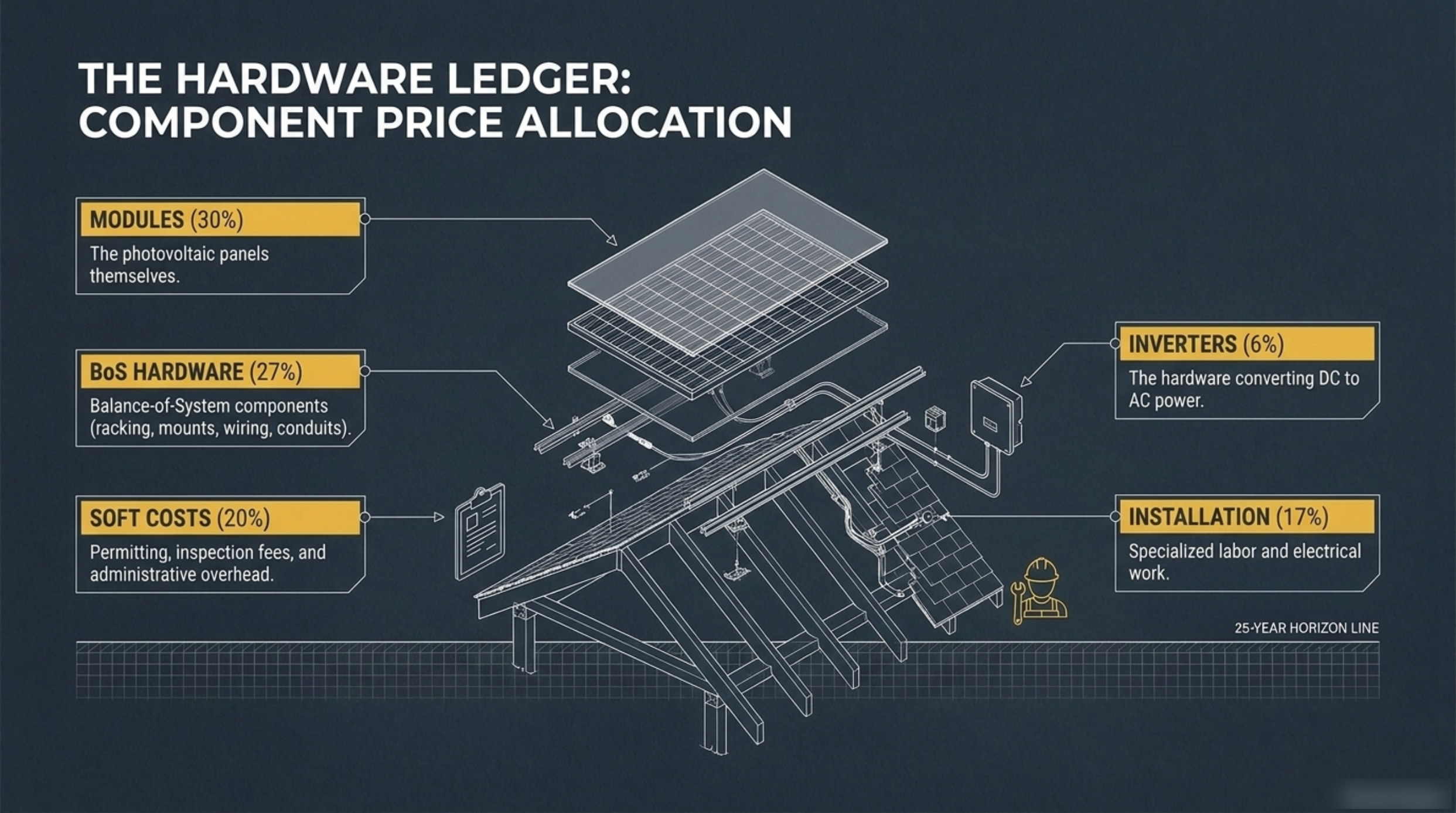
The hardware ledger answers that question with percentages. Modules take 30% of the price. Balance-of-system hardware takes 27%. Soft costs take 20%. Installation takes 17%. Inverters take the remaining 6%. Those five shares add up to the whole invoice — and, once converted to a per-watt basis, they add up to the $2.56 per watt baseline the rest of this series uses.
Five buckets, one checkable total
Applied to the deck's $16,129 baseline, the allocation produces five dollar figures. Modules at 30% is $4,838.70. Balance-of-system hardware at 27% is $4,354.83. Soft costs at 20% is $3,225.80. Installation at 17% is $2,741.93. Inverters at 6% is $967.74. The five sum to $16,129.00.
| Bucket | Share | Cost | Per watt | What it buys |
|---|---|---|---|---|
| Modules | 30% | $4,838.70 | $0.77/W | The photovoltaic panels themselves |
| BOS hardware | 27% | $4,354.83 | $0.69/W | Racking, mounts, wiring and conduits |
| Soft costs | 20% | $3,225.80 | $0.51/W | Permitting, inspection fees and administrative overhead |
| Installation | 17% | $2,741.93 | $0.44/W | Specialised labour and electrical work |
| Inverters | 6% | $967.74 | $0.15/W | The hardware converting DC to AC power |
| Total | 100% | $16,129.00 | $2.56/W | Gross price before the 30% federal credit |
The per-watt sanity check
The per-watt column is the auditing tool. Modules at $0.77 and inverters at $0.15 per watt are commodity lines whose prices are published and move with global supply, so a quote materially above them should carry an explanation. Balance-of-system hardware at $0.69 per watt sits in the middle: rails, flashing and conduit are manufactured goods, but the quantity installed depends entirely on roof geometry and the length of the runs.
Adding the column gives $0.77 + $0.69 + $0.51 + $0.44 + $0.15, which is $2.56 per watt — the baseline rate from slide two, reproduced from the parts. That is the point of the exercise. A quote whose line items do not reproduce its own headline rate has been assembled by hand rather than calculated from a design, and that is a question worth asking before signing anything. The fuller treatment of how those five buckets behave at a larger system size sits in our itemisation of turnkey solar installation costs.
Hardware is 63%, people and paperwork are 37%
Grouping the five buckets differently exposes a second split that is more useful for negotiation. Modules, balance-of-system hardware and inverters together account for 63% of the price — $10,161.27 of the $16,129. Soft costs and installation labour account for the remaining 37%, or $5,967.73.
| Grouping | Buckets | Share | Cost | Per watt |
|---|---|---|---|---|
| Hardware | Modules, BOS, inverters | 63% | $10,161.27 | $1.61/W |
| Labour + soft costs | Installation, soft costs | 37% | $5,967.73 | $0.95/W |
| Total | All five buckets | 100% | $16,129.00 | $2.56/W |
More than a third of a solar bill is not equipment. It is the labour required to put equipment on a Flagstaff roof and the administration required to make the jurisdiction accept it. Hardware prices are set by the market and are broadly the same whoever installs your array. The 37% is the part that varies with how carefully the job is designed and run, and it is the only part worth pressing on.
Soft costs deserve the closest reading
Soft costs cover permitting, inspection fees and administrative overhead — the least standardised line in any solar quote, because there is no market index for paperwork. At $3,225.80 on this baseline, the bucket can be itemised into permit applications, plan review, interconnection paperwork and design work, or it can appear as a single line reading "engineering and permits" with nothing underneath.
Two contractors can quote the same $2.56 per watt and hold very different detail in that bucket. The quote with sub-itemised soft costs is the better quote even when the headline rate matches, because it tells you what the installer has actually accounted for. Cross-checking soft costs against a second bid is the simplest way to find out whether the administration on your project has been priced honestly — and the seasonal maintenance work that keeps the resulting asset on its engineered baseline is covered in our Flagstaff snow guide.
Call (928) 698-6192 for free, no-obligation quotes from pre-vetted Flagstaff solar professionals.
Frequently asked questions
Why do modules only account for 30% of a solar quote?
Because panels are the most commoditised part of the system. Module pricing is published, competitive and global, while racking, wiring, conduit, permitting and labour are all site-specific. On the deck's baseline, the panels are $4,838.70 of a $16,129 gross price; the other 70% is everything required to design, permit and install them.
What counts as a soft cost in a solar installation?
Permitting, inspection fees and administrative overhead. It is the least transparent bucket in the model because none of it is a physical product. At 20% of the baseline price it is $3,225.80, and a quote that does not sub-itemise it is the one to interrogate.
Should I care that inverters are only 6% of the price?
Yes, but for a different reason than cost. Inverters are the smallest hardware bucket at $967.74 on this baseline, yet they are the component most likely to need attention during the 25-year horizon and the one continuous monitoring is designed to watch. A small line item can still be a large long-term risk.