A turnkey solar quote is a single number, and that is precisely the problem. When an 8 kW system in Flagstaff comes in at $20,480, the homeowner sees one line item and has no way to tell whether they are being charged fairly for the panels or overcharged for paperwork. Itemising the quote turns one opaque number into five checkable ones, and it immediately shows where the negotiating room actually lives.
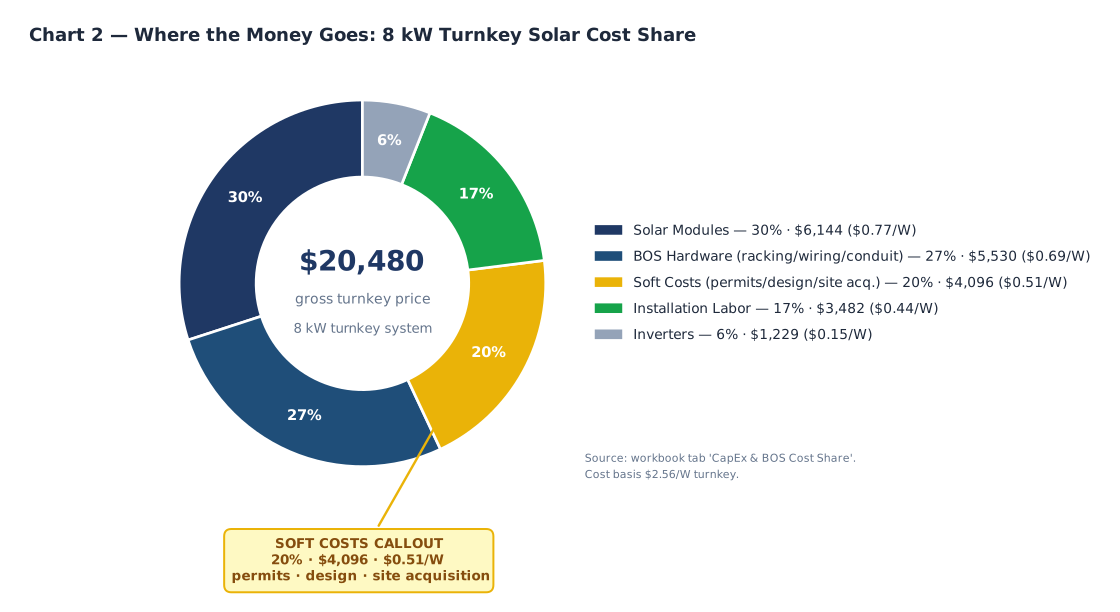
The workbook behind this guide breaks the $20,480 gross price into five cost buckets. Modules take 30%. Balance-of-system hardware — racking, wiring and conduit — takes 27%. Soft costs take 20%. Installation labour takes 17%. Inverters take the remaining 6%. Converted to a per-watt basis, those five buckets add up to $2.56 per watt, and that sum is the number to hold every contractor against.
The five buckets, priced out
Read Table 1 as a checklist. Every legitimate quote should be decomposable into these five lines, and every line can be sanity-checked against the per-watt figures the workbook provides. Modules at $0.77 per watt and inverters at $0.15 per watt are commodity lines: prices for both are published, they move with global supply, and a quote that is materially above them should be explained. Soft costs at $0.51 per watt are the opposite — there is no market index, which is exactly why they deserve the closest reading.
| Cost bucket | Share of price | Cost on 8 kW | Cost per watt | What it buys |
|---|---|---|---|---|
| Solar modules | 30% | $6,144 | $0.77/W | Roughly 20 × 400 W panels at the design wattage the workbook specifies |
| BOS hardware (racking / wiring / conduit) | 27% | $5,530 | $0.69/W | Mounts, rails, flashing, DC and AC conductors, conduit runs |
| Soft costs | 20% | $4,096 | $0.51/W | Permits, system design, site acquisition, interconnection paperwork |
| Installation labour | 17% | $3,482 | $0.44/W | Roof work, electrical work, commissioning |
| Inverters | 6% | $1,229 | $0.15/W | Power conversion and monitoring hardware |
| Total | 100% | $20,481 | $2.56/W | Gross turnkey price before the 30% federal ITC |
Two things fall out of that table immediately. First, the per-watt column sums to $2.56 exactly, which means the quote is internally consistent — if a contractor's line items do not sum to their headline $/W figure, the quote has been assembled rather than calculated. Second, the module line and the federal tax credit are the same number: $6,144 at 30% of $20,480 is exactly what the panels cost. That is not a coincidence of this example so much as an accident of pricing that turns out to be rhetorically perfect. The 30% ITC pays for the modules outright.
Hardware versus everything else
Grouping the five buckets differently exposes a second, more useful split. Modules, BOS hardware and inverters together account for 63% of the price — $12,903 of the $20,480. Soft costs and installation labour account for the other 37%, or $7,578. In other words, more than a third of a turnkey solar bill is not equipment at all. It is the labour and the administration required to put equipment on a Flagstaff roof.
| Grouping | Buckets included | Share | Cost on 8 kW | Per watt |
|---|---|---|---|---|
| Hardware | Modules, BOS, inverters | 63% | $12,903 | $1.61/W |
| Labour + soft costs | Installation labour, soft costs | 37% | $7,578 | $0.95/W |
| Total | All five buckets | 100% | $20,481 | $2.56/W |
That 37% is the part of the bill a homeowner can actually influence. Hardware prices are set by the market, but soft costs vary with how much design work a site needs, how many permit revisions the jurisdiction requires, and how much of the paperwork the installer absorbs. Flagstaff has real advantages here: at 5.2 peak sun hours per day and a design de-rate factor of 82%, a well-laid-out 8 kW array needs fewer panels per kilowatt than a shaded, north-facing or steeply pitched alternative, and fewer panels means less racking, less labour and less conduit.
The soft costs callout in Chart 2 is the one to keep in mind when comparing bids. Two contractors can quote the same $2.56 per watt and have very different soft-cost lines underneath. A quote with $4,096 of permits, design and site acquisition described in detail is a better quote than one where the same bucket is a single line reading "engineering and permits" with no sub-items, even though the headline number is identical.
The national baseline, and the Flagstaff gap
The workbook's baseline cost assumption is $2.85 per watt, with an industry range of $2.50 to $3.20 per watt. Measured against that baseline, the $2.56 per watt turnkey price used throughout this guide sits below the middle of the national band. The gap is $0.29 per watt, which on an 8 kW system is $2,320 of avoided cost — more than half of the net $14,336 price after the tax credit.
| Benchmark | Cost per watt | Cost on 8 kW | Gap vs. this model |
|---|---|---|---|
| Workbook baseline (industry average) | $2.85/W | $22,800 | +$2,320 |
| This model (8 kW turnkey) | $2.56/W | $20,480 | — |
| Industry low end ($2.50/W) | $2.50/W | $20,000 | −$480 |
| Industry high end ($3.20/W) | $3.20/W | $25,600 | +$5,120 |
The spread between the low and high ends of that band is $0.70 per watt, or $5,600 on an 8 kW system — more than the price of the battery the workbook lists at $8,500, and more than the $4,096 soft cost bucket. That is the practical reason to collect multiple quotes: at this system size, the difference between the best and worst fair quote exceeds the cost of most of the individual components.
What the incentives actually subtract
Two incentives apply to the $20,480 gross price. The 30% federal Investment Tax Credit is worth $6,144 and reduces the net out-of-pocket cost to $14,336. The workbook also carries a $500 state or utility cash rebate line. Stacked, those two bring the modelled net cost to roughly $13,836 on an 8 kW array, which is $1.73 per watt — more than a third below the national baseline of $2.85 per watt.
It is worth being precise about what the credit does and does not cover. Because the ITC equals the module line exactly, the effective accounting is clean: the credit buys the panels, and the homeowner's $14,336 buys the $12,903 of remaining hardware plus the $7,578 of labour and soft costs, less the $500 rebate. Seen that way, the "expensive" part of solar is not the technology at all — it is the 37% of the bill that pays people and paperwork to install it.
Call (928) 698-6192 for free, no-obligation quotes from pre-vetted Flagstaff solar professionals.
Frequently asked questions
- What is a fair price per watt for solar in Flagstaff?
- The model in this guide uses $2.56 per watt turnkey for an 8 kW system, against a workbook baseline of $2.85 per watt and an industry range of $2.50 to $3.20 per watt. The full range is worth $5,600 on an 8 kW array, so multiple quotes matter more than any single benchmark.
- Why are soft costs 20% of the price?
- Soft costs cover permits, system design, site acquisition and interconnection — none of which scale with panel count the way hardware does. At $0.51 per watt on an 8 kW system they total $4,096, and they are the least standardised line in any quote.
- Does the 30% tax credit really cover the panels?
- On this model, yes. The credit is $6,144 and the module line is $6,144. That is a coincidence of the 30% rate and a 30% module share, but it makes the arithmetic unusually easy to follow.
- How much of my bill is equipment versus labour?
- Hardware is 63% ($12,903 across modules, BOS hardware and inverters) and labour plus soft costs are 37% ($7,578). Only the second group is meaningfully negotiable.