Panel shopping is usually framed as an efficiency contest, and that framing quietly wastes money. Efficiency tells you how much power a module produces per square metre of roof on day one. The number that decides whether your system is still earning in year 25 is degradation — how much of that output survives two and a half decades of Flagstaff ultraviolet, freeze-thaw cycling and monsoon hail seasons.
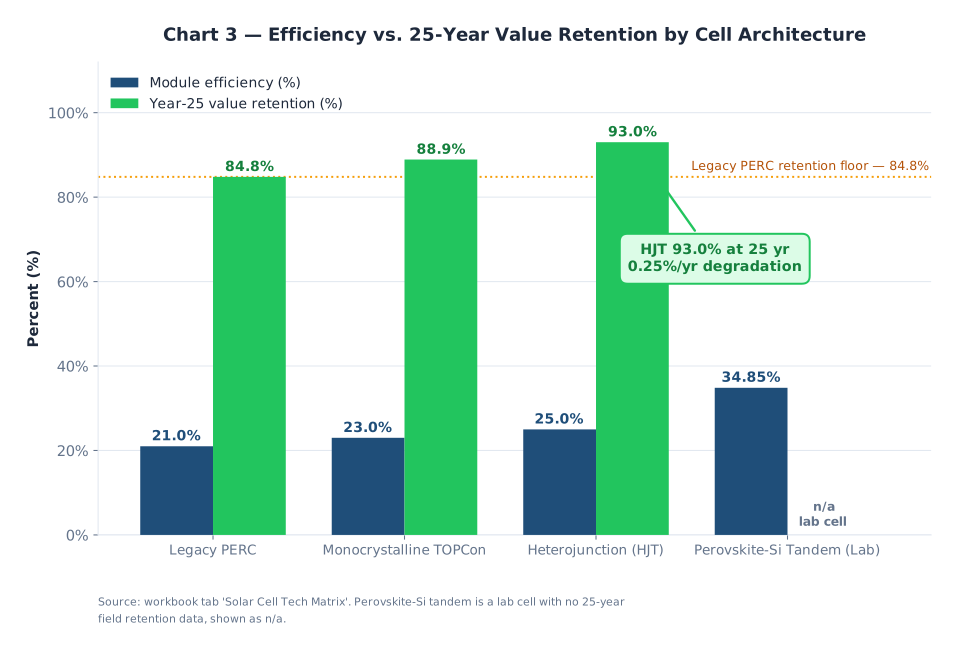
The workbook's cell technology matrix tracks both numbers across four architectures. Legacy PERC sits at 21.0% efficiency and retains 84.8% of its value at year 25. Monocrystalline TOPCon reaches 23.0% efficiency with 88.9% retention. Heterojunction, or HJT, leads the commercial three at 25.0% efficiency and 93.0% retention, degrading at 0.25% per year. Perovskite-silicon tandem cells post a lab efficiency of 34.85% but have no 25-year field retention figure at all, because they have not been in the field for 25 years.
The two numbers that matter, side by side

Reading efficiency and retention together changes the ranking. PERC and TOPCon are separated by 2.0 efficiency points and by 4.1 retention points. TOPCon and HJT are separated by another 2.0 efficiency points and another 4.1 retention points. In other words, the retention gap between adjacent generations is roughly twice the efficiency gap — and retention is the figure that compounds.
| Architecture | Module efficiency | Year-25 value retention | Gap vs. PERC | Notes |
|---|---|---|---|---|
| Legacy PERC | 21.0% | 84.8% | — | Established, cheapest, lowest retention in the matrix |
| Monocrystalline TOPCon | 23.0% | 88.9% | +4.1 pts | The 2026 mainstream specification; 0.4%/yr assumed degradation in the sizing model |
| Heterojunction (HJT) | 25.0% | 93.0% | +8.2 pts | Highest retention in the matrix; 0.25%/yr degradation |
| Perovskite-Si tandem (lab) | 34.85% | n/a | — | Lab cell; no 25-year field retention data exists |
The tandem row is the one that tempts people into bad decisions. A 34.85% efficiency figure is 9.85 points above HJT and nearly 14 points above PERC, and it is a genuine laboratory result. But there is no 25-year retention number attached to it, which means there is no basis for modelling what a tandem array is worth in 2051. An efficiency figure without a retention figure is a day-one number, not a lifetime number.
What retention means at the meter
Retention is easiest to understand as a percentage of whatever the array produces in its first year. An 8 kW system that puts out 12,451 kWh in year one — the figure implied by 5.2 peak sun hours per day and the workbook's 82% de-rate factor — behaves very differently at year 25 depending on which cells sit on the roof.
The workbook's own sizing model assumes a 0.4% annual degradation rate, described as the 2026 TOPCon standard. That is the conservative figure baked into every payback calculation in the model, and it is worth knowing that the HJT annotation of 0.25% per year is meaningfully better than the assumption being used. On a 25-year horizon, the difference between losing 0.4% per year and losing 0.25% per year is exactly the difference between the TOPCon and HJT retention bars in Chart 3.
| Architecture | Year-1 basis | Year-25 retention | Retention gap vs. PERC | Retention gap vs. TOPCon |
|---|---|---|---|---|
| Legacy PERC | 21.0% module efficiency | 84.8% | — | −4.1 pts |
| Monocrystalline TOPCon | 23.0% module efficiency | 88.9% | +4.1 pts | — |
| Heterojunction (HJT) | 25.0% module efficiency | 93.0% | +8.2 pts | +4.1 pts |
| Perovskite-Si tandem (lab) | 34.85% module efficiency | n/a | n/a | n/a |
Note the staircase in the retention columns. Each commercial generation adds exactly 4.1 points over the one below it. That regularity is useful for buyers because it means the choice is not a gamble on unproven technology — it is a predictable trade of cost against durability, in increments of roughly 4 points per step.
Efficiency still matters — but for a specific reason
Module efficiency does one job that retention cannot: it determines how much capacity fits on the roof you have. At 400 watts per panel, an 8 kW array needs 20 modules. Higher-efficiency cells let you hit the same kilowatt count with fewer panels or exceed the target in the same footprint, and a Flagstaff roof with dormers, vents, chimneys or heavy shading does not offer unlimited placement options.
There is a cost dimension too. The workbook's cost-share model puts modules at $0.77 per watt within a $2.56 per watt turnkey price — 30% of the total bill. That is the line most sensitive to which technology you specify, and it is the line where the 2.0-point efficiency steps between PERC, TOPCon and HJT get priced. A quote that specifies a premium architecture without showing a premium module line is worth questioning; a quote that specifies legacy PERC at premium prices is worth rejecting outright.
Choosing a specification in Flagstaff
Flagstaff's climate argues for retention over peak efficiency more strongly than a mild coastal market would. At 5.2 peak sun hours per day and an 82% design de-rate factor, output per panel is already good enough that efficiency is rarely the binding constraint. What the high-desert climate does test is durability: intense UV, large day-night temperature swings and freeze-thaw cycles all push degradation, which is why a 4.1-point retention improvement is worth more here than an extra 2 points of nameplate efficiency.
Perovskite-silicon tandem deserves a mention for completeness rather than as a purchase. At 34.85% lab efficiency it points at where the industry is going, and it is the reason the matrix includes a fourth row at all. But a homeowner buying today is buying a 25-year cash flow, and the only three rows with retention data are PERC, TOPCon and HJT.
| Your constraint | Specify | Reason from the matrix |
|---|---|---|
| Roof space is tight; need maximum watts per panel | HJT (25.0%) | Highest commercial efficiency, fewest modules per kilowatt |
| Maximising 25-year value retention | HJT (93.0% retention) | 8.2 points more than PERC, 4.1 more than TOPCon |
| Lowest upfront cost per watt | Legacy PERC (21.0%) | Cheapest of the three commercial rows; accept 84.8% retention |
| Best balance of price and durability | TOPCon (23.0% / 88.9%) | The 2026 mainstream specification and the model's own degradation assumption |
| Waiting for the next generation | Do not specify tandem yet | 34.85% efficiency, but zero 25-year retention data |
Call (928) 698-6192 for free, no-obligation quotes from pre-vetted Flagstaff solar professionals.
Frequently asked questions
- Which solar panel technology holds its value best?
- HJT, at 93.0% retention at year 25, according to the workbook's cell technology matrix. That is 4.1 points better than TOPCon (88.9%) and 8.2 points better than legacy PERC (84.8%).
- Is the 34.85% perovskite tandem panel worth waiting for?
- Not on today's evidence. It is a lab cell with no 25-year field retention data, so its 34.85% efficiency cannot be converted into a defensible 25-year cash flow. The three commercial rows are the investable ones.
- How much does degradation actually cost me?
- It compounds over the whole life of the array. The workbook's sizing model assumes 0.4% per year, while the HJT annotation is 0.25% per year — that gap is the difference in the retention bars in Chart 3, and it is why retention matters more than day-one efficiency in a high-UV climate.
- Do I need high-efficiency panels in Flagstaff?
- Only if roof area is the constraint. At 5.2 peak sun hours per day and an 82% de-rate factor, output is strong; efficiency buys you fewer panels for the same kilowatts, while retention buys you more value in year 25.