Three Chemistries, Three Different Jobs
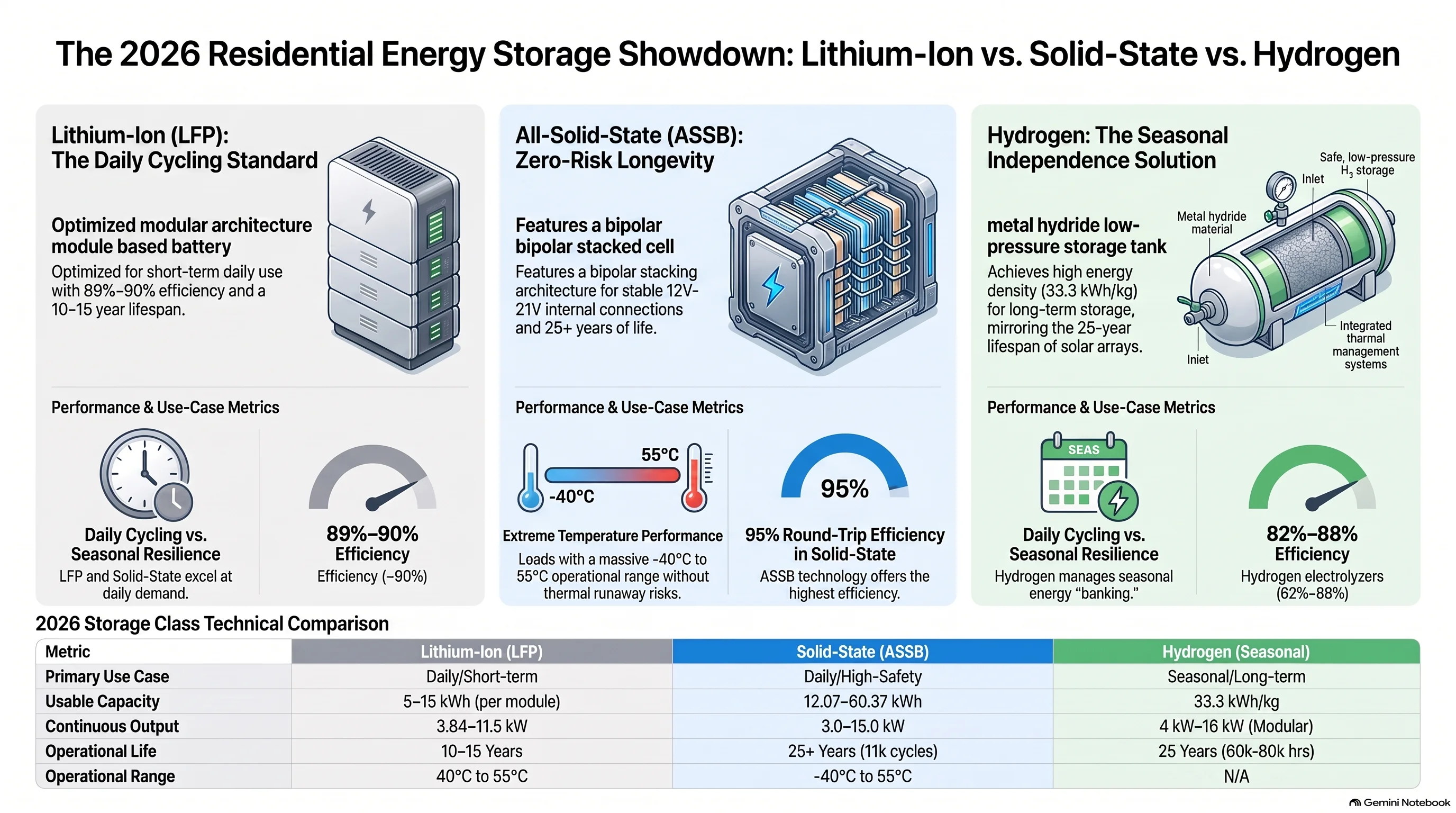
Home energy storage in 2026 is a three-way race. Lithium iron phosphate (LFP) remains the daily-cycling standard — safe, proven, and cheap per kilowatt-hour. Solid-state batteries, now shipping in early commercial forms, trade a liquid electrolyte for a rigid one, eliminating the fuel for thermal runaway entirely. Hydrogen storage, meanwhile, plays a completely different game: instead of a battery that charges and discharges electrons, it banks energy as gas, holding it for weeks or months. If you are here looking into home battery storage queen creek, the sections below walk through the process from the first quote to the finished job.
Matching the Chemistry to the Job
For day-to-day solar shifting — charge during the day, run the house at night — LFP is still the value leader. For maximum safety in a garage or attached installation, solid-state's zero-liquid design removes the thermal-runaway risk that makes some insurers and building codes nervous. And for seasonal storage, the solar-hydrogen approach banks summer sun for winter, something no battery can do at practical cost. The smartest systems combine them: a solid-state or LFP battery for daily cycling, with hydrogen or long-duration storage for multi-day weather events.
The short version
- The article frames 2026 home storage as a three-way race among lithium iron phosphate, solid-state and hydrogen, each suited to a different job.
- LFP stays the daily-cycling value leader, described as safe, proven and cheap per kilowatt-hour for charge-by-day, run-by-night shifting.
- Solid-state batteries swap a liquid electrolyte for a rigid one, eliminating the thermal-runaway fuel that makes some insurers and building codes nervous.
- Hydrogen storage works differently: instead of cycling electrons it banks energy as gas, holding it for weeks or months.
- The recommended architecture pairs a solid-state or LFP battery for daily cycling with hydrogen or long-duration storage for multi-day weather events.