A solar contract does not carry one warranty. It carries three, and they do different jobs. That distinction matters more than any single duration, because a homeowner who only checks the headline number — the twenty-five years on the front of the folder — has checked the layer that protects output and left the layers that protect the equipment and the roof unexamined.
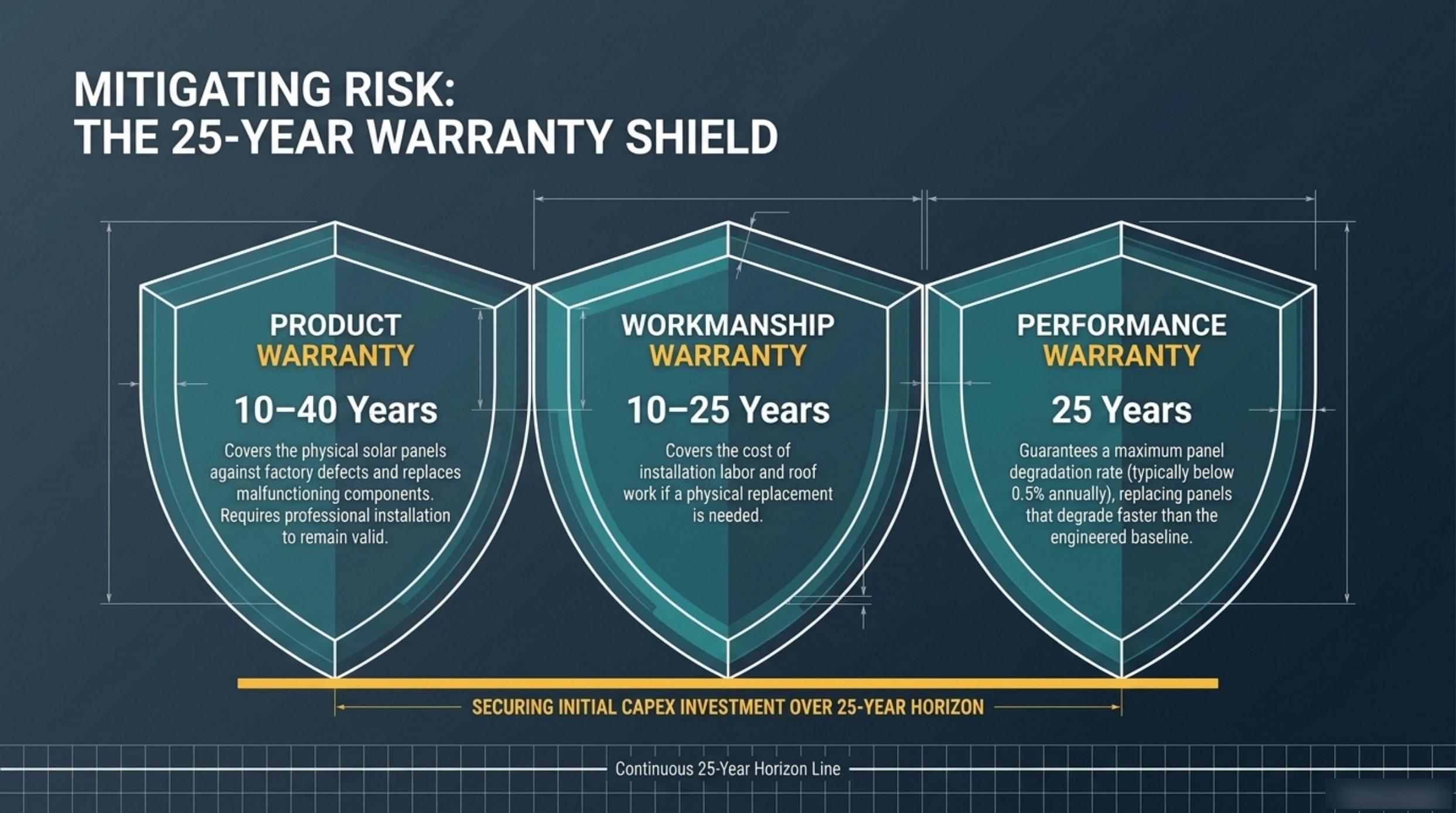
The deck calls the whole arrangement a warranty shield, and the metaphor earns its place. Three overlapping layers, each with its own duration and its own trigger, sit between a homeowner's initial capital and the twenty-five-year horizon the asset has to survive. Where any one of them is missing, there is a literal gap in the cover.
Three warranties, three different jobs
The clean way to hold the three layers apart is to ask what each one pays for. The product warranty replaces hardware. The workmanship warranty pays for the labour and roof work that replacing hardware requires. The performance warranty guarantees an output level and replaces panels that fall below it. One covers the thing, one covers the work, one covers the result.
| Layer | Duration | What it covers | Condition |
|---|---|---|---|
| Product warranty | 10–40 years | The physical solar panels against factory defects; replaces malfunctioning components | Requires professional installation to remain valid |
| Workmanship warranty | 10–25 years | The cost of installation labour and roof work if a physical replacement is needed | Held by the installer, not the manufacturer |
| Performance warranty | 25 years | Guarantees a maximum panel degradation rate, typically below 0.5% annually; replaces panels that degrade faster than the engineered baseline | Measured against the engineered baseline, not the nameplate |
Product warranty: 10 to 40 years
This is the manufacturer's promise about the hardware itself. It covers the physical solar panels against factory defects and provides for replacing malfunctioning components. The spread from ten to forty years is not marketing noise; it tracks the quality tier of the module. A module backed for a decade is not the same product as one backed for four.
One condition is attached and it is easy to overlook: the product warranty requires professional installation to remain valid. That single clause is the hinge between the first layer and the second. A homeowner who mounts panels personally, or who has them mounted by an uncertified crew, can void the manufacturer's cover on equipment that cost the largest hardware share of the whole system.
Workmanship warranty: 10 to 25 years
Product warranties replace panels. They do not remove and refit them, and they certainly do not repair the roof underneath. That is the workmanship warranty's job: the cost of installation labour and roof work if a physical replacement is needed. It is the layer that pays when a panel must come off a Flagstaff roof and go back on again.
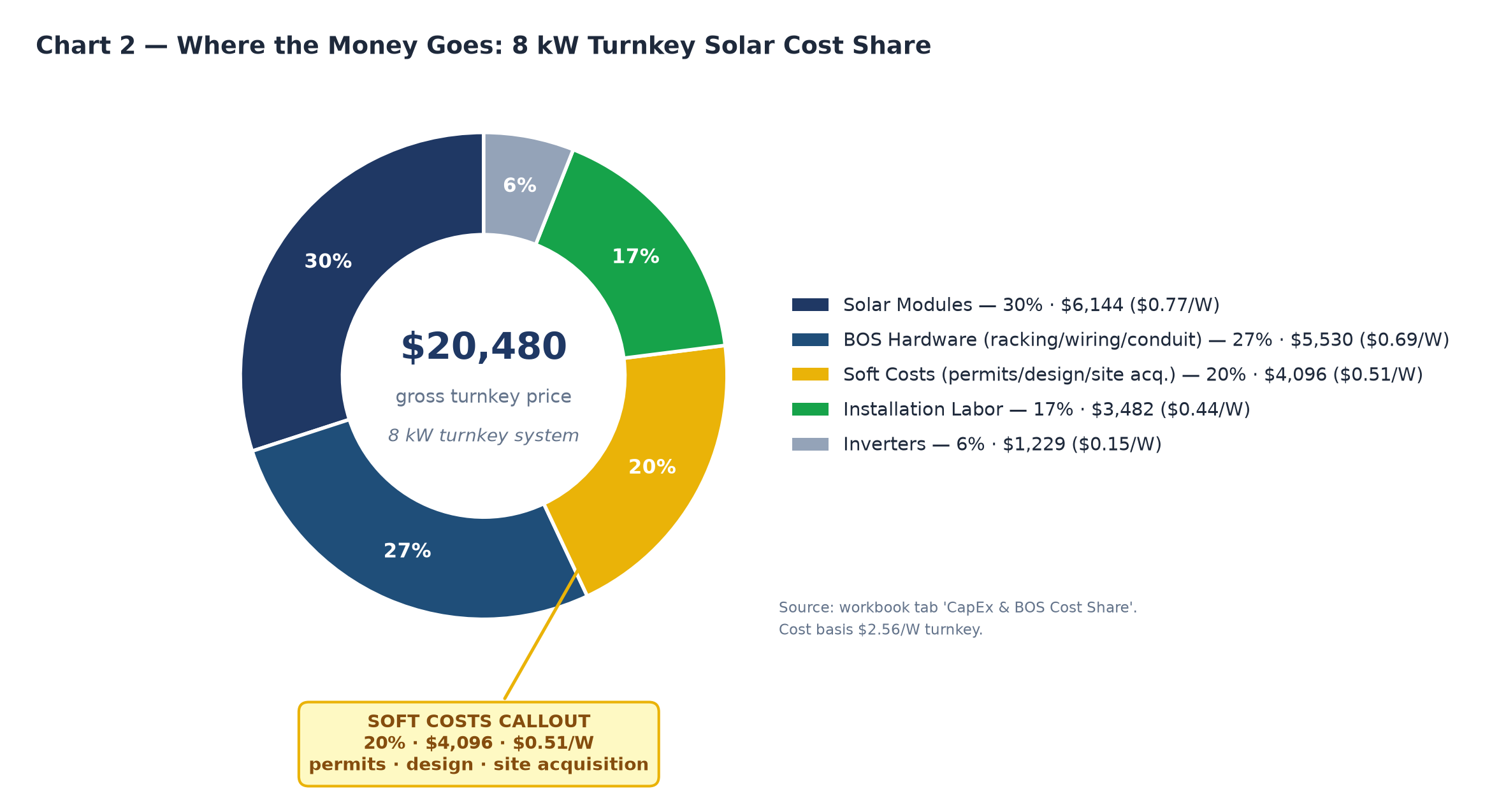
Notice who holds it. A workmanship warranty comes from the installer, which makes it the most fragile of the three layers and the one most dependent on the company still being in business a decade from now. It is also the layer that responds to roof penetrations, flashing detail and the quality of the original mounting work — all of which are invisible once the array is up. Our breakdown of turnkey solar installation costs shows how much of the original price sits in exactly that labour.
Performance warranty: 25 years below 0.5% a year
The performance warranty is the one homeowners quote from memory, and it is the one that decides what the asset is worth at the end. It guarantees a maximum panel degradation rate, typically below 0.5% annually, and commits the manufacturer to replacing panels that degrade faster than the engineered baseline.
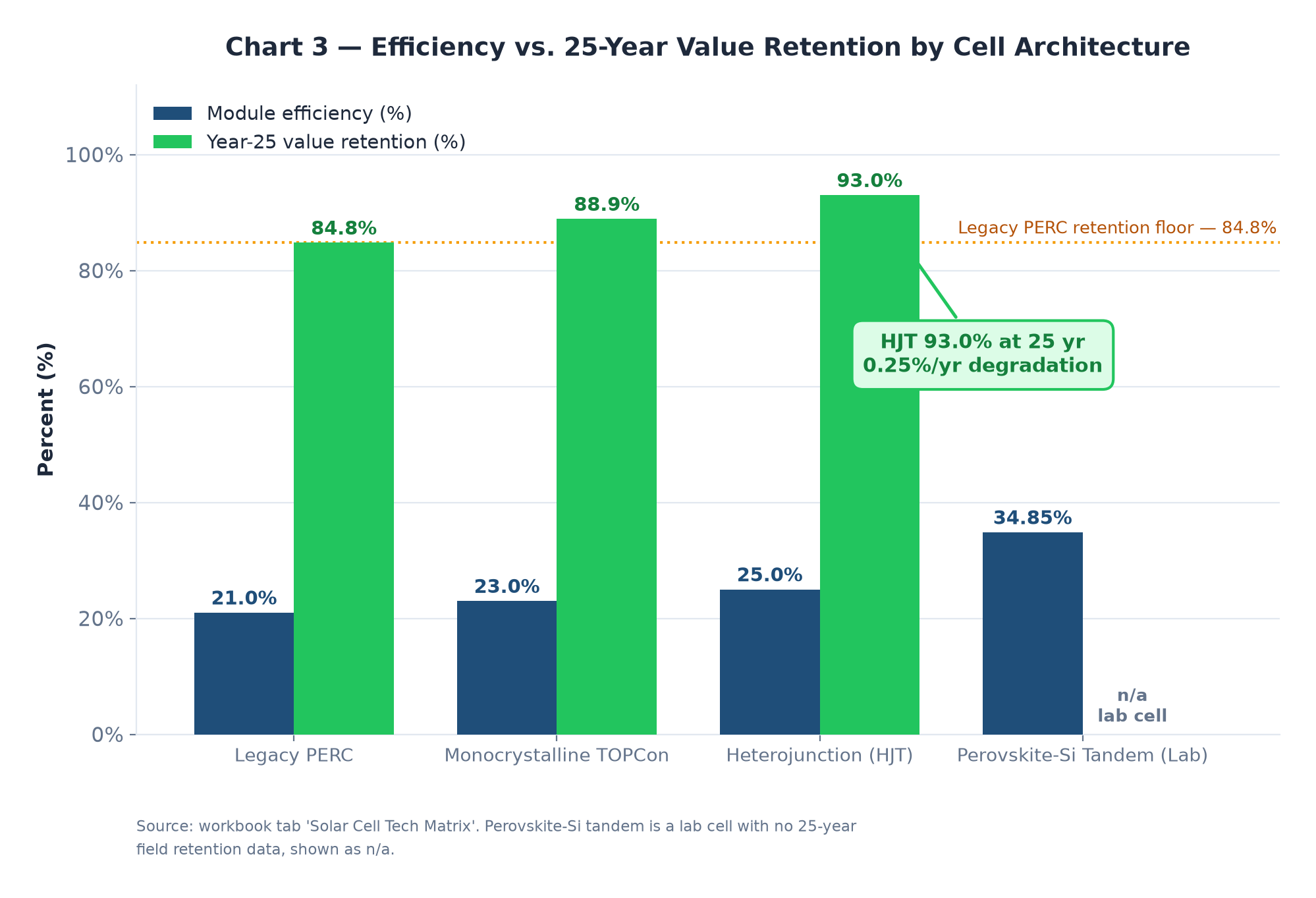
Those two clauses — the annual cap and the baseline comparison — are why this layer interacts so directly with cell technology. A module rated to hold 93.0% of output at year twenty-five is promising something materially different from one rated at 84.8%, and the performance warranty is the instrument that makes the promise enforceable. We work through those retention figures in TOPCon vs. HJT vs. PERC, and the 25-year maths behind them in our slide-by-slide teardown of the total cost of ownership model.
Why the three layers have to be read together
Each layer covers what the others do not, and the failure mode of the shield is always the same: one missing panel of three. A strong product warranty with a thin workmanship warranty means the manufacturer will send a replacement module and the homeowner will pay a crew to fit it. A long workmanship warranty with a weak performance guarantee means the roof is protected while the output quietly erodes. Twenty-five years of performance cover with no professional-installation record behind it means the first layer was never valid to begin with.
Read as a set, the three layers map onto the same 25-year horizon line the rest of the model runs along. Product cover may extend well past it, workmanship cover typically spans the first half, and performance cover is written to the end. The shield is only as strong as its shortest term and its weakest condition — which is precisely why the ask to make of any Flagstaff installer is not "how long is the warranty?" but "which warranty, covering what, and held by whom?"
Call (928) 698-6192 for free, no-obligation quotes from pre-vetted Flagstaff solar professionals.
Frequently asked questions
Why is the workmanship warranty shorter than the performance warranty?
Because it covers a different kind of risk. Performance is a property of the module, so a manufacturer can carry a promise across the full 25-year horizon. Workmanship is a property of the installation, and it is held by the installing company — which is why the deck puts it in the 10–25 year band rather than at the far end of the line.
Does an installation void the product warranty?
Only a non-professional one. The product warranty requires professional installation to remain valid, so the installer's credentials and the installation record are part of the manufacturer's cover, not separate from it. That is the mechanism linking the first layer of the shield to the second.
What does "below 0.5% annually" actually guarantee?
It caps the maximum degradation rate the performance warranty will accept, and it obliges the manufacturer to replace panels degrading faster than the engineered baseline. The practical effect is that the guarantee is measured against a projection rather than against the panel's day-one rating.