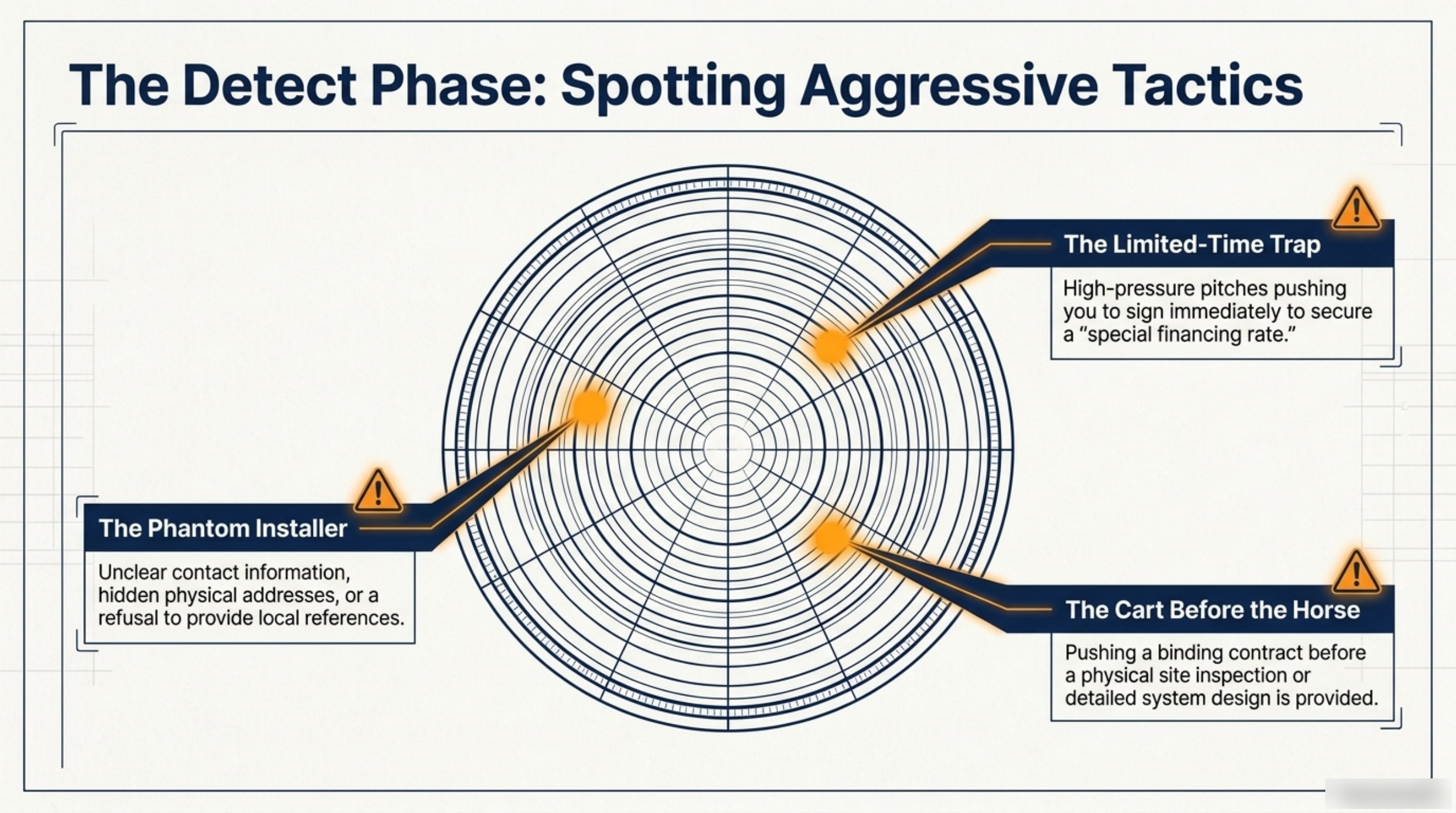
The detect phase of the vetting guide is the cheapest part of due diligence, because it costs nothing but attention. Its job is to identify sales behaviour that disqualifies a company before you spend time checking credentials or reading contracts. The deck names three patterns that recur often enough to deserve names of their own.
None of the three is illegal, and that is precisely why they persist. Each one is a legitimate-looking sales technique applied to a purchase where the stakes are unusually high. An array is a twenty-five-year commitment priced in the tens of thousands, and the decision is difficult to reverse. Pressure works best on decisions that are expensive to unwind.
Recognising the pattern is most of the defence. The rest is knowing which question to ask in the moment.
Tactic one: the limited-time trap
The pitch arrives as urgency: a special financing rate that expires tonight, a rebate that disappears this week, a price that only holds while the salesperson is still in the room. The deck describes it as high-pressure selling designed to make you sign immediately to secure a special financing rate.
The tell is not the deadline itself. Deadlines exist in every industry. The tell is what happens when you decline to meet it. A company with a real promotional cycle will quote you a new, slightly higher price tomorrow and mean it. A company applying pressure will escalate the deadline, add a discount, or suggest you are about to make a costly mistake.
The disarming question is simply: what will this cost if I sign next week? Ask for that number in writing. If the answer cannot be written down, the urgency was manufactured.
Tactic two: the phantom installer
The second pattern is harder to spot because it is defined by absence. The deck lists unclear contact information, hidden physical addresses and a refusal to provide local references. A company that will not tell you where it is based, or cannot produce a single customer in your own jurisdiction, is asking you to trust a warranty to an entity you cannot find.
Solar systems outlive sales organisations. An installer that has been operating locally for years has a reputation to protect and premises you can visit. A firm assembled around a marketing campaign has neither.
Check the address against a map before you check the price. Then ask for two references from installations in the same county, and call them. In a state where licensing and registration are traceable, this takes an afternoon.
Tactic three: the cart before the horse
The third pattern concerns sequence. The deck describes companies that push a binding contract before a physical site inspection or a detailed system design has been provided. Signing at that point means committing to an unknown scope at a known price.
The design is what the price is supposed to describe: panel layout, shading, equipment specification, electrical scope and trenching. Without it, there is no basis for comparison and no way to tell later whether the crew built what you bought.
The disarming question is to ask which documents come before signature and which come after. In a properly sequenced project, the site inspection and the design come first, and the contract is the written record of a scope you have already seen.
| Tactic | How it works | What it depends on | Your question |
|---|---|---|---|
| The limited-time trap | A "special financing rate" that expires within hours or days | You believing the deadline is real and external | What is the price if I sign next week — in writing? |
| The phantom installer | No verifiable address, unclear contact details, no local references | You never checking whether the company exists locally | What is your address, and who can I call in this county? |
| The cart before the horse | A binding contract offered before any site inspection or design | You signing a scope you have never seen | Which documents come before I sign, and which after? |
Why the detect phase comes first
There is a practical reason the guide puts sales behaviour ahead of paperwork. Credentials are checkable in an afternoon, but only for companies that survive being checked. Walking away from a pressure pitch at the kitchen table costs nothing, whereas discovering a warranty gap after installation costs a claim, a repair bill and the effort of pursuing a company that may no longer be trading.
The detect phase also protects the homeowner's own reasoning. Being rushed is the state in which people accept an unfamiliar financing structure or a scope they have not read. Buying time is not a negotiating tactic; it is the condition under which any other check becomes possible.
Call (928) 698-6192 for free, no-obligation quotes from pre-vetted Flagstaff solar professionals. You can also run your own numbers in our Flagstaff solar calculators.
Frequently asked questions
Is it normal for solar prices to expire?
Prices can change, and promotions exist in every trade. The problem is not a deadline but a deadline that cannot be written down. Ask for the same specification priced with a later signing date. A real offer produces a number; a manufactured one produces more pressure.
What counts as a local reference?
A customer in the same county, ideally with a similar roof and electrical setup, who is willing to take a call. Two names is a reasonable ask. An installer with a real local track record has far more than two to offer.
Should I ever sign before seeing a design?
If you are signing at all, sign for a scope you have read. The deck's line is that a binding contract before a site inspection or detailed design puts the cart before the horse, and the reason is simple: without a design there is nothing to compare and nothing to enforce.