The roof is the part of a solar installation that homeowners examine least and worry about most. It deserves both the worry and the examination, because a mounting system is a series of deliberate holes in a structure whose whole job is to keep water out. The deck devotes a section to that trade-off, and it contains two warnings worth taking seriously.
The first is that penetration coverage must be written into the contract rather than assumed. The second is that an installer who suddenly announces that your roof needs full replacement before solar can proceed may be selling something you did not ask for.
Both warnings assume you understand what is actually being penetrated, so that comes first.
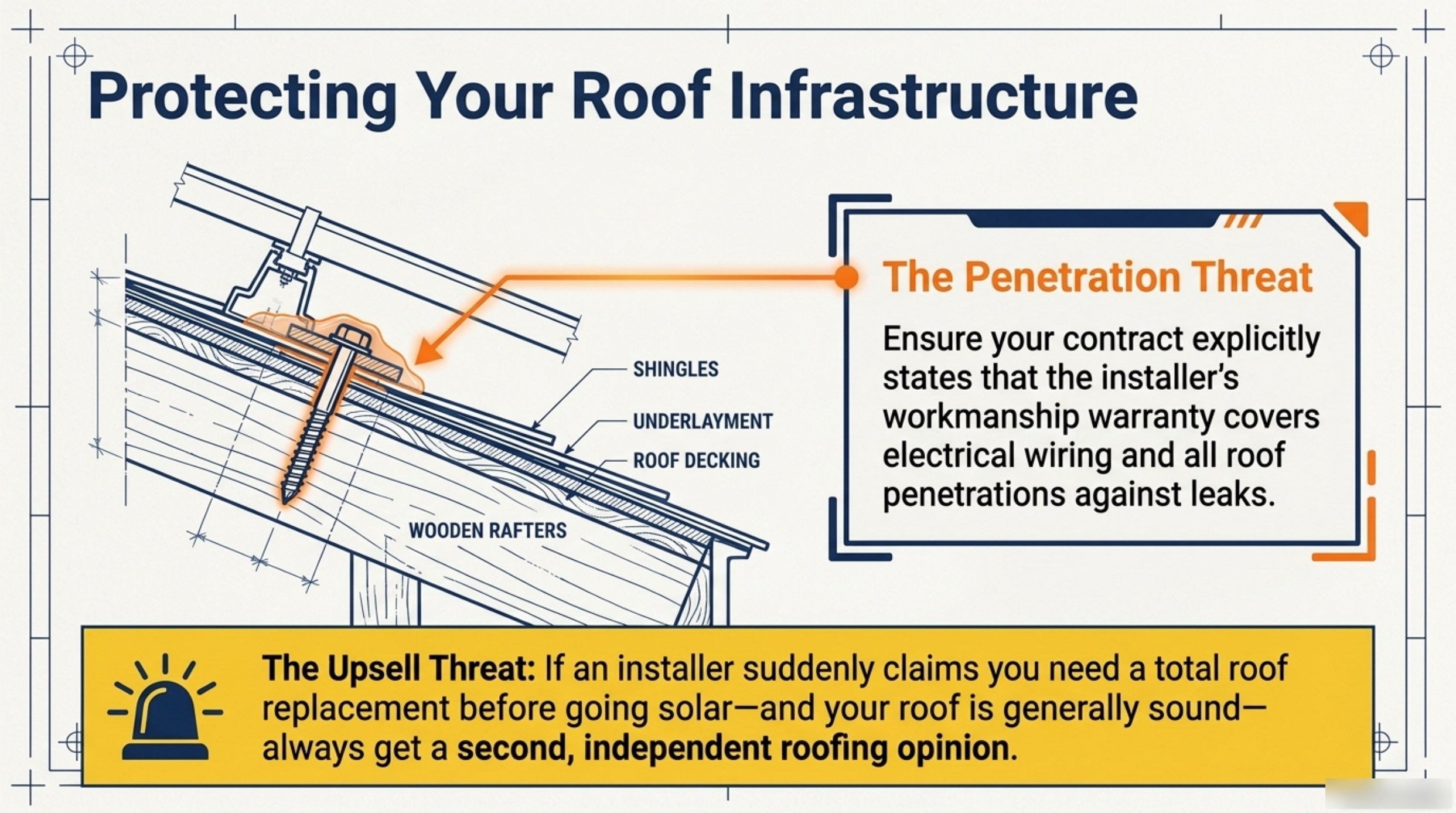
What a penetration actually passes through
The deck names four layers. Shingles are the outermost weather surface and the first barrier. Underlayment sits beneath them as the secondary water-resistive layer, and it is usually the last line of defence once water is past the shingles. Roof decking is the structural sheathing that carries the load and spans the framing. Wooden rafters are the framing itself, and they are what the mounting hardware ultimately transfers the array's load into.
A properly flashed penetration seals the shingle course and laps into the underlayment so that water is directed over the top of the opening rather than into it. A poorly detailed one relies on sealant alone, which dries, cracks and fails under Flagstaff's ultraviolet exposure and freeze-thaw cycling.
The point of naming the layers is that a homeowner can ask a specific question about them. Rather than asking whether the roof will be fine, ask how the flashing will lap into the underlayment, and whether the fasteners will land in rafters or in sheathing alone.
The penetration threat: get it in the contract
The deck's instruction here is direct. Your contract should explicitly state that the installer's workmanship warranty covers electrical wiring and all roof penetrations against leaks. Not the equipment warranty, which covers modules and inverters, and not a general promise of quality, but the workmanship warranty, named and extended to penetrations.
The reason is that a leak is almost always a workmanship failure rather than an equipment failure. Modules rarely cause water intrusion. Flashing, sealing and fastener placement do. If the workmanship warranty excludes roof penetrations, or is silent on them, you have purchased a system whose most likely failure mode sits outside the coverage that would pay for it.
Ask for the warranty document before signing, not after, and read the exclusions. A stated exclusion for roof penetrations is a decision point, not a detail. Note also the duration of the workmanship cover, since penetration failures frequently appear years after installation rather than within the first season.
| Layer | Role | Leak risk if the work is poor | Your question |
|---|---|---|---|
| Shingles | Primary weather surface | Cracked or lifted material around the flashing | How is the shingle course sealed and restored? |
| Underlayment | Secondary water-resistive barrier | Water bypasses the shingle and finds the opening | Does the flashing lap into the underlayment, or sit on top of it? |
| Roof decking | Structural sheathing over the framing | Water tracking along the sheathing into the attic | Is the decking sound where each mount lands? |
| Wooden rafters | Structural framing carrying the load | Fasteners in sheathing only; load not transferred properly | Do fasteners reach the rafters, and is that documented? |
The upsell threat: the sudden roof replacement
The second warning is about a sale that appears mid-process. The deck describes the pattern as an installer suddenly claiming that a total roof replacement is required before solar can proceed, when the roof is generally sound. Its instruction is unambiguous: always obtain a second, independent roofing opinion.
The sequence is worth understanding because it is not always dishonest. A genuinely failing roof is a real obstacle to mounting an array, and some installers will decline the job rather than mount hardware on it. The problem is the diagnosis arriving from the party that profits from the replacement, especially when it appears late in the process after a contract has already been signed.
The correct response is procedural rather than confrontational. Engage a roofer with no connection to the solar company, ask for a written assessment of remaining service life, and make the sequencing decision on that basis. If the roof does need replacing, it makes sense to re-roof first and install afterwards, because removing and reinstalling an array later is expensive.
Call (928) 698-6192 for free, no-obligation quotes from pre-vetted Flagstaff solar professionals. You can also run your own numbers in our Flagstaff solar calculators.
Frequently asked questions
Which warranty covers roof leaks from a solar installation?
The workmanship warranty, and only if the contract says so explicitly. The deck's requirement is that the workmanship warranty covers electrical wiring and all roof penetrations against leaks. Equipment warranties cover modules and inverters, not the roof.
How long should the workmanship warranty run?
Long enough to outlast the period in which flashing and sealant failures typically appear, which is often several seasons rather than one. Read the stated term and the exclusions, and treat a silence on roof penetrations as a gap that will be argued about later.
Is a roof replacement ever genuinely necessary before solar?
Sometimes. A roof near the end of its service life should be replaced before an array is mounted, because later removal and reinstallation is costly. The deck's caution concerns a sudden demand for replacement on a generally sound roof, which is why an independent second opinion belongs in the process.