The Blueprint for Energy Independence: Integrating Battery Storage With Home Solar
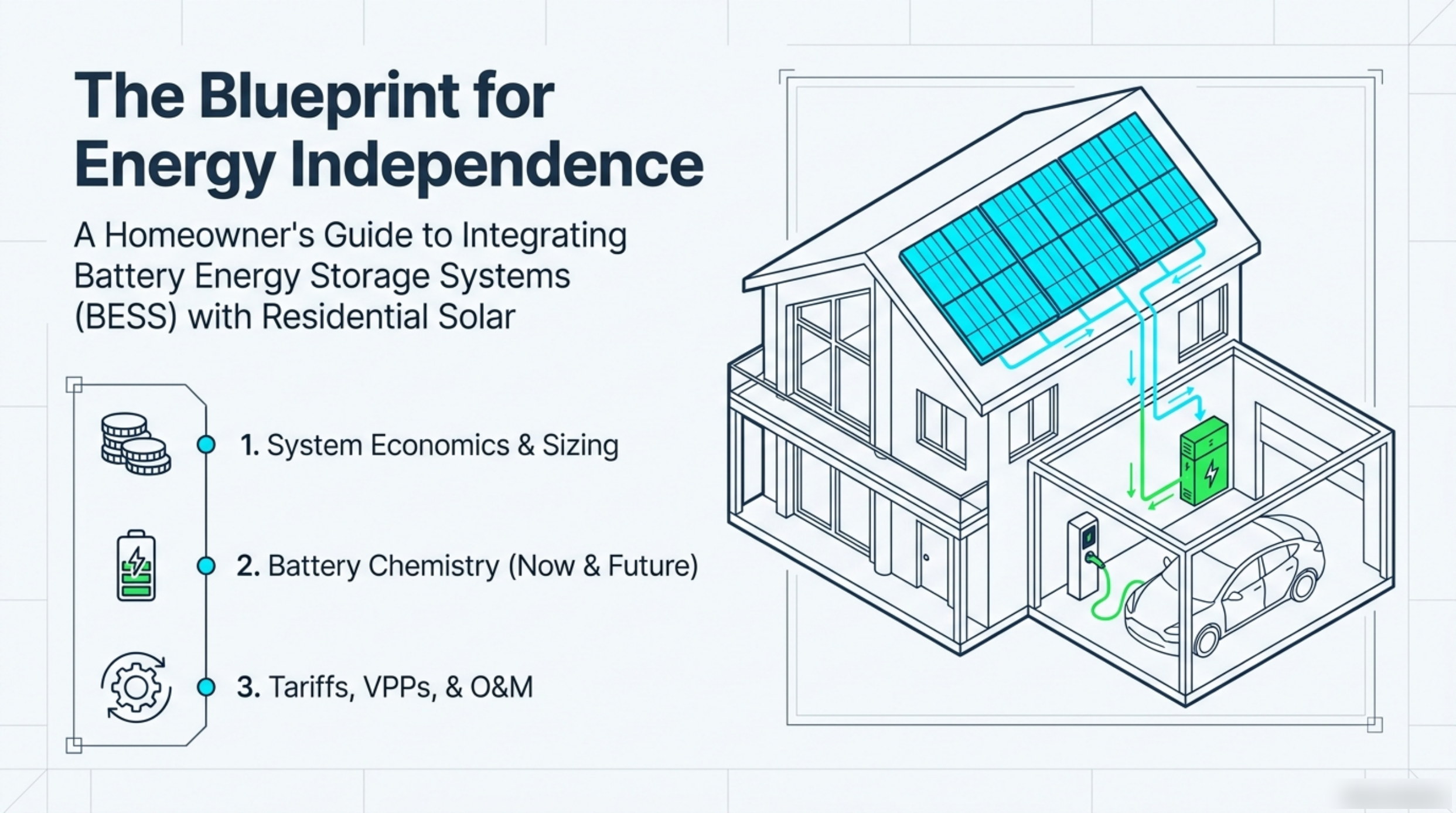
Most Flagstaff homeowners who start looking into solar are really looking at two projects at once. The first is generation: panels on the roof turning high-altitude northern Arizona sunlight into usable electricity. The second is everything that happens to that electricity after the sun goes down, or after the grid goes down with it. A deck we work from, The Blueprint for Energy Independence, opens by naming both halves of that project in its subtitle: a homeowner's guide to integrating Battery Energy Storage Systems, or BESS, with residential solar.
The word "integrating" is doing real work there. A solar array and a battery are not two appliances that happen to share a roof; they are one system sharing one design, one inverter strategy and one set of electrical assumptions. Get that integration right at the start and the home gains an asset that keeps working for decades. Get it wrong, or defer the decision, and the same home pays twice: once for the original installation, then again for the retrofit that makes storage possible. What follows is the map of that blueprint, and the three questions it puts in front of a homeowner.
The short version
- A solar-plus-storage project is one integrated system, not a solar array with a battery bolted on afterwards.
- The blueprint splits the decision into three parts: system economics and sizing, battery chemistry now and in the future, and tariffs, virtual power plants and O&M.
- Economics and sizing come first because they determine how much generation and how much usable stored energy a home actually needs.
- Chemistry sets what the battery can safely do over the next decade; tariffs and virtual power plants decide what the stored energy is worth once it is on the wall.
Two decisions, not one: generation and storage
A solar-only system is sized around one number: how much of the home's consumption the array can offset while the sun is up. A solar-plus-storage system is sized around three: how much the array generates, how much of that generation the battery can absorb and hold, and how much load the battery can carry when the grid is not available. That third number is the one that changes the design conversation, because it forces a homeowner to answer a question that has nothing to do with kilowatts: which circuits in this house are non-negotiable when power stops?
It is also why the blueprint leads with economics and sizing rather than equipment. Sizing decisions flow downhill. They determine the array's capacity, whether the inverter has to be a hybrid unit, whether a critical-load sub-panel gets wired during construction, and whether the battery ends up as a single unit or several stacked together. Every one of those choices is far cheaper to make before the first mounting rail goes on the roof than after.
Pillar one: system economics and sizing
The first section of the blueprint covers what the project costs and what it is sized to do. Solar-only pricing and solar-plus-storage pricing are genuinely different line items, and a homeowner comparing quotes needs to know which of the two they are holding. Storage adds hardware, an inverter able to manage current flow in both directions, and usually some electrical work at the main panel. In return the home gains the ability to use its own generation after sunset instead of exporting it.
Sizing is the quieter half of this pillar. An array sized purely around annual consumption can look correct on paper and still leave a battery unable to carry an evening load, because usable battery capacity and peak array output are separate constraints. The blueprint treats them as a pair, which is the only way to answer the practical question a homeowner actually has: what will this system be doing at seven in the evening in January?
Pillar two: battery chemistry, now and in the future
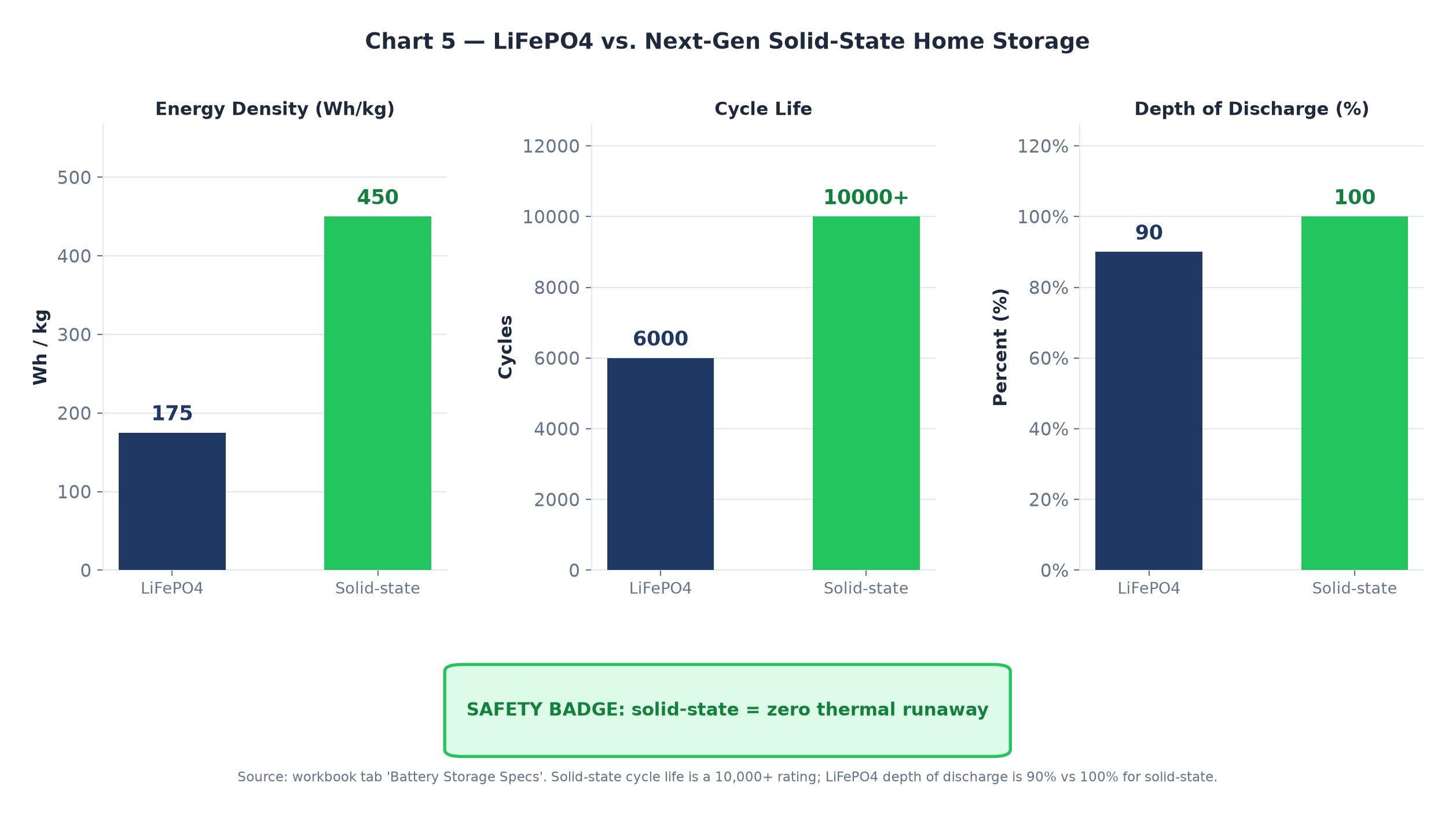
The second section looks at what sits inside the box on the garage wall. Lithium iron phosphate chemistry has become the residential default because its thermal behaviour is predictable, its cycle life is long, and its cost per usable kilowatt-hour has fallen far enough to make home storage sensible in the first place. The blueprint pairs that present-tense picture with a forward look, because a homeowner buying into a five-figure asset is also buying into whatever chemistry arrives next.
That is not idle futurism. A system designed as battery-ready accepts a replacement or an additional battery later without rewiring the roof or replacing the inverter, which means the chemistry decision made today does not lock the house into today's cells for the next two decades. That thread runs from the second pillar straight into the third.
Pillar three: tariffs, virtual power plants and O&M
The final section covers what stored energy is worth and what it costs to keep. Tariffs are the rules a utility uses to price electricity across the day and to set what it pays for exports. Those rules move. In APS territory, as almost everywhere else, the direction of travel has been toward lower export compensation and higher evening import prices, an environment in which a kilowatt-hour held in a battery until evening is worth more than the same kilowatt-hour pushed to the grid at noon.
Virtual power plants extend the same logic. A VPP aggregates many home batteries into one dispatchable resource and pays participating homeowners for that flexibility, which makes it a tariff product as much as a hardware product and explains why the blueprint files it in the same section. The third element, operations and maintenance, is the least glamorous and the most neglected: battery management systems, monitoring, warranty terms and the labour charges attached to a service visit are all part of the long-run cost of owning the asset.
How to use the blueprint on your own roof
Read the three pillars in order and they turn into a checklist.
| Pillar | What it decides | The question it answers |
|---|---|---|
| Economics and sizing | Array capacity, hybrid inverter, critical-load sub-panel, battery count | What is the system doing at 7 PM in January? |
| Battery chemistry | What sits inside the box, and what a later cell swap would cost | What can the hardware credibly promise? |
| Tariffs, VPPs and O&M | What stored energy is worth, and what it costs to keep running | Is evening storage worth more than a noon export? |
If you want the deep background before you talk to anyone, our solar battery guide for Flagstaff covers the hardware in more detail and our solar cost breakdown covers what the numbers look like on a real contract. For the chemistry question specifically, the LiFePO4 versus solid-state comparison looks at what is available now against what is coming.
If you would rather model the numbers yourself first, the site's free calculators hub covers solar savings and storage sizing.
If you want this sized against your own roof rather than in the abstract, call (928) 698-6192 or request free quotes through the form on this page. Every provider we match is licensed and insured in Arizona, and there is never any obligation to move forward.
Frequently Asked Questions
Do I have to buy the battery at the same time as the panels?
No, but the decision carries a cost either way. A battery-ready design adds very little during construction and keeps the option open. Deferring both the battery and the wiring that supports it means the later retrofit brings its own electrical work and labour with it.
Is storage worth it in Flagstaff if I mainly want lower bills?
It depends on when your usage lands. A battery earns its keep by shifting generation from the middle of the day into the evening, when import prices are highest and export compensation is lowest. A home whose load is already concentrated during daylight hours gets less value from the same hardware.
What does O&M actually cover on a home battery?
Thermal management, cell balancing and day-to-day monitoring are handled by the battery management system inside the unit. What sits on top of that is the human side: warranty administration, diagnostics and the labour charge for a technician visit. Those details are worth reading before you sign.