Nobody quotes the OpEx column. A solar sales conversation is almost entirely about hardware and price, because those are the numbers that fit on a one-page proposal. What does not fit is the routine that keeps the asset performing for twenty-five years — and in Flagstaff that routine has its own shape, dictated by pine needles, high-altitude dust and a winter that drops snow on a roof-mounted array.
The deck treats maintenance as a cycle rather than a task, drawn around an annual maintenance dial. Four routines sit on it: seasonal cleaning, visual inspections, winter protocols and system diagnostics. Each one is cheap. Each one is easy to skip. Together they are the difference between an array that tracks its engineered baseline and one that quietly slides below it.
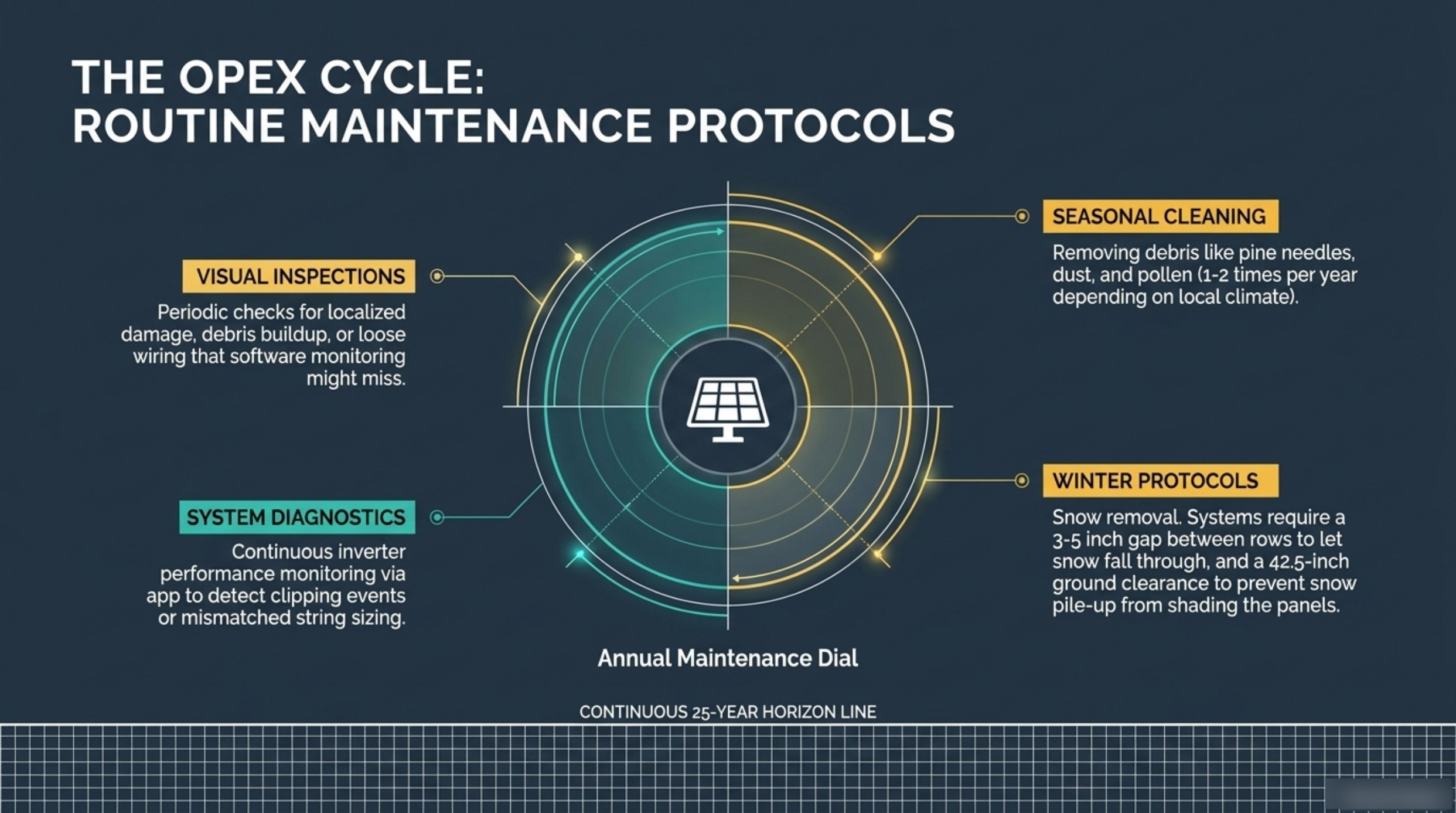
The annual maintenance dial
The dial is a useful way to think about effort allocation, because these are not four equal jobs done at four points in the year. Cleaning is seasonal and driven by the local climate. Inspection is periodic and driven by nothing in particular, which is why it gets forgotten. The winter routine is triggered by weather. Diagnostics run continuously in the background whether anyone remembers them or not.
| Routine | Frequency | What it involves | What it catches |
|---|---|---|---|
| Seasonal cleaning | 1–2× per year, depending on local climate | Removing debris such as pine needles, dust and pollen | Soiling that reduces output gradually and invisibly |
| Visual inspections | Periodic | Checks for localised damage, debris build-up and loose wiring | Faults that software monitoring might miss |
| Winter protocols | Weather-dependent | Snow removal; maintaining a 3–5 inch gap between rows and 42.5 inch ground clearance | Snow pile-up shading the array from below |
| System diagnostics | Continuous | Inverter performance monitoring through an app | Clipping events and mismatched string sizing |
Seasonal cleaning: once or twice a year
The deck's cleaning routine is deliberately modest: one to two times per year, depending on local climate. In a ponderosa pine corridor that means clearing needles, which accumulate along the bottom edge of a roof array and hold moisture against the frame. Elsewhere the same routine is about dust and pollen, which cut transmission without producing any visible drama.
Frequency is the interesting variable. A single annual clean after pollen season is enough on many Flagstaff roofs. A property with heavy conifer cover, or one whose array sits below a prevailing dust line, may need two. What the routine is not is monthly, and it is not a pressure-washing job — the goal is removing material that blocks light, not scrubbing the glass. If your winter routine needs to be more aggressive than the standard one, our Flagstaff guide to solar panels and snow deals with that half of the year specifically.
Visual inspections: what monitoring cannot see
Monitoring software reports that a system produced less than expected. It does not report why, and it cannot distinguish a shading problem from a cracked junction box or a wire that has worked loose under a rail. That is the gap periodic visual inspection fills: localised damage, debris build-up and loose wiring that the data would eventually flag but never diagnose.
Because the trigger is periodic rather than seasonal, this is the routine most likely to lapse. A sensible cadence is alongside the cleaning visit, so the array is inspected while someone is already on or near the roof. The inspection is also the moment to confirm that nothing has been built, planted or parked in a position that has started shading the array since it was designed.
Winter protocols: the two numbers that matter
Snow handling in the deck is not a vague instruction to clear the panels. It comes with two geometric requirements. Systems need a 3–5 inch gap between rows so that snowfall can pass through rather than bridging and building. And they need 42.5 inches of ground clearance so that snow piled underneath does not rise high enough to shade the lower edge of the array.
Both numbers are about preventing the same failure. Snow that cannot fall through a row gap or slide clear of the ground will accumulate in front of the array, and a shaded panel produces disproportionately less than a partially covered one — shading is not linear. Roof-mounted and ground-mounted systems fail this test differently, which is why the gap and the clearance figure are specified separately. The routine itself is simple: keep snow moving, and keep the geometry the design assumed.
System diagnostics: continuous inverter monitoring
The fourth routine is the only one that never asks the homeowner to do anything. Inverters report continuously, and the deck frames the job as watching that stream for two specific conditions: clipping events, where output is capped because the array is producing more than the inverter can convert, and mismatched string sizing, where strings of unequal length pull each other down.
Both are engineering faults rather than wear-and-tear, and both are invisible from the ground. A clipping inverter is not broken, but it is an under-sized component relative to the array behind it. A mismatched string configuration is a design issue that shows up as a persistently lower yield rather than an outage. Neither shows up on a utility bill. Both show up immediately in the monitoring data, which is why the diagnostic routine is continuous rather than annual.
Call (928) 698-6192 for free, no-obligation quotes from pre-vetted Flagstaff solar professionals.
Frequently asked questions
How often do solar panels need cleaning in Flagstaff?
The deck's protocol is one to two times per year depending on local climate. The job is removing pine needles, dust and pollen rather than scrubbing the glass, and a single post-pollen clean is enough on many roofs. Properties under heavy conifer cover typically need the second visit.
Do I need to clear snow off my panels?
Snow removal is part of the winter protocol, and the design should do most of the work for you. A 3–5 inch gap between rows lets snowfall pass through, and 42.5 inches of ground clearance stops snow piling up beneath the array and shading the lower edge.
What can monitoring detect that an inspection cannot?
The reverse of the usual question, and the answer runs both ways. Monitoring catches clipping events and mismatched string sizing as they happen, because those are patterns in the generation data. Inspection catches localised damage, debris build-up and loose wiring, because those are physical conditions that generate no distinct data signature.