Solar shopping now happens in two very different places. One is a comparison marketplace, where a homeowner enters an address and a monthly bill and receives several quotes. The other is a conversation with a local installation company. Both can be useful, and the deck's point is not that one is a scam. The point is that they sit at different points in the liability chain, and confusing the two is how homeowners end up with nobody accountable.
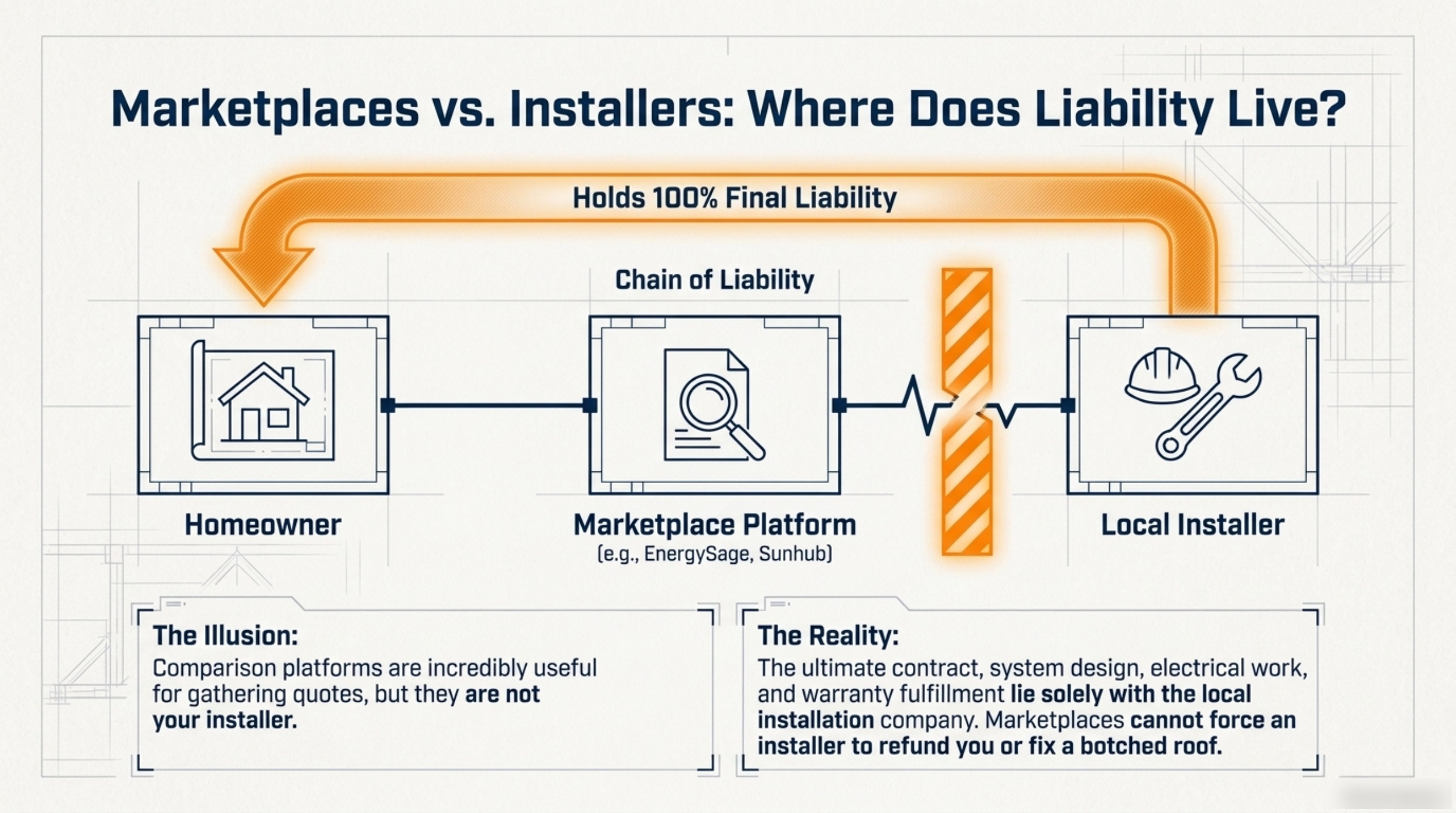
The deck draws that chain explicitly: homeowner, marketplace platform, local installer, with the local installer holding one hundred percent of the final liability. The marketplace appears in the middle because that is where the quote is sourced, not where the work is done.
Understanding which party you can actually pursue is the subject of this article.
The illusion of the platform
Comparison marketplaces are genuinely useful at one job: gathering quotes quickly. A homeowner who wants to see how four installers price the same roof can save weeks of phone calls. The platform collects your details, distributes them and returns proposals.
The illusion is that the platform is therefore a party to the project. It is not your installer. It has not designed the system, will not be on the roof, will not pull the electrical work and will not honour the warranty. When a homeowner later discovers a leak at a mounting foot or a rejected inspection, the platform's role in the transaction is already over.
What the local installer actually owns
The deck lists four things that sit solely with the local installation company: the contract, the system design, the electrical work and warranty fulfillment. Read together, those four items are the entire substance of the project. The contract defines the scope and the price. The design defines what gets built. The electrical work is the part that inspectors examine. The warranty is the promise that outlasts the crew.
A marketplace cannot force an installer to refund a homeowner or to fix a botched roof. It has no contractual lever over the workmanship because the contract is between the homeowner and the installer. That is not a criticism of marketplaces; it is a description of where legal responsibility lives when two parties are not in privity with each other.
| Item | Marketplace platform | Local installer |
|---|---|---|
| Quote sourcing and comparison | Yes — this is its function | Provides its own quote |
| Binding contract | No | Yes — the contractor of record |
| System design | No | Yes — site-specific design |
| Electrical work and permitting | No | Yes |
| Warranty fulfillment | No | Yes — product, workmanship and performance |
| Final liability | None | 100% of it |
Why this matters in APS territory
Flagstaff sits in APS service territory and Coconino County, and local installation work is where the jurisdiction-specific knowledge lives. Interconnection paperwork, inspection scheduling and the practical details of how a system is metered are handled by the installer, in this county, with this utility. A platform operating nationally cannot carry that knowledge, and it does not need to, because it never files the paperwork.
When a homeowner later needs a warranty truck roll, the party that matters is the company that knows how the system was interconnected and can locate the design file. That is the local installer, and only the local installer.
Using a marketplace without confusing it for a contractor
The rational way to use a comparison platform is as a sourcing tool, not an accountability structure. Gather quotes there if it saves time. Then run the vetting standard against the companies that quote you: certification held by at least one crew member, one million dollars of general liability cover, workers' compensation and a verified local reputation in this jurisdiction and utility territory.
Those checks apply to the installer regardless of how the introduction happened. A marketplace can shorten the search but cannot substitute for the four documents.
The paper trail that survives the introduction
There is one habit that keeps the liability chain legible months after the work is finished: keep the platform's role in the file and keep the installer's obligations separate. Save the comparison quotes, the platform correspondence and the introduction alongside the installer's contract, design drawings, permit records and warranty documents. If a dispute arises later, that folder shows who was asked to do what, and it prevents any confusion about which party was responsible for the roof detail.
It also settles a question that comes up when a home is sold. A buyer's inspector will ask who installed the array, who holds the warranty and whether the interconnection was approved in this utility territory. Those answers point to the local installer, and the paperwork that proves it should be filed with the deed documents rather than left in an email inbox.
Call (928) 698-6192 for free, no-obligation quotes from pre-vetted Flagstaff solar professionals. You can also run your own numbers in our Flagstaff solar calculators.
Frequently asked questions
Does using a comparison marketplace cost me anything?
The commercial models vary, and the honest answer is that you should ask. What matters more is that no platform becomes the counterparty to your contract. The design, electrical work and warranty obligations sit with the installing company.
Can a marketplace help me if the installer does poor work?
It has no contractual lever over the workmanship, because the contract is between you and the installer. In practice a platform may pass on a complaint, but it cannot compel a refund or a repair. Your remedy runs against the company that signed the contract.
What should I verify before signing, whoever introduced us?
The same four items every time: installation certification held by at least one crew member, one million dollars of general liability insurance, workers' compensation cover, and a local reputation verified through independent platforms in this county and utility territory.