Buying solar is often described the way people describe buying an appliance: compare the specifications, find the best price, have it fitted. The deck rejects that model outright in its opening argument. Solar is a construction project, not just a product, and the moment you accept that framing you start asking a different set of questions about your own house.
A product arrives finished and is attached to a structure. A construction project changes the structure. On a typical Flagstaff installation that means new holes in the roof, new circuits at the electrical panel and a new buried conduit run across the front yard. The deck prices the average system at $16,129, and that number buys work on three parts of your property, each of which can be done well or done badly.
Knowing where the risk concentrates is what turns a vague worry about contractors into a checklist.
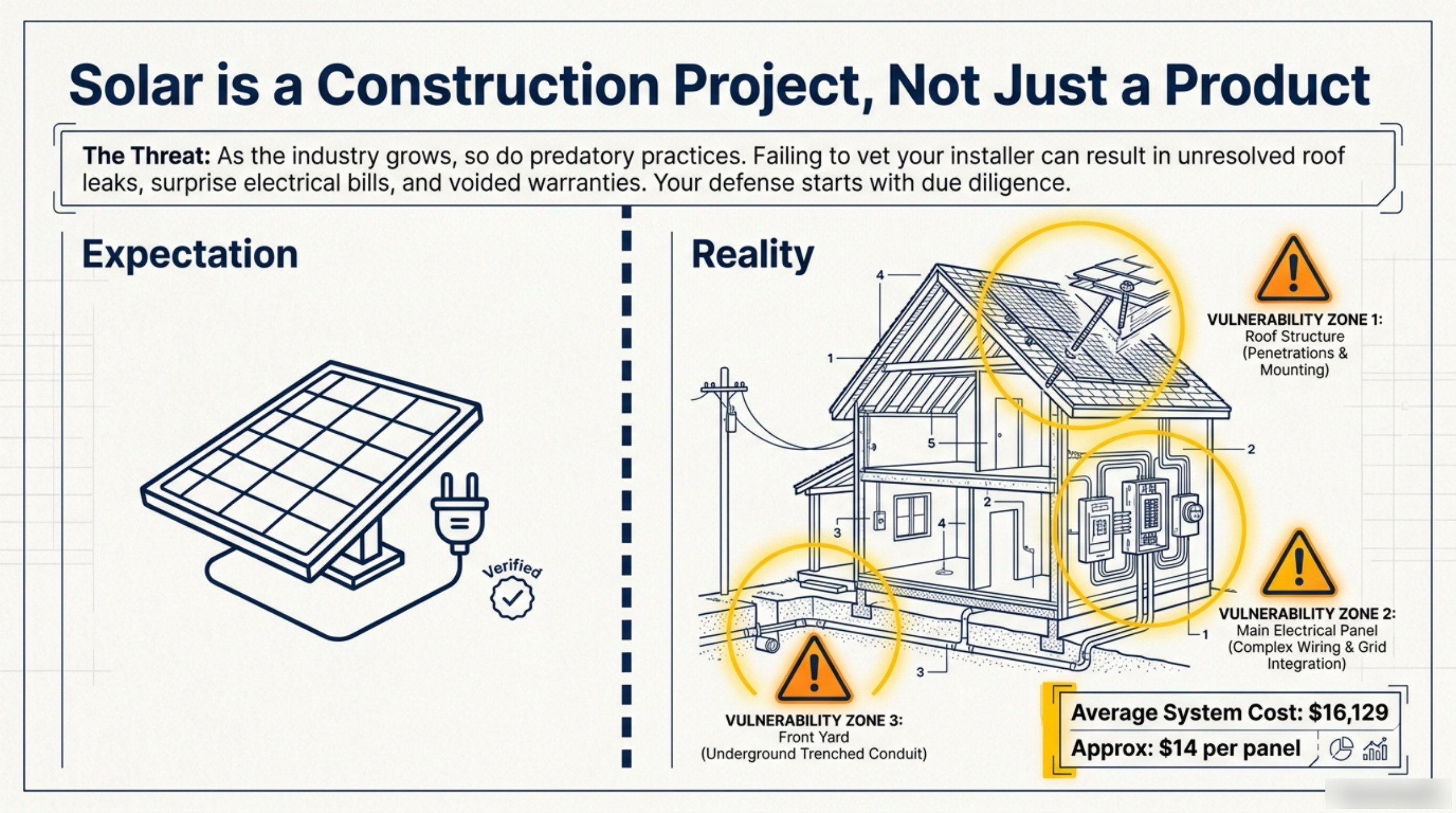
Zone one: the roof structure
The roof is where penetrations and mounting hardware meet the shingles, the underlayment and the framing below. A solar mount is a small roof penetration repeated a few dozen times, and each one is a potential leak path if the flashing is improvised or the fasteners miss the rafters.
The failure mode is slow. Water that enters at a mounting foot may not show up inside the house until the next monsoon season or the following spring thaw, by which point the original crew has been paid and the trail has cooled. This is the single strongest argument for reading the workmanship warranty before signing: the roof is where you are most likely to need it.
Zone two: the main electrical panel
The panel is where the array meets the grid, and it is the zone most often underestimated by homeowners because it is indoors and invisible from the driveway. Complex wiring and grid integration happen here, and a panel that is already close to capacity may need upgrading before a solar circuit can be added at all.
Two problems arise. The first is capacity: an inspector can reject a system whose panel cannot safely carry the added circuit, and the remedy is a panel upgrade the original quote may not have included. The second is documentation: a poorly labelled panel makes every future electrical job in the house harder and more expensive, including the one you might sell the home with.
Ask for the panel work in writing, with the capacity calculation, rather than a verbal assurance that the panel is fine.
Zone three: the front yard
The conduit run to the meter is the zone homeowners forget entirely, because it disappears within a day of being installed. Underground trenching crosses landscaping, irrigation lines, driveways and sometimes utility easements, and once the trench is backfilled nobody can see whether the conduit was laid to the correct depth or protected properly.
Because it is unrepeatable, this zone needs to be documented before it is covered. Photographs of the open trench, the specified conduit type and the depth should all exist in the project file. A contractor who cannot show you that detail on request is asking you to take the most buried part of the job on faith.
| Zone | What can go wrong | The question that exposes it | When to ask |
|---|---|---|---|
| Roof structure | Leaks at penetrations; fasteners missing framing | How are the mounting feet flashed, and does the warranty cover them? | Before signing |
| Main electrical panel | Insufficient capacity; rejected inspection; poor labelling | What is my panel's spare capacity, and is an upgrade in the price? | Before signing, after the site inspection |
| Front-yard conduit | Shallow or unprotected conduit; damaged irrigation or paving | What depth and conduit specification, and will you photograph the open trench? | Before the trench is backfilled |
Why the zones explain the price gap between quotes
Two quotes for the same nominal system size can differ by thousands of dollars, and the difference is rarely the panels. Modules are a commodity line item. The variability lives in the zone work: how the penetrations are sealed, whether the panel is upgraded or merely tapped, and how much trenching the yard requires.
That is also why a quote assembled from a satellite image is worth less than it appears. Roof geometry can be estimated remotely, but panel capacity, attic framing and the path of a conduit run cannot. A price built without a site visit has to be padded or vague, and vague is how homeowners end up paying for zone work that was never in the original figure.
Call (928) 698-6192 for free, no-obligation quotes from pre-vetted Flagstaff solar professionals. You can also run your own numbers in our Flagstaff solar calculators.
Frequently asked questions
Do all three zones apply to every Flagstaff home?
Every installation touches the roof and the panel. The front-yard zone depends on where the meter sits relative to the array. A home with the meter on a garage wall next to the roof may need very little trenching, while a property with a long driveway run needs considerably more.
How do I know whether my electrical panel needs upgrading?
That is a site-inspection answer, not a phone answer. The crew needs to see the panel, its rating and its spare breaker capacity, and the resulting calculation should appear in the written scope. Treat a phone estimate of panel capacity as provisional.
What if the roof is older and may need replacing soon?
Then the sequencing question comes first. Mounting hardware should not be installed on a roof that is close to the end of its service life, because removing and reinstalling an array to re-roof is expensive. The deck treats an unsolicited roof-replacement demand as a separate issue that deserves a second, independent opinion.