By the time a solar quote arrives, the question most homeowners ask is what equipment is specified. The deck argues for a second question that is harder to answer and more consequential: who will actually be on the roof? The two arrangements that dominate residential work behave very differently when something goes wrong.
An in-house crew is employed by the company that sold you the system. A subcontractor is a separate business engaged to do part or all of the work. Both arrangements exist throughout the industry, and both can produce good installations, but they distribute responsibility differently, and that difference shows up years later.
The deck frames the comparison as a roof test: not which crew is cheaper on paper, but which one you can hold accountable when the roof leaks.
Unified accountability versus the blame loop
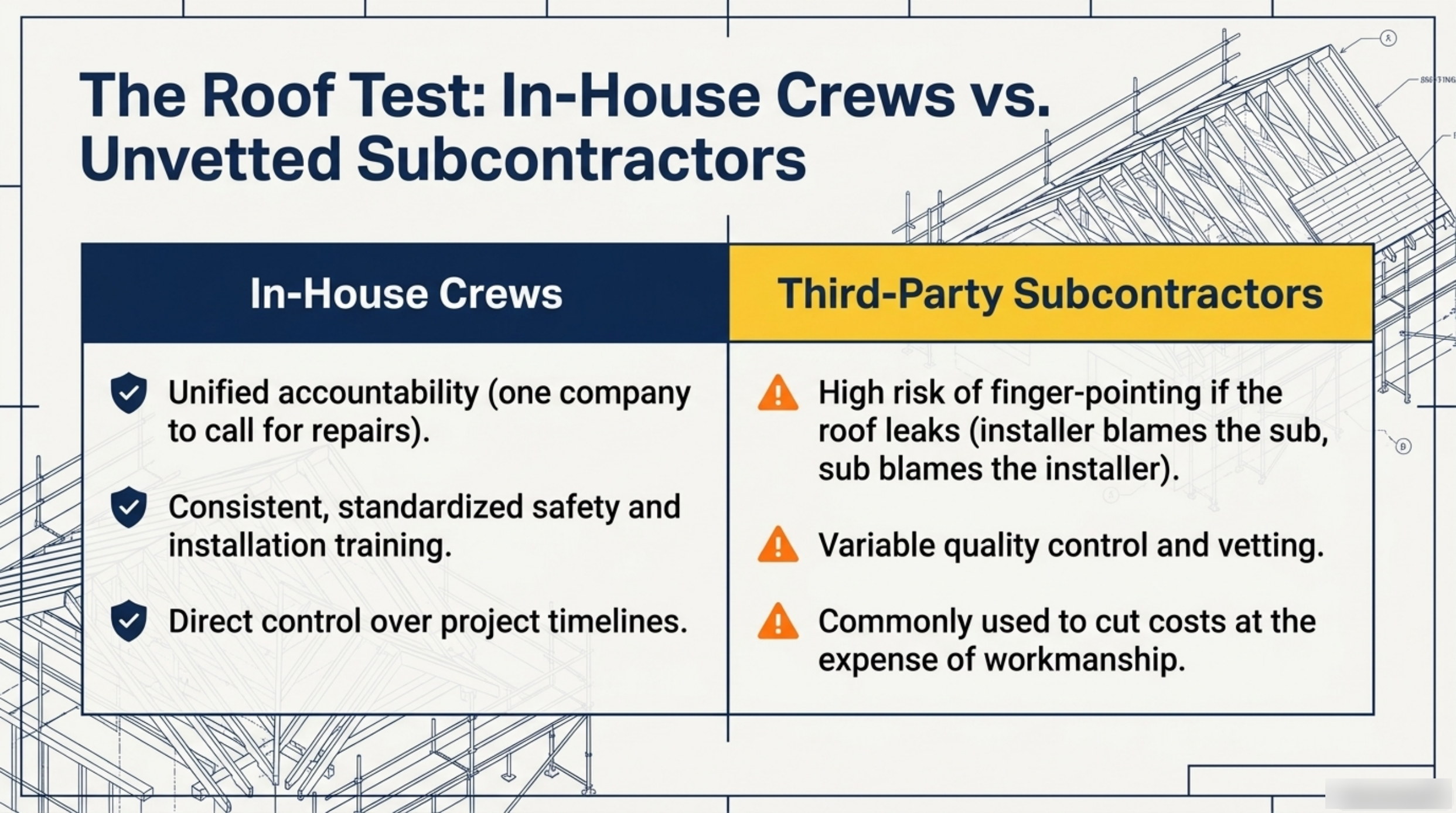
The deck's first contrast is the decisive one. An in-house crew provides unified accountability, which in plain terms means one company to call for repairs. A subcontractor arrangement creates a high risk of finger-pointing if the roof leaks, with the installer blaming the subcontractor and the subcontractor blaming the installer.
That loop is expensive for a homeowner because it consumes time and leaves the repair unpaid while two businesses dispute responsibility. Warranty language can close part of the gap, but only if the contract names who is responsible for what work, and most residential agreements do not.
The practical test is to ask, in writing, whether the company will use its own employees on the roof and on the electrical work. If the answer is qualified, ask who the subcontractor is and whether that firm carries its own liability and workers' compensation cover.
Consistent training versus variable vetting
The second contrast concerns standards. In-house crews receive consistent, standardised safety and installation training, because the employer manages the training programme and applies it across every job. Subcontractors bring their own practices, which means quality control varies from crew to crew and job to job.
On a roof, variation is not a philosophical problem. Flashing details, fastener placement and sealing practice are the specific techniques that determine whether a penetration stays watertight through a Flagstaff freeze-thaw season. A standard that is applied consistently across a company's jobs tends to be better documented and easier to enforce than a practice that is renegotiated with each subcontractor.
| Dimension | In-house crew | Third-party subcontractor |
|---|---|---|
| Accountability if something fails | One company to call for repairs | High risk of finger-pointing between installer and sub |
| Training | Consistent, standardised safety and installation training | Variable quality control and vetting |
| Timeline | Direct control over project scheduling | Dependent on the sub's other commitments |
| Cost pressure | Higher direct labour cost built into the price | Commonly used to cut costs, at the expense of workmanship |
Timeline control and the hidden cost of subcontracting
The third contrast is schedule. A company working with its own crews has direct control over project timelines, because it controls the labour. Where subcontractors are involved, the schedule depends on the sub's commitments elsewhere, and a solar installation that floats between jobs can stretch from days into weeks.
That has a specific local dimension. Roof work in and around Flagstaff is weather-sensitive, and a delay that pushes an installation into a snow period creates new problems: cold-weather sealing, site access and the risk of water intrusion through partially completed penetrations.
The deck is also explicit about the commercial motive on the other side. Subcontracting is commonly used to cut costs at the expense of workmanship. That is not an accusation about any particular company; it is an explanation of why a lower quote sometimes is lower. Labour is the flexible line in a construction budget, and a price that undercuts the field is often undercutting the training and consistency that protect your roof.
What to ask before you sign
Three questions settle the matter. First, will the roof work and the electrical work be performed by your own employees? Second, if any part is subcontracted, who is the subcontractor and what credentials and insurance do they carry? Third, which company's name appears on the workmanship warranty and who answers the phone when a repair is needed?
A company that answers all three directly, in writing, is behaving like an employer rather than a broker. That is the behaviour the roof test is designed to detect.
Call (928) 698-6192 for free, no-obligation quotes from pre-vetted Flagstaff solar professionals. You can also run your own numbers in our Flagstaff solar calculators.
Frequently asked questions
Is a subcontractor always a bad sign?
Not always. Specialists are sometimes engaged for tasks such as trenching or panel upgrades. What matters is disclosure and coverage: you should know who is doing the work and be able to confirm that the firm carries its own insurance and is accountable to the company that holds your contract.
Does an in-house crew cost more?
A company employing its own crews carries training and labour costs directly, which appears in its price. The comparison to make is against the lifetime cost of disputed repairs and variable workmanship rather than against the lowest number in the inbox.
How do I confirm whether the crew is in-house?
Ask in writing before signing, and look at who arrives on the day. Uniforms and branded vehicles are weak evidence; the contract naming the contractor of record for the work, and the workmanship warranty naming the same company, is stronger.