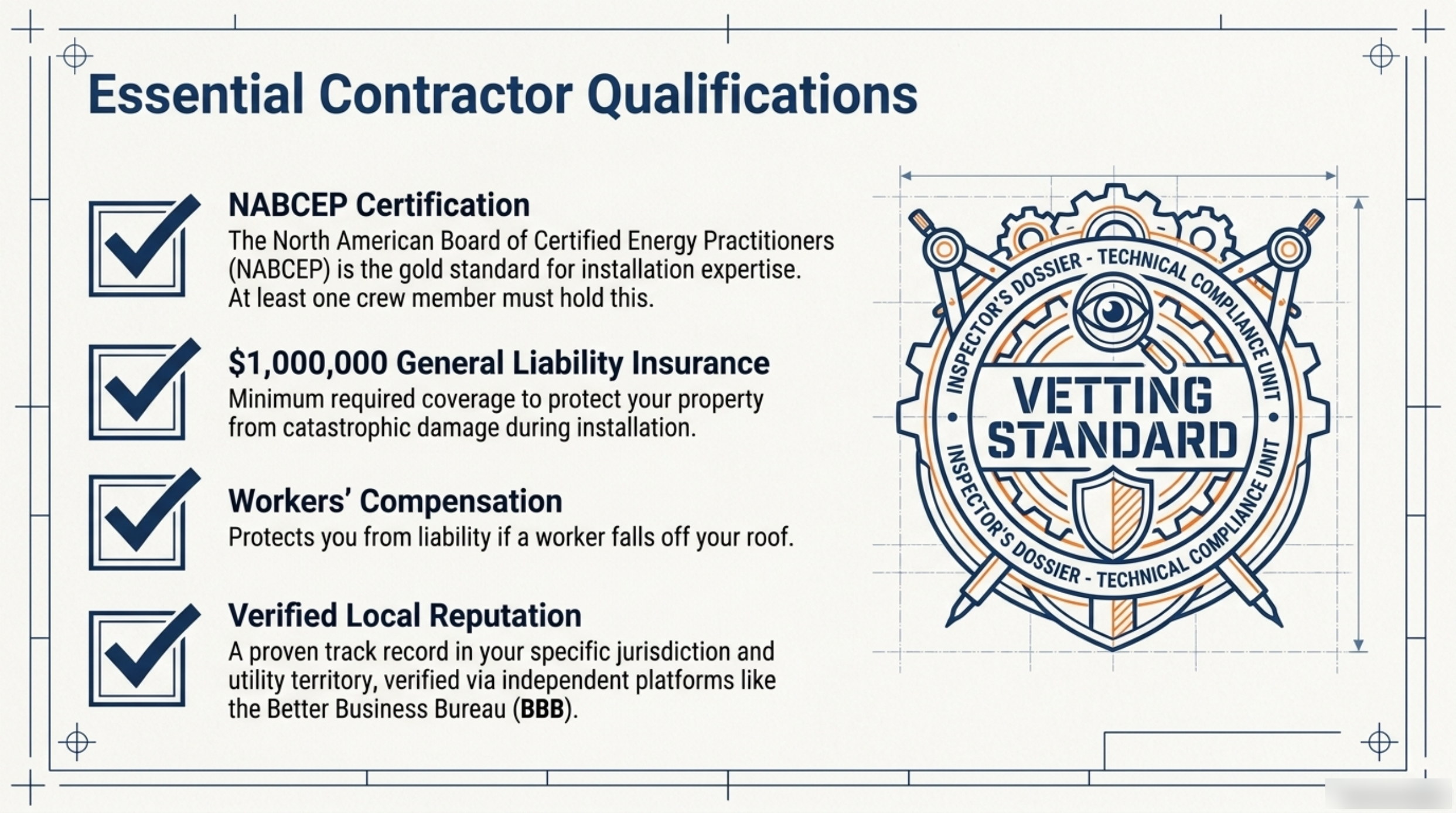
Every vetting conversation eventually narrows to a small set of documents. The deck's vetting standard lists four, and each one answers a different question about how the risk of a construction project is distributed between the homeowner and the installer. Presented together, they form a checklist you can work through in a single sitting.
The four are certification of installation expertise, one million dollars of general liability insurance, workers' compensation cover, and a verified local reputation. None of them is exotic and none should be difficult for an established company to produce. That is the point: a contractor that already operates properly has these documents to hand, and the absence of one is a signal rather than an oversight.
What follows is what each item does, and how to read it.
Certification: expertise you can trace
Installation quality depends on training, and training in this trade is formalised through industry certification. The deck's standard requires that at least one crew member holds a recognised certification from an established industry body, which it treats as the benchmark for installation expertise.
The wording matters. It asks that the crew contains certified expertise, not that a certificate be displayed by a sales office. Ask which member of the crew on your roof holds the credential, and ask to see it. A company that cannot name the person is describing a marketing asset rather than a capability.
Certification does not guarantee a flawless installation. It does establish that the person directing the work has been assessed against a published standard rather than trained entirely on your roof.
General liability insurance: one million dollars of cover
The deck sets the minimum at one million dollars of general liability insurance, describing it as the coverage required to protect your property from catastrophic damage during installation. The exposure it addresses is concrete: a lift or a crew member damaging roofing, siding, windows or a vehicle.
Ask for the certificate of insurance rather than the word insured, and read three things on it. The policy limit should meet or exceed one million dollars. The policy period must be current, not expired. And the named insured on the certificate should be the company you are contracting with, which is worth checking if the brand on the quote sheet differs from the legal entity on the paperwork.
| Document | The risk it transfers | How to verify it |
|---|---|---|
| Industry certification | Untrained installation workmanship | Name the crew member who holds it, and see the certificate |
| General liability, $1,000,000 | Catastrophic property damage during the work | Current certificate of insurance, limit and named insured checked |
| Workers' compensation | Injury to workers on your property | Certificate or state coverage record, current for the work period |
| Verified local reputation | An installer who disappears after payment | Independent reputation platforms and local references in this county |
Workers' compensation: the one homeowners overlook
Workers' compensation is the least glamorous of the four and the one most often skipped. The deck's description is blunt about why it belongs on the list: it protects the homeowner from liability if a worker falls off your roof.
Without coverage, an injury on your property can become your exposure under Arizona law, and a single serious fall can exceed the value of the entire system. This is not a hypothetical. Roof work is among the highest-risk activities in residential construction, and the physics are unforgiving in winter conditions.
Ask for the workers' compensation certificate in the same request as the liability certificate. A company that carries one and not the other is unusual, and the gap is worth understanding before work begins.
Verified local reputation: the jurisdiction test
The fourth item is a proven track record in your specific jurisdiction and utility territory, verified through independent reputation platforms rather than the company's own testimonials. In practice that means a history of installations in Coconino County, work interconnected with APS, and a public record long enough for problems to have surfaced.
Local reputation is the document that cannot be purchased at the last minute. Review profiles, ask for references from the same county, and notice whether the company has been operating here long enough to have replaced a failed inverter under warranty. A firm with a decade in this market has a different stake in doing the job properly than one assembled around an advertising campaign.
Call (928) 698-6192 for free, no-obligation quotes from pre-vetted Flagstaff solar professionals. You can also run your own numbers in our Flagstaff solar calculators.
Frequently asked questions
How much insurance should a solar contractor carry?
The deck's minimum is one million dollars of general liability, described as the level needed to protect your property from catastrophic damage during installation. Read the certificate for the limit, the current policy period and the named insured rather than accepting a verbal confirmation.
Why does workers' compensation matter if I have homeowners insurance?
Because an uninsured injury on your property can become your liability, and roofing is a high-risk activity. Workers' compensation cover addresses that exposure directly. It is one of the four items in the vetting standard and should be requested alongside the liability certificate.
What if the company is new but otherwise well qualified?
A short local history is a genuine risk factor, since verified local reputation is one of the four documents. A newer firm can compensate by allowing a thorough inspection of the other three items and by providing references from any nearby installations it has completed.