The Era of Solar-Only Is Over: Security, Economics and Future-Proofing
A solar array without storage is a generator with nowhere to put its output. That is the closing argument of the Blueprint for Energy Independence deck, and it is a statement about architecture rather than about product preference. Solar is the generator; the battery is the foundation. Once you accept that framing, the question stops being whether to add storage and becomes how to sequence a project so the foundation is right the first time.
This closing article does two things. It restates the three arguments the deck makes for storage, and then it lays out the process a Flagstaff homeowner can actually follow, from the first utility bill review to the twelve-month check that proves the system is doing what it was sold to do.
The short version
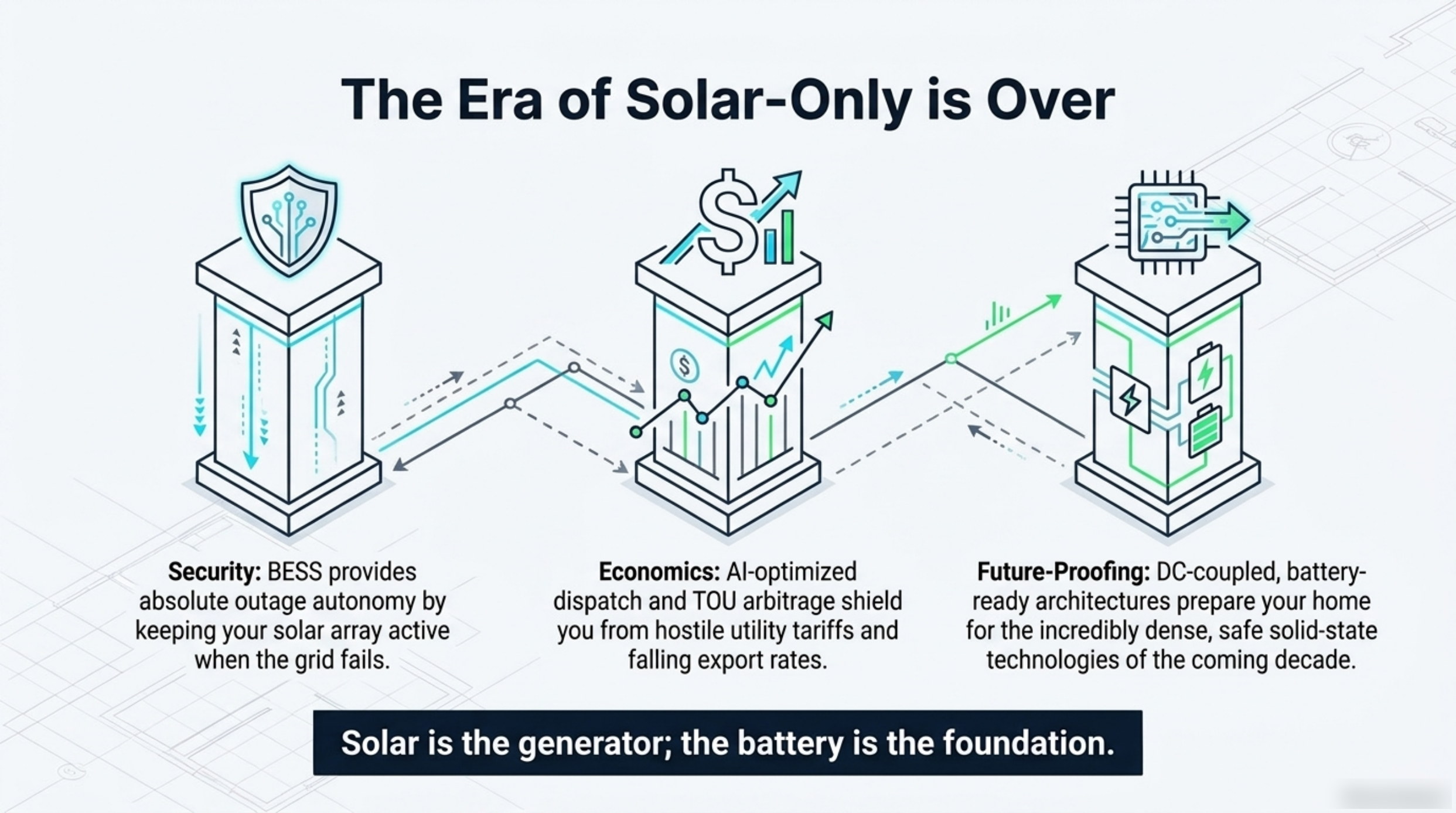
- Security: storage provides absolute outage autonomy by keeping the solar array active when the grid fails.
- Economics: AI-optimised dispatch and time-of-use arbitrage shield you from hostile utility tariffs and falling export rates.
- Future-proofing: direct-current coupled, battery-ready architecture prepares the home for the dense, safe solid-state technologies of the coming decade.
- The process is the same in every case: measure the load, design the architecture, size the storage, commission it, then verify it against real bills.
- Doing the architecture once, on purpose, is the difference between a system you extend and a system you replace.
Pillar One: Outage Autonomy
The deck's security argument is specific. Storage provides absolute outage autonomy by keeping the solar array active when the grid fails. That detail is the whole point. A grid-tied array without a battery is required to shut itself down during an outage, which means the most productive asset on your roof is switched off at precisely the moment you would value it most.
Flagstaff winters make that scenario concrete. Storms, heavy snow loading, and high-country grid stress have all produced multi-day interruptions, and an outage during a cold snap is a different problem from an outage in July. With storage in place, the array keeps generating, the battery buffers the difference between production and load, and the critical circuits stay live. Autonomy is not a comfort feature in this climate. It is the difference between a difficult week and an unlivable one.
Pillar Two: Economics
The deck's economic argument has two halves, and both respond to forces outside your control. AI-optimised dispatch and time-of-use arbitrage shield you from hostile utility tariffs and falling export rates. Hostile is a strong word for a tariff, but the direction of travel in APS territory justifies it: compensation for exported solar has been moving toward avoided-cost style credits, while evening hours remain the most expensive hours to buy power.
Storage inserts a controllable asset between your production and your consumption. Instead of exporting midday solar for a small credit and buying evening power at a premium, the system keeps the midday energy and spends it in the expensive window. The tariff still applies to you, but it applies to a much smaller number of kilowatt-hours. That is the whole mechanism, and it explains why dispatch intelligence matters: an inverter that decides hour by hour how to move energy is what makes the arbitrage repeatable rather than occasional.
Pillar Three: Future-Proofing
The third argument is the one most homeowners underweight. Direct-current coupled, battery-ready architecture prepares the home for the dense, safe solid-state technologies of the coming decade. Solid-state cells are projected at 400-500+ Wh/kg against 150-200 Wh/kg for today's lithium iron phosphate units, with residential availability expected in the mid-2030s. When that arrives, the homes that benefit are the ones whose electrical architecture can accept it without being rebuilt.
Future-proofing is therefore not a software promise. It is a wiring and inverter specification made at the time of the original installation. Direct-current coupling at the system level, a hybrid inverter capable of battery operation, and physical space reserved for a future unit are the three components of it. Each one costs little when specified up front and considerably more when added later, because later means repricing the inverter, the conduit, the permitting and the labour on top of the battery.
The Process: How a Flagstaff Project Actually Sequences
The three pillars are arguments. The process is what converts them into a system. The deck's material supports a clear sequence, and each step has a deliverable you can hold an installer to.
| Step | What happens | Deliverable to ask for |
|---|---|---|
| 1. Measure | Review twelve months of interval usage and identify the evening load between 7 PM and midnight | A written load profile, not an estimate from a satellite image |
| 2. Design the architecture | Specify a hybrid inverter and direct-current coupled battery connection, with space reserved for storage | A one-line electrical diagram showing how a battery connects later |
| 3. Choose the scope | Decide critical-load sub-panel backup or a larger system, and size capacity to the goal | An itemised quote naming the circuits being protected |
| 4. Permit and interconnect | Local permitting and utility interconnection approval for the array and the storage | Confirmation of who files what, and what the fees cover |
| 5. Commission and monitor | Commissioning, monitoring setup, and operating parameters such as state of charge and core temperature | Monitoring access, warranty documents and the labour policy |
| 6. Verify | Compare the first bills against the projected savings and adjust the dispatch settings | A review conversation in the first year, not only at the sale |
Steps one and two are where the value is created, and they are also the two steps most often skipped. A design produced from a satellite image without your usage data cannot size evening capacity honestly. A design that chooses a string inverter to save a few hundred dollars forecloses the storage option you will probably want in two years. Both are cheap to get right and expensive to correct.
What Changes After the First Year
Once the system is commissioned, the character of ownership changes. The battery management system handles thermal management and cell balancing on its own, the inverter dispatches energy according to your rate plan, and your involvement drops to reviewing data. That is when the three pillars become measurable rather than theoretical: outage autonomy is proven by the first grid interruption, the economics are proven by the usage section of your utility bill, and future-proofing is proven by nothing at all until the day you decide to add capacity.
The one habit worth keeping is the annual review. Tariffs change, export compensation changes, and household load changes. Re-sizing a battery-ready system is a straightforward exercise; re-sizing a system that was never designed for storage is a project.
If you want the arithmetic in advance, start with the storage and savings calculators in our tools hub, and read the companion pieces on why grid-tied solar shuts down during an outage and how battery chemistry is evolving so you know what you are building toward. When you are ready for an itemised, written comparison from licensed, insured Arizona installers, call (928) 698-6192 or request quotes through our matching service. No cost, no obligation, and every step of the process above in writing.
Frequently Asked Questions
Is solar still worth it without a battery?
Yes, the array pays for itself on daytime self-consumption, but it leaves value on the table. Without storage, midday surplus is exported at a low credit under net-billing terms and evening load is bought at peak pricing. That is exactly why the deck argues for battery-ready design at the time of the original installation.
How long does a solar-plus-storage project take?
The sequence above typically spans a design and permitting phase followed by installation and utility interconnection, with the first usage review about a year after commissioning. Ask your installer for the expected milestones at each step: design, permit submission, installation, inspection, interconnection approval and monitoring handover.
What single decision matters most?
The architecture decision. Choosing a hybrid inverter and a direct-current coupled battery connection at the start keeps outage backup, evening arbitrage and future battery upgrades all available to you. Choosing a system that cannot accept a battery closes those doors and turns every later addition into a retrofit. Everything else can be adjusted over time; that one cannot.