The Homeowner's Decision Tree: Outage Security, Rate Beating, or Waiting for Solid-State?
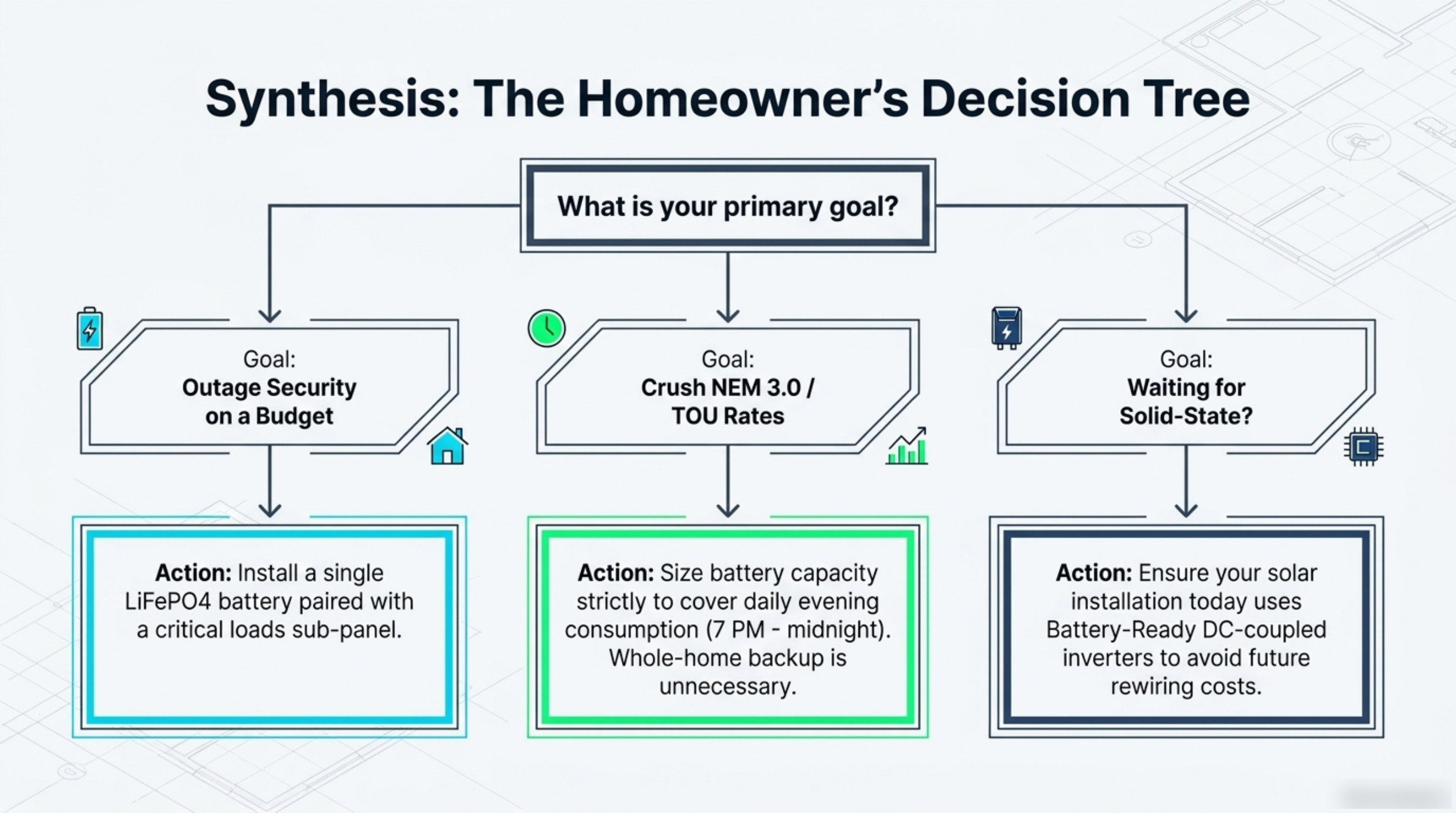
Most storage advice fails because it answers a question the homeowner has not asked. Deciding what battery to buy starts with one sentence about what you actually want the system to do. The Blueprint for Energy Independence deck closes with a decision tree that branches on exactly that sentence: what is your primary goal?
The deck offers three answers, and each one leads to a different action and a different budget. This article walks the tree in the order a Flagstaff homeowner should, covering what each goal really requires, what each one does not require, and how to avoid paying for capability you will never use.
The short version
- Goal one, outage security on a budget: install a single lithium iron phosphate battery paired with a critical loads sub-panel. Whole-home backup is unnecessary.
- Goal two, beating evening peak rates: size battery capacity strictly to cover daily evening consumption, roughly 7 PM to midnight.
- Goal three, waiting for solid-state: make sure today's installation uses battery-ready direct-current coupled inverters to avoid future rewiring costs.
- The three goals are not mutually exclusive, but the primary one sets the size, the switchgear and the budget.
- You do not need to predict the future of battery chemistry to make a good decision this year.
Start With the Sentence, Not the Spec Sheet
Ask yourself what you want to be true on the worst day of the year, and on the most expensive evening of the year. If the answer is "the lights stay on when the grid does not", your priority is autonomy. If the answer is "my evening bill stops being the biggest line on the statement", your priority is arbitrage. If the answer is "I want the best batteries, and I will wait for them", your priority is optionality, and it produces the least expensive action of the three.
Branch One: Outage Security on a Budget
The deck's action for this branch is short and firm: install a single lithium iron phosphate battery paired with a critical loads sub-panel, and accept that whole-home backup is unnecessary. The reasoning is about what outage protection actually requires. During a multi-day winter outage, the loads that matter are the furnace controls, refrigeration, well or circulation pumps, internet and a handful of lights. Those are circuits you can enumerate, and they can be moved onto a dedicated sub-panel.
Whole-home backup is a different product with a different price. On the deck's sizing slide, whole-home backup sits in the $30,000-plus range and typically requires multiple batteries, because it has to survive the startup surge of a compressor or an electric vehicle charger on top of normal household load. Critical-load backup sits in the $15,000 range with a single battery. If your goal is security rather than convenience, the second number buys the outcome you asked for.
The honest trade is that a critical-load panel requires discipline. The circuits on it need to be chosen, and the ones left off it will be off during an outage. That is a one-time design conversation, and it is the price of the lower cost structure. For a full treatment of autonomy and what the array can do while the grid is down, our article on why grid-tied solar shuts down during an outage explains the safety mechanism involved.
| Primary goal | Deck's action | What you are deliberately not buying |
|---|---|---|
| Outage security on a budget | One LiFePO4 battery plus a critical loads sub-panel | Whole-home backup and its multiple-battery cost |
| Beating evening peak rates | Capacity sized strictly to daily evening consumption, about 7 PM to midnight | Nameplate capacity beyond what the evening window can use |
| Waiting for solid-state | Battery-ready, direct-current coupled inverters installed today | Any battery hardware at all, until you decide to add it |
Branch Two: Beating Evening Peak Rates
If your primary goal is the bill rather than the outage, the deck's action is precise: size battery capacity strictly to cover daily evening consumption, between roughly 7 PM and midnight. Strictly is the operative word. Storage earns its keep by covering the hours when imported power is most expensive, and once that window is covered, additional capacity has no expensive hour left to serve.
That is why oversized batteries are a poor deal on purpose. Energy you cannot deploy into a peak-priced hour has no arbitrage value, and energy exported back to the grid under net-billing terms earns a low credit rather than the premium you avoided. The efficient design is a battery that empties at about the time the peak ends, refills from midday solar the next day, and repeats. If you want the mechanics of that cycle in detail, the article on beating evening peak rates with time-of-use arbitrage walks through the daily chart.
Two practical notes belong here. First, size from measured data rather than assumption: twelve months of interval usage tells you what your evening load actually is, and winter evenings behave nothing like summer ones in a Flagstaff home. Second, take the whole-home versus critical-load decision separately from capacity sizing. The first decides which circuits are protected; the second decides how long they are protected.
Branch Three: Waiting for Solid-State
The third branch is the most misunderstood, because the action is not to wait. The deck's instruction for a homeowner waiting for solid-state is to ensure today's solar installation uses battery-ready direct-current coupled inverters, so future rewiring costs are avoided. In other words, the way to prepare for a battery you cannot buy yet is to make the electrical architecture ready for it now.
Residential solid-state availability is expected in the mid-2030s, which is a long time to leave an array without storage. But the cost of being ready is modest if it is part of the original installation: the inverter and the direct-current coupling have to be specified correctly, and the physical location for a future unit has to be left available. Retrofit it later and you are repricing the inverter, the wiring, the permitting and the labour on top of the battery.
Crossing the Branches Without Overbuilding
The three goals can combine, and the elegant way to combine them is by sequence rather than by size. Lead with a battery-ready architecture, because it is the cheapest decision and it keeps every option open. Choose critical-load backup if autonomy is what you want, since it delivers the outcome at the lower cost point. Add evening-sized capacity if the bill is the driver, because that is what the arbitrage math rewards.
The one thing to avoid is buying outward capability to hedge a decision you have not made: a system sized for every possible goal costs like every possible goal. Your installer can size from a one-sentence answer about the worst day and the most expensive evening.
The storage sizing and savings calculators in our tools hub help you check the numbers before a sales visit, and our matching service connects you with licensed, insured Arizona installers who will put the scope in writing. Call (928) 698-6192 for a free, no-obligation comparison.
Frequently Asked Questions
What if I want all three things eventually?
Sequence them. Start with battery-ready direct-current coupled architecture, because it is the enabling decision and the least expensive. Then add storage sized to your evening window, and configure the backup circuits you actually need on a critical-load panel. That route reaches all three goals without paying for a whole-home system you never intended to run.
Is critical-load backup genuinely enough protection?
For most families, yes. The circuits that matter during an outage are enumerable: heating controls, refrigeration, connectivity, a few lights and any pump the property depends on. A critical-load sub-panel covers exactly those, at close to half the cost of a whole-home system that also has to survive compressor and vehicle-charging surges.
How do I know whether waiting for solid-state makes sense for me?
Compare what you would spend on storage now against the value you would forgo by not having it. If your evening imports are modest and your outage risk is low, battery-ready architecture plus patience is defensible. If your evening bill is large, the arbitrage savings over the years before solid-state arrives are likely to exceed any benefit from waiting.