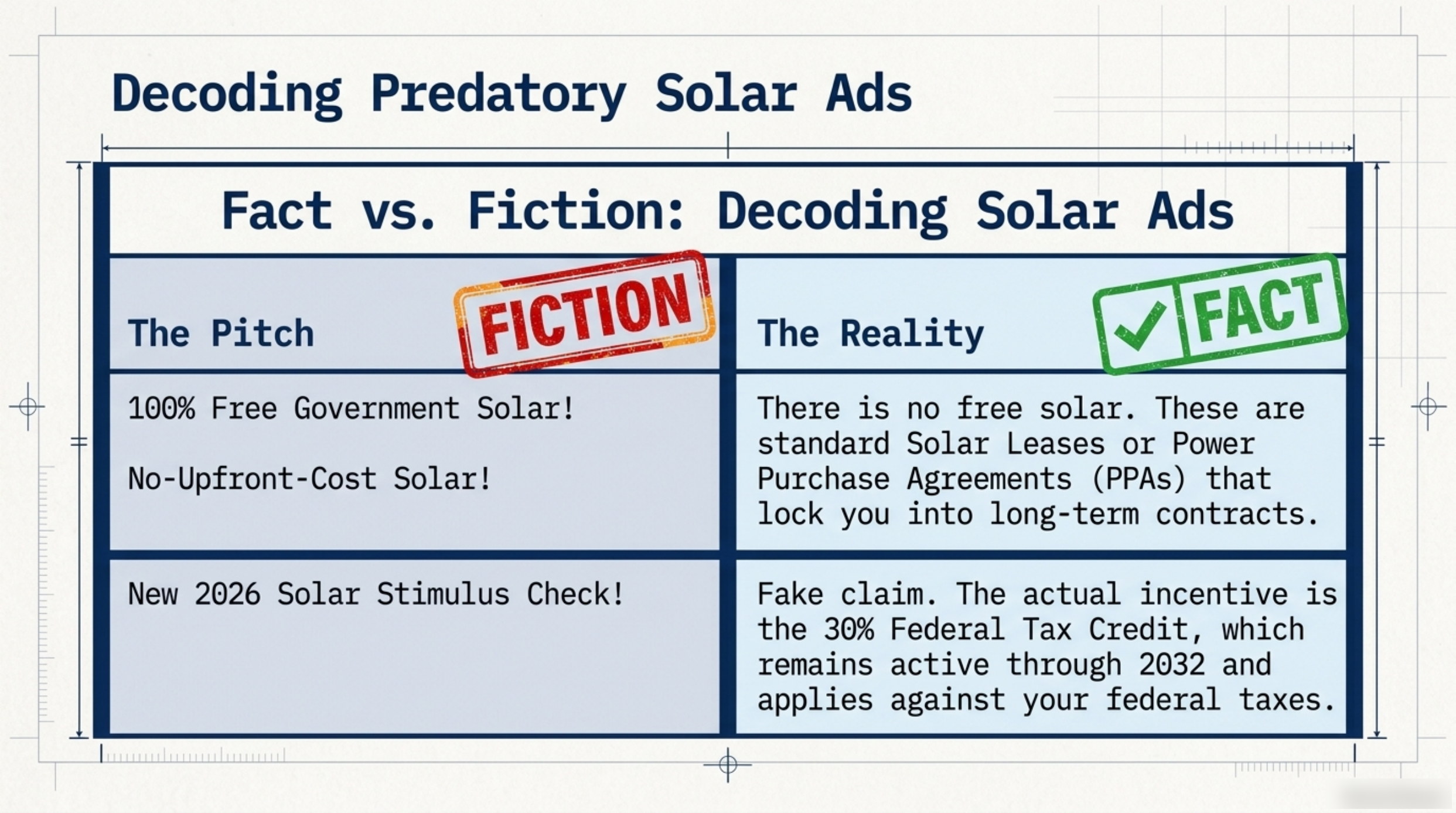
Advertising is where the solar industry's worst claims live, because an advertisement does not have to survive a technical review. The deck opens this section with a fact-versus-fiction table, and the fiction column reads like a set of headlines many Flagstaff homeowners have already seen on a website or in their feed.
The three claims are that solar is free from the government, that there is a no-upfront-cost option which is the same thing, and that a new federal stimulus cheque is available for homeowners who act now. Each is designed to move a homeowner past the two questions that matter: what exactly am I signing, and who pays for it.
The honest version of this subject is shorter and less exciting, which is why it needs stating plainly.
Myth one: 100% free government solar
There is no free solar. The deck is unambiguous on this point, and the mechanism behind the pitch is worth understanding because it is not fraud in itself. A zero-upfront-cost offer is usually a standard solar lease or a power purchase agreement, both of which are long-term contracts.
In a lease you pay a monthly amount for the use of equipment someone else owns. In a power purchase agreement you buy the electricity the system produces at a contracted rate. In both structures the array is delivered without a large upfront payment, and in both you are committed for years, sometimes decades, with escalator clauses and transfer conditions that matter if you sell the house.
Neither structure is inherently bad. Each can be the right answer for a household that cannot use the federal credit or does not want capital tied up. The problem is the word free. A long-term contract with an escalating payment is not free; it is financed in a way that does not look like financing.
Myth two: no-upfront-cost means no cost
The second claim usually appears directly under the first, as if it were a definition. It is a description of the payment schedule, not the total price. Over the term of a lease or agreement, the cumulative payments can exceed the cash price of the same system.
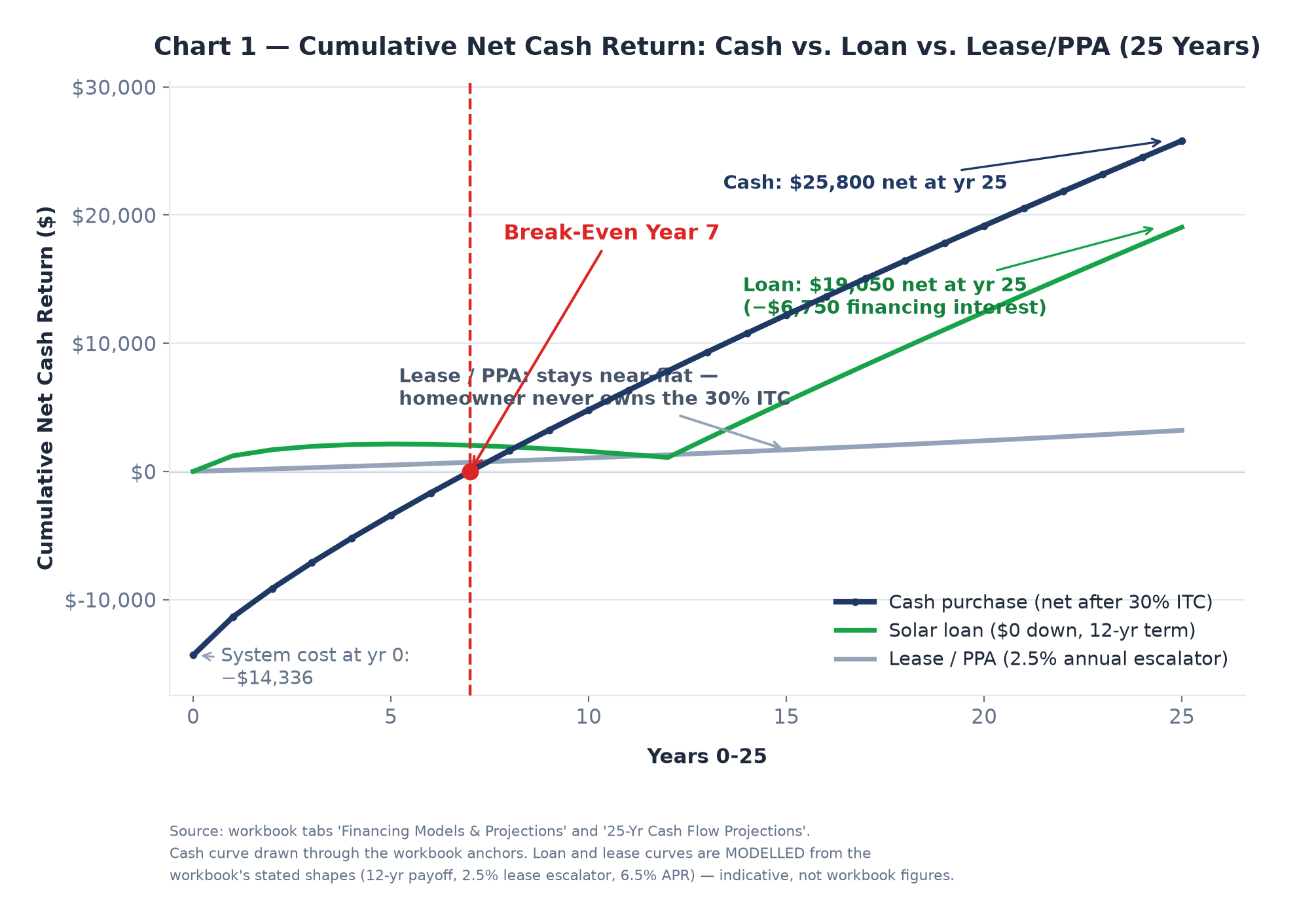
The comparison that matters is cumulative cost of ownership across the contract term, which is exactly the analysis a purchase-versus-lease comparison should make. Ask for the total of all payments over the term, not the monthly figure, and compare it against an owned system net of the tax credit.
Myth three: the 2026 stimulus cheque
The third claim is simply false. The deck labels it a fake claim, and there is no such cheque. What exists is the 30% federal tax credit, which remains active through 2032 and applies against the federal tax you owe.
That distinction matters in three ways. It is a credit rather than a grant, so it reduces a tax liability instead of arriving as a payment. It is claimed on your tax return rather than issued at the point of sale. And if your liability in a given year is smaller than the credit, the excess may carry forward rather than being refunded in cash.
This is also where Arizona-specific framing helps. The federal credit is a federal instrument, not a utility programme, and it is not connected to anything APS offers. A salesperson who presents it as a limited local incentive is misrepresenting a standing federal provision.
| The claim in the ad | What it actually is | What to ask |
|---|---|---|
| "100% free government solar" | A solar lease or power purchase agreement with long-term commitments | Who owns the equipment, and what is the term and escalator? |
| "No-upfront-cost solar" | A payment structure, not a price reduction | What is the total of all payments across the full term? |
| "New 2026 solar stimulus cheque" | Not real. The actual incentive is the 30% federal tax credit | Is this a federal credit claimed on my return, or cash at signing? |
What a truthful offer sounds like
An honest proposal names the structure plainly: cash purchase, loan, lease or agreement. It states the gross system price, the expected credit and the net figure. It separates what the homeowner owns from what the homeowner rents. And it does not need the word free, because the economics of five kilowatts to ten kilowatts of Flagstaff sun are usually strong enough to stand on their own numbers.
When a claim cannot survive being rewritten as a sentence with a subject, a verb and a price, it is a slogan rather than an offer.
Call (928) 698-6192 for free, no-obligation quotes from pre-vetted Flagstaff solar professionals. You can also run your own numbers in our Flagstaff solar calculators.
Frequently asked questions
Is there any government programme that gives free solar panels?
No. The deck states it directly: there is no free solar. Offers described that way resolve to a lease or a power purchase agreement, which are contracts with monthly obligations and defined terms rather than gifts.
How does the 30% federal tax credit actually reach me?
It is claimed against the federal tax you owe when you file, not handed over at the point of sale. The credit remains active through 2032. Because it is a credit rather than cash, your own tax position determines how much you can use in a given year.
Should I ignore leases and agreements entirely?
No. They can be sensible for households that cannot use the credit or prefer to keep capital. The point is to compare the total cost across the term honestly, rather than accepting a no-cost headline that hides the term, the escalator and the ownership question.