LiFePO4 vs Solid-State, Spec by Spec: Safety, Density, Lifespan and Availability
Choosing home storage is easier once you stop comparing marketing language and start comparing four numbers. The Blueprint for Energy Independence deck puts today's lithium iron phosphate chemistry and the emerging solid-state option side by side on exactly four metrics: safety, energy density, lifespan, and availability. Read as a table rather than as a sales pitch, those four lines tell you what you can buy this year, what you are really paying for, and what is still a promise.
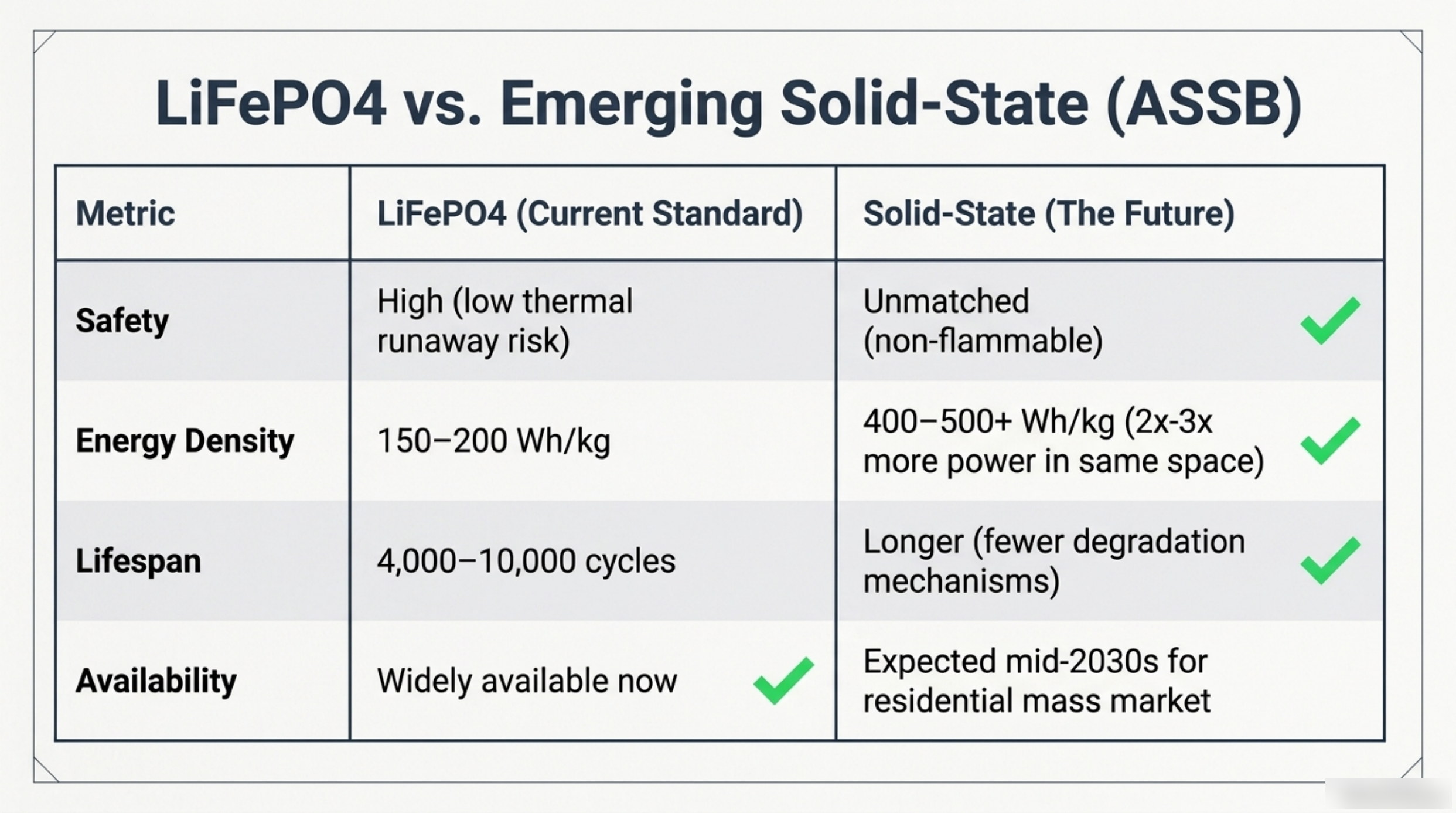
This is the buyer's view of the chemistry question. The table below reproduces the deck's comparison, and the sections after it translate each row into something you can use during a Flagstaff quote review.
The short version
- Safety: today's LiFePO4 is rated high because thermal runaway risk is low; solid-state is expected to be non-flammable outright.
- Energy density: 150-200 Wh/kg today versus 400-500+ Wh/kg projected for solid-state, roughly two to three times more power in the same space.
- Lifespan: 4,000-10,000 cycles for LiFePO4, with solid-state expected to go longer because it has fewer degradation mechanisms.
- Availability: LiFePO4 is widely available now; solid-state is expected in the mid-2030s for the residential mass market.
- Three of those four rows are already good enough to act on. Only the fourth is a reason to design ahead rather than to wait.
The Comparison, Row by Row
| Metric | LiFePO4 (current standard) | Solid-state / ASSB (the future) |
|---|---|---|
| Safety | High, with low thermal runaway risk | Unmatched, described as non-flammable |
| Energy density | 150-200 Wh/kg | 400-500+ Wh/kg, two to three times more power in the same space |
| Lifespan | 4,000-10,000 cycles | Longer, thanks to fewer degradation mechanisms |
| Availability | Widely available now | Expected mid-2030s for the residential mass market |
Row One: Safety Is a Number, Not a Feeling
Both columns score well, which is the point. Lithium iron phosphate earns a high safety rating because its thermal runaway risk is low. Solid-state earns an unmatched rating because the flammable liquid electrolyte is gone altogether, which is what allows the word non-flammable to be used at all. Note that neither row describes a dangerous product. The improvement is real, but it is an improvement on something already rated as good.
For an installation, safety rating translates into placement rules. Clearances, enclosures, thermal management, and distance from sleeping areas and combustibles are all downstream of how the cell behaves under abuse. A chemistry rated high on this row can be installed in a garage, a utility closet, or an exterior wall of a Flagstaff home under standard practice. A chemistry rated non-flammable would relax those rules further, and that is a real benefit in a house where the only available wall is next to the furnace.
Row Two: Energy Density Decides Your Footprint
Energy density is measured in watt-hours per kilogram, and the gap here is the largest on the slide. Today's cells carry 150-200 Wh/kg. Projected solid-state cells carry 400-500+ Wh/kg, which the deck describes as two to three times more power in the same space. Two to three times is not a tweak. It is the difference between a storage bank that consumes a full bay of your garage and one that occupies a cabinet.
Practically, density sets three things in a design: how much wall area the equipment claims, whether a wall can carry the load without reinforcement, and how many units a given location can hold. In Flagstaff homes where the utility space is often shared with a water heater, a furnace, and holiday storage, the dense option is worth planning for even if you cannot buy it yet. A battery-ready layout leaves that physical room available.
Row Three: Cycle Life and What It Means Over 25 Years
Lithium iron phosphate is rated for 4,000 to 10,000 cycles. On a normal residential duty cycle, one full cycle per day is a reasonable approximation, which puts the lower end of that range past a decade of daily use and the upper end well beyond it. Solid-state is expected to last longer still because it has fewer degradation mechanisms, but the row you can act on today already comfortably outlives most financing terms.
Read that row together with the safety row and the value case becomes clear. A battery that cycles daily for a decade or more, and that fails gracefully rather than dramatically, is a durable asset rather than a consumable. The warranty structure that accompanies it, including the ten-year product and performance coverage typical of today's units, is written around that physics.
Row Four: Availability Is the Only Real Constraint
The final row separates the two columns cleanly. Lithium iron phosphate is widely available now. Solid-state is expected for the residential mass market in the mid-2030s. That is a decade-scale gap, not a next-model-year gap, and it decides the strategy for anyone building a system in Flagstaff today.
The decision that follows from the table is simple to state: buy the chemistry that exists, and design the installation so the chemistry that does not exist yet is a drop-in. A hybrid inverter and a direct-current coupled battery connection are what make that possible. A system without them turns a future cell upgrade into a full rewiring project, which is the one avoidable cost the comparison is warning you about.
Frequently Asked Questions
Will a current battery be obsolete before solid-state arrives?
No. Availability for the residential mass market is expected in the mid-2030s, and a lithium iron phosphate unit installed today is rated for 4,000 to 10,000 cycles, which covers a full daily duty cycle for well past that horizon. The realistic scenario is that your first battery serves its warranty life and the second one is the different chemistry.
Does higher energy density mean a cheaper system?
Not automatically. Density changes how much space the same capacity occupies, which is a placement and weight benefit rather than a price promise. Cost still depends on capacity, the inverter, the labour, and the electrical work involved. What density does affect is whether a battery fits where you want it, which sometimes decides whether the project is feasible at all.
What should I ask an installer to show me?
Ask for the cell chemistry in writing, the energy density of the specific unit quoted, its cycle rating, and whether the inverter and battery connection are battery-ready and direct-current coupled. Those four answers map directly onto the four rows of this comparison, and a licensed Flagstaff installer should be able to provide all of them without hesitation.
To compare quoted systems against each other with the numbers in hand, work through the storage sizing and knowledge tools in our tools hub, or talk it through with a licensed local professional: call (928) 698-6192 for a written, no-obligation estimate.