AI Inverters and the Virtual Power Plant Economy: Getting Paid for Your Battery
A home battery can do more than shift your own solar power into your own evening load. It can be paid work. The Blueprint for Energy Independence deck introduces two ideas that turn storage from a defensive purchase into an income line: inverters that decide what to do with your energy hour by hour, and virtual power plants that pay you for access to the battery when the grid needs it.
Taken separately, each is useful. Taken together, they change the arithmetic on the whole system, because revenue from the battery shortens the payback period on the battery itself. This article covers how the dispatch logic works, what a virtual power plant actually pays for, what the numbers look like in active markets, and how to ask the right questions before you enrol.
The short version
- Modern hybrid inverters use machine-learning dispatch to decide hour by hour whether to store, consume, or export energy.
- Inputs include grid conditions, weather forecasts, time-of-use rates and your own home load profile.
- In a virtual power plant, your utility pays you for access to your battery during periods of grid strain.
- In active markets that access yields $200-$1,000 per year, which meaningfully shortens the battery's payback period.
- The dispatch logic should be tied to your rate plan and your habits, not to a single fixed schedule.
The Brains: What an AI Inverter Is Actually Doing
The deck describes the modern hybrid inverter as the brain of the system, and the description is literal. It is a small computer with a power-electronics front end, and its job is to answer one question every hour: should this kilowatt-hour be stored, consumed on site, or exported?
The slide lists four inputs the dispatch engine draws on, and each one closes a different way of being wrong.
| Input the inverter reads | What it learns | Why it matters |
|---|---|---|
| Grid hub | Current grid conditions | Sets whether export is useful or wasteful |
| Weather forecasts | Expected production tomorrow | Sets how much reserve to hold overnight |
| Time-of-use rates | What each hour is worth | Sets the price of being wrong |
| Home load profile | What the house will actually draw | Stops exports of power the house needs in twenty minutes |
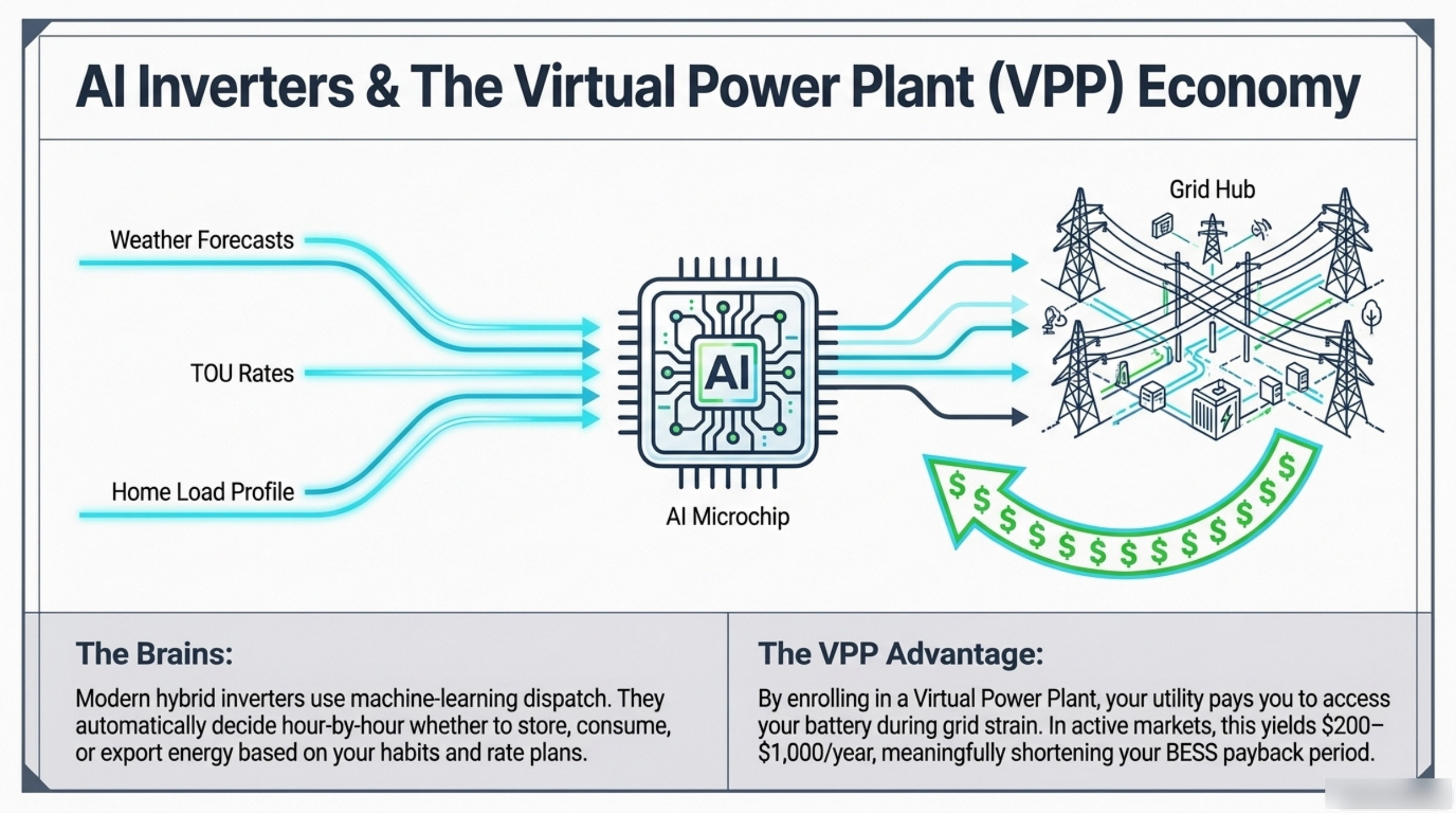
The alternative to machine-learning dispatch is a fixed schedule, and the difference shows up on unusual days. A schedule written in April does not know that a storm is coming in October, that the household will be away for a week in December, or that the evening peak load doubled because a heat pump is running. An adaptive engine re-decides every hour with current information, which is why the deck treats dispatch intelligence as a hardware feature worth paying for rather than a software novelty.
The VPP Advantage: When Your Battery Earns
A virtual power plant aggregates many home batteries into a single resource that behaves, from the grid's point of view, like one power station. The utility gets flexible capacity exactly when demand is highest. You get paid for the use of hardware you already own.
The deck puts a figure on it: in active markets, virtual power plant enrolment yields $200 to $1,000 per year, which meaningfully shortens the payback period on the storage system. That range is wide because earnings depend on how many events the operator calls, how the compensation is structured, and how much capacity you make available. Even the low end is not trivial, because it is revenue against a fixed asset rather than against additional equipment.
The economics compound with arbitrage. A battery that already saves you money by moving midday solar into the evening peak can also be paid to help the grid during system strain, and those two functions draw on different parts of the same capacity. If you want to understand how these aggregations are organised beyond single-family homes, our article on virtual power plants and how apartments join the energy economy covers the multi-unit version of the same market. For the grid-scale context of why flexible capacity is worth paying for, see clean firm power and the intermittency gap.
What Enrolment Actually Involves
Enrolment is a contract, not a switch, and the terms deserve reading. Three clauses decide whether the arrangement is fair to you.
First, how much capacity does the operator get to control, and over what window? A program that can request power during a defined set of hours is different from one with open-ended access. Second, what guarantee do you have that your own backup reserve is protected? A well-structured agreement keeps a floor on state of charge so that outage protection is never traded away for revenue. Third, how are events compensated, and is the rate per event, per kilowatt-hour delivered, or per month of availability?
Ask also what happens in a year with very few events. Availability payments and performance payments behave differently in a quiet grid year, and the deck's $200 to $1,000 band reflects exactly that kind of variation. A program with a modest availability payment and a steeper performance payment is more volatile than one that pays for standing by.
How This Changes the Payback Calculation
Storage is usually justified on avoided evening imports alone, and that justification is sound: it is the core of the tariff arbitrage argument. Virtual power plant revenue is what changes the shape of the payback curve rather than the total. A battery that would have taken a decade to pay back from bill savings can cross over years earlier when annual program payments are counted against the same capital cost.
It is also a reason to buy dispatch capability now rather than later. An inverter without adaptive dispatch cannot participate meaningfully in a program that calls events on short notice, and no amount of future software can add the hardware. This is the same forward-looking logic that argues for battery-ready direct-current coupled design: the components that must exist are the ones worth specifying at the start.
Getting Paid: What to Ask Your Installer
Four questions sort a real offer from a hopeful one. Does the quoted inverter support adaptive, rate-aware dispatch, and can it be updated over the air? Which virtual power plant programs does the installer have experience enrolling customers in, and what did those customers actually earn last year? Is there a state-of-charge floor that protects outage backup during an event? And what does the program do to the warranty, if anything?
That last question matters more than it sounds. Programs that cycle your battery more often are asking the hardware to do more work, and the answer should be that the equipment, the warranty, and the program terms were designed with each other in mind. Storage maintenance and warranty coverage, including what a ten-year product and performance warranty really covers, is worth reviewing side by side with any program you are considering.
To model the revenue side against your own consumption, try the storage and profit-sharing calculators in our tools hub, including the allocator that shows how program value is split. Then get it in writing from a licensed professional: call (928) 698-6192 or request a free comparison through our matching service.
Frequently Asked Questions
Does joining a virtual power plant mean losing control of my battery?
It should not. A well-written agreement defines the control window, protects a reserve floor for your own backup needs, and limits how often the operator can call on your capacity. Read those three clauses before you sign, and ask the installer to show you the same terms they have agreed to elsewhere.
How much can a Flagstaff battery really earn from a program?
The deck's figure for active markets is $200 to $1,000 per year, and the spread reflects real differences between programs and between grid years. Treat it as revenue that shortens payback rather than as a guaranteed annuity.
Is a smart inverter worth the extra cost?
It is the component that makes both arbitrage and program participation possible, and it cannot be retrofitted by software alone. If your plan includes evening rate beating or any future enrolment, the dispatch capability has to be in the hardware from the start, which makes it part of the system rather than an upgrade.