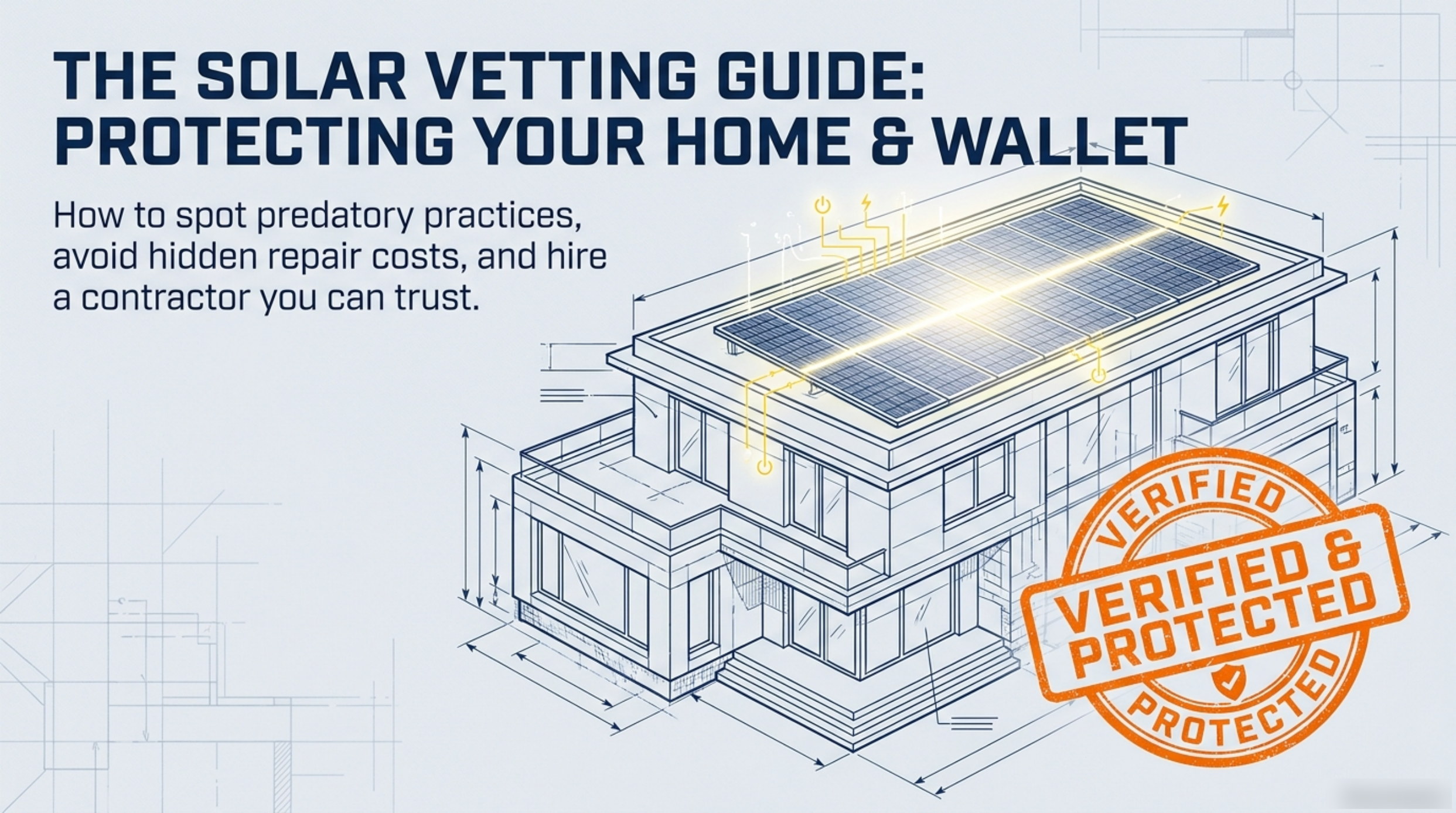
Most homeowners begin the solar conversation by collecting prices. This guide begins somewhere else. Its cover sets the task in three parts: spot predatory practices, avoid hidden repair costs, and hire a contractor you can trust. None of those three questions is answered by a number on a quote sheet, because the quote is written by the same company whose behaviour you are trying to judge.
The stake is larger than most household purchases. The deck prices the average residential system at $16,129, a figure in the same range as a kitchen remodel or a good used truck, and it attaches that spending to the most valuable asset most families own. A solar array is a construction project bolted to a roof, wired into the electrical service and trenched across the yard, and the paperwork that follows the installation outlives the salesperson who collected the signature.
Vetting is the practice of retiring risk one question at a time, before money changes hands. It is slower than price shopping and considerably cheaper than repairing the consequences of skipping it.
Why price comparison is the wrong first move
A quote comparison tells you which of three offers is cheapest. It tells you nothing about which of three companies will still answer the phone in year four when a roof flashing fails. The deck's own threat statement is blunt about the consequences of getting that wrong: unresolved roof leaks, surprise electrical bills and voided warranties. Every one of those outcomes carries a cost, and none of them appears anywhere on the original quote.
That is why the guide frames the decision as due diligence rather than shopping. Price belongs at the end of the process, once the field has been narrowed to companies that can prove they are certified, insured and locally accountable. Comparing prices before comparing those proofs compares the wrong thing.
The four phases of due diligence
The guide runs in four movements — detect, verify, protect and secure — and each one answers a different question. Detect is about sales behaviour, and it is the cheapest phase because it costs nothing but attention. Verify is about paperwork and credentials. Protect is about the fabric of the house: the roof, the electrical panel and the ground between the meter and the array. Secure is about the warranty structure that decides who pays when a component fails in year twelve. Working the phases in order means you never spend effort verifying a company whose sales behaviour should already have eliminated it.
| Phase | The question it answers | What a good answer looks like | What ends the conversation |
|---|---|---|---|
| Detect | How does this company sell? | Written quotes, time to read them, no same-night pressure | A rate that expires tonight, or a refusal to give local references |
| Verify | Are the credentials real? | Certification, insurance certificates and licence details in writing | Verbal assurance with nothing to show for it |
| Protect | What happens to the house? | A site-specific design naming the roof, panel and conduit scope | A binding contract offered before any site inspection |
| Secure | Who pays when it fails? | Product, workmanship and performance cover, each in writing | One vague warranty described as total protection |
What you are actually protecting
The deck names three vulnerability zones where residential installations go wrong, and each is a place where a rushed crew can cause damage a homeowner may not notice for months.
Zone one is the roof structure, where penetrations and mounting hardware meet the shingles and the framing beneath them. Zone two is the main electrical panel, where complex wiring and grid integration happen; a panel that is overloaded or poorly documented becomes both a safety exposure and an inspection problem. Zone three is the front yard, where the conduit run to the meter is buried. Underground work is invisible once the trench is backfilled, which makes it the hardest zone to audit after the fact.
Homeowners rarely get a second look at any of the three. That asymmetry is the argument for vetting the installer before work begins rather than inspecting afterwards.
The documents that move risk back to the installer
Four items form the vetting standard, and each one transfers a specific risk away from the homeowner. Certification of installation expertise, held by at least one member of the crew, is evidence of formal training rather than on-the-job improvisation. One million dollars of general liability insurance covers property damage caused during the work. Workers' compensation covers injuries that happen on your property, which otherwise becomes your exposure under Arizona law. A verified local track record, checked through independent reputation platforms rather than the installer's own testimonials, shows the company has operated long enough in this jurisdiction and utility territory to remain accountable.
Ask for all four in writing, and read the insurance certificate for the policy period rather than the logo. A certificate that lapsed two months ago protects nobody.
The answer that should end the conversation
If a company asks you to sign a binding contract before a physical site inspection and a detailed system design have been provided, the deck treats that as a disqualifying pattern rather than an aggressive upsell. So does a refusal to supply local references, and so does a sales call that keeps you on the line to lock in a rate that expires at midnight. Each of those behaviours belongs to the detect phase, and each is visible before you spend a dollar.
Call (928) 698-6192 for free, no-obligation quotes from pre-vetted Flagstaff solar professionals. You can also run your own numbers in our Flagstaff solar calculators.
Frequently asked questions
How long should vetting a solar installer take?
Long enough to read a written quote, check four documents and speak to at least one earlier customer. The deck's phases are sequential, so the practical limit is set by how quickly the company supplies paperwork. A firm that cannot produce certificates promptly is not a firm worth waiting on.
Is the cheapest quote usually the risky one?
Not automatically, but a low number has to be explained. On a $16,129 average system, the line items most often trimmed are the ones you cannot see afterwards: roof flashing detail, panel work and the buried conduit run. Ask what was excluded to reach that price.
What if the installer offers no local references at all?
Treat it as a stop sign rather than a gap. A verified local reputation in the same jurisdiction and utility territory is one of the four vetting documents, and an established company has no reason to withhold it.