A solar array without a battery sells its output to the grid at the moment it produces it. A solar array with a battery decides when to sell, when to self-consume, and what happens to the lights during an outage. That flexibility is what you are buying, and it is priced separately from the panels — the workbook lists a 10 kWh LiFePO4 battery at $8,500 on top of the $14,336 net cost of an 8 kW array.
Two chemistries are competing for that $8,500 line. Lithium iron phosphate, known as LiFePO4 or LFP, is the mature choice: 175 Wh per kilogram of energy density, 6,000 cycles, and a 90% depth of discharge. Next-generation solid-state storage is the incoming alternative: 450 Wh per kilogram, a 10,000-plus cycle rating, and 100% depth of discharge with zero thermal runaway risk. The gap between them is not marketing — it is a set of measurable specifications that translate directly into usable kilowatt-hours and years of service.
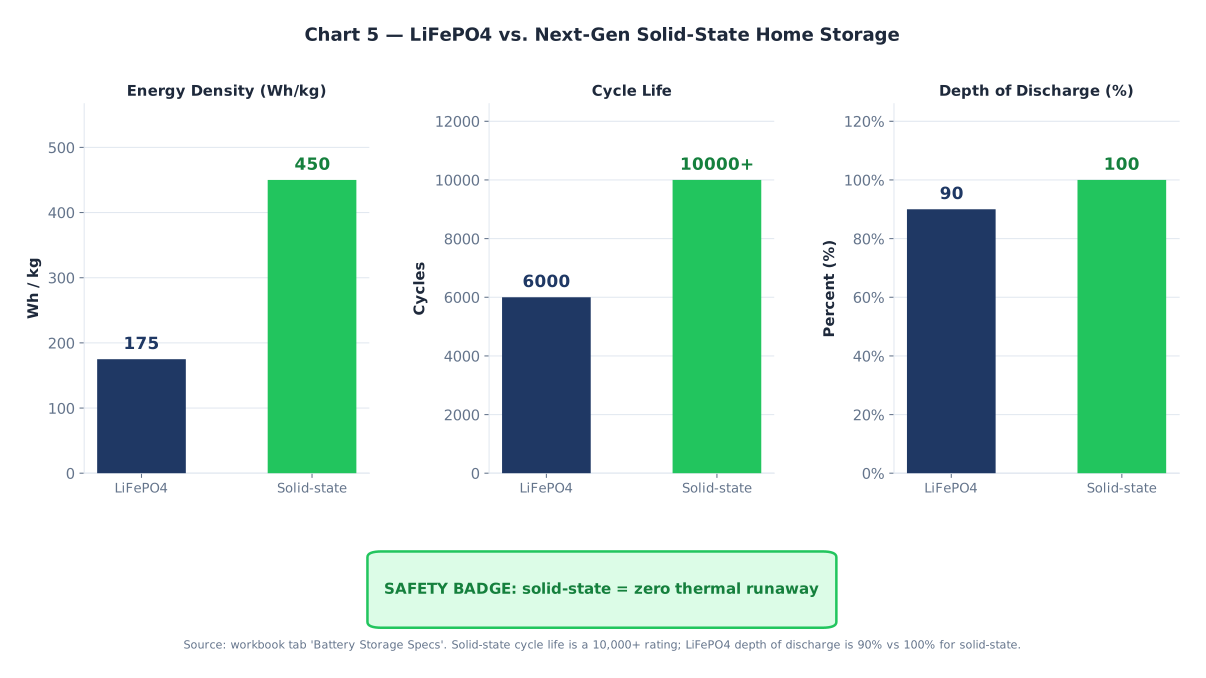
The specification matrix

Three numbers separate the two chemistries, and each one answers a different homeowner question. Energy density is a space question: how much wall space does 10 kWh occupy? Cycle life is a longevity question: how many times can the battery be filled and emptied before it degrades meaningfully? Depth of discharge is a usable-capacity question: of the kilowatt-hours on the label, how many can you actually draw?
| Metric | LiFePO4 | Solid-state (next-gen) | Difference | Why it matters at home |
|---|---|---|---|---|
| Energy density | 175 Wh/kg | 450 Wh/kg | 2.57× | Same capacity in roughly 39% of the mass — less wall space, easier retrofits |
| Cycle life | 6,000 cycles | 10,000+ cycles | 1.67× minimum | Longer service life before replacement |
| Depth of discharge | 90% | 100% | +10 pts | More of the nameplate capacity is usable on every cycle |
| Thermal safety | Standard protection | Zero thermal runaway | — | The headline safety property of solid-state chemistry |
The energy density multiple is the most dramatic and the least useful for most buyers. A 10 kWh LiFePO4 battery already fits on a garage wall; tripling the density matters most for retrofits where space is genuinely constrained, or for manufacturers trying to squeeze storage into a combined inverter-and-battery cabinet. Cycle life and depth of discharge are the numbers that change the ownership maths.
Translating specifications into usable kilowatt-hours
Specifications only become decision-relevant when they are applied to a specific installation. Take the workbook's 10 kWh battery as the reference unit and run both chemistries through it. Depth of discharge is what converts nameplate capacity into usable capacity, and cycle life is what converts cycles into years at a realistic daily duty cycle.
| Measure | LiFePO4 | Solid-state | Delta |
|---|---|---|---|
| Nameplate capacity | 10.0 kWh | 10.0 kWh | — |
| Usable capacity at rated DoD | 9.0 kWh | 10.0 kWh | +1.0 kWh |
| Rated cycles | 6,000 | 10,000+ | +4,000 |
| Years of service at one cycle per day | 16.4 years | 27.4+ years | +11.0 years |
| Installed cost (workbook figure) | $8,500 | not yet published | — |
| Cost per usable kWh | $944 | n/a | — |
Two derived figures deserve attention. The first is the usable-capacity difference: 90% of 10 kWh is 9.0 kWh, so the LiFePO4 unit gives up a full kilowatt-hour of its label every cycle while solid-state gives up none. The second is service life. At one full cycle per day — an aggressive duty cycle for a home but the right stress test — 6,000 cycles is 16.4 years and 10,000 cycles is 27.4 years. That is a difference of more than a decade, and it is why the cycle-life rating matters more than the energy density rating for a residential buyer.
The cost-per-usable-kilowatt-hour figure of $944 comes from dividing the workbook's $8,500 installed cost by 9.0 usable kWh. That is the honest basis for comparison: not the nameplate 10 kWh, but the 9.0 kWh the battery will actually deliver on a deep discharge.
The tax credit changes the battery maths
Storage paired with solar is eligible for the same 30% federal Investment Tax Credit that applies to the array. On the workbook's $8,500 battery, the credit is worth $2,550, bringing the net cost to $5,950 — or $661 per usable kilowatt-hour on a LiFePO4 unit. Compare that with the same battery at its gross price and the case for storage improves by nearly a third.
This is why battery economics are usually evaluated after the solar decision rather than alongside it. The 8 kW array nets to $14,336 after its own $6,144 credit. Adding a 10 kWh battery at $8,500 gross and $5,950 net raises the total net investment to $20,286. The workbook's 25-year savings figure of $25,800 for the array does not include any value for backup power or time-of-use arbitrage, so the battery is best judged on resilience and on the export-versus-self-consume spread rather than on the energy-savings line alone.
| Your priority | Best fit | Evidence from the specs |
|---|---|---|
| Proven chemistry, available today | LiFePO4 | 175 Wh/kg, 6,000 cycles, 90% DoD — all established, published figures |
| Maximum years before replacement | Solid-state | 10,000+ cycles versus 6,000 — 27.4 vs 16.4 years at one cycle per day |
| Every last kilowatt-hour usable | Solid-state | 100% DoD versus 90%: recover a full 1.0 kWh per cycle on a 10 kWh unit |
| Maximum safety margin | Solid-state | Zero thermal runaway risk — relevant in a hot Flagstaff garage |
| Smallest physical footprint | Solid-state | 450 vs 175 Wh/kg, a 2.57× density advantage |
| Lowest price you can buy today | LiFePO4 | $8,500 installed for 10 kWh is a published workbook figure; solid-state installed pricing is not yet published |
What to do about Flagstaff winters
Battery choice interacts with climate in ways the spec sheet does not spell out. Flagstaff's cold snaps and high-altitude temperature swings are exactly the operating conditions that make depth of discharge and thermal behaviour matter. A chemistry that can be drawn to 100% without accelerating degradation and that carries no thermal runaway risk is a better match for a garage that swings from below freezing in January to over 100°F in July than a chemistry that prefers to stop at 90%.
The practical recommendation for most Flagstaff households today is straightforward. LiFePO4 is the buyable option: it is priced at $8,500 for 10 kWh in the workbook, it delivers 9.0 kWh of usable capacity per cycle, and its 6,000-cycle rating covers 16.4 years at one cycle per day — comfortably past the year-7 break-even on the array and into the profitable part of the cash-flow curve. Solid-state is the option to watch: it wins on all three specifications, and the only thing missing from the model is a published installed cost to run the same $/usable-kWh comparison against.
Call (928) 698-6192 for free, no-obligation quotes from pre-vetted Flagstaff solar professionals.
Frequently asked questions
- How long does a home battery last?
- At one full cycle per day, the workbook's 6,000-cycle LiFePO4 rating is about 16.4 years. A solid-state battery rated at 10,000-plus cycles covers 27.4 years or more on the same duty cycle.
- What does 90% depth of discharge cost me?
- One kilowatt-hour per cycle on a 10 kWh battery. LiFePO4 gives 9.0 kWh of usable capacity and solid-state gives 10.0 kWh. Divided into the $8,500 installed cost, the LiFePO4 unit works out at $944 per usable kWh.
- Is solid-state storage safer than LiFePO4?
- On the safety specification the workbook tracks, yes — solid-state carries zero thermal runaway risk, which is why it gets the green safety badge in Chart 5. That matters more in a garage that sees triple-digit summer temperatures.
- Does the 30% tax credit apply to batteries?
- Storage paired with solar is eligible for the same 30% credit. On an $8,500 battery the credit is $2,550, reducing the net cost to $5,950, or $661 per usable kilowatt-hour.