Grid Down, Solar Off: Why Grid-Tied Solar Shuts Down in a Flagstaff Outage
Here is the counterintuitive part of owning solar that almost nobody explains at the kitchen table. On a bright, cloudless Flagstaff afternoon, with the array producing at full tilt, a grid outage leaves the home dark. The panels are working. The home is not. Nothing is broken, and nothing is misconfigured. The inverter has done exactly what it is designed to do, and it has done it deliberately.
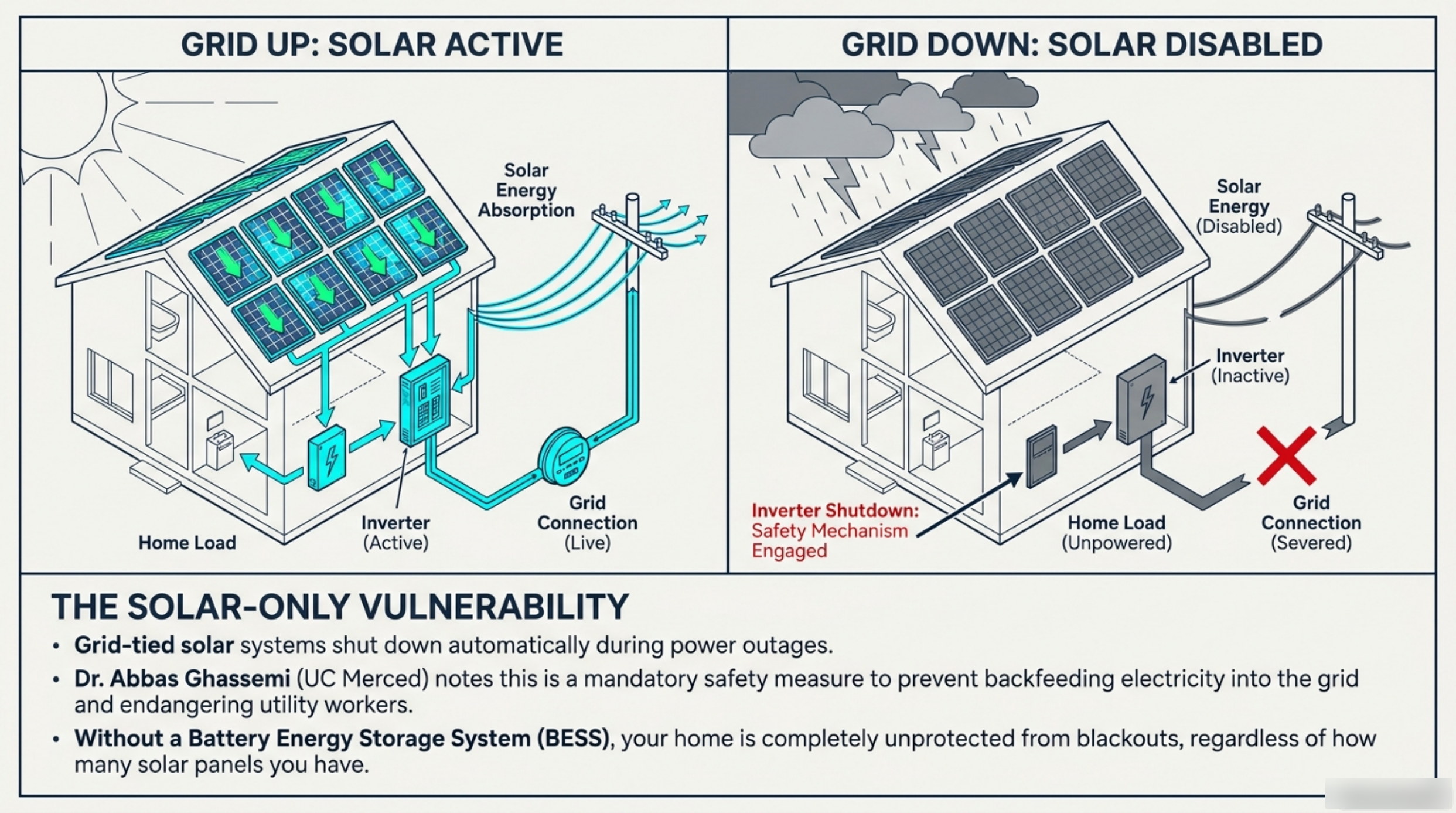
The diagram at the heart of this article shows two states of the same system side by side. Grid up: the array is active, the inverter is running, the grid connection is live and the home load is powered. Grid down: the inverter is inactive, the array's output is absorbed rather than delivered, the grid connection is severed and the home load is unpowered. Same panels, same wiring, same sunny day.
The short version
- Grid-tied solar systems shut down automatically during a power outage, even in full sunshine.
- The inverter detects the loss of grid voltage and engages a safety mechanism, severing the home from the array.
- The shutdown is a mandatory safety measure, not a fault: it prevents backfeeding electricity into the grid and endangering utility workers.
- Solar alone has no answer to an outage; a battery or a standby source is what keeps circuits live.
Grid up: what the system does on an ordinary day
On a normal day a grid-tied system runs as one continuous electrical circuit shared with the utility. Whatever the array produces goes first to the home's loads; any surplus is exported onto the grid, and at night the home draws from the grid exactly as it did before solar was installed. The inverter's job in that state is to synchronise its output with the grid's waveform so the two can run in parallel. It is following the grid's lead the entire time.
That dependency is the whole point of the design. Grid-tied inverters are built to match an existing grid signal, not to create one. Which means the moment the grid signal disappears, the inverter has nothing left to follow.
Grid down: what changes in the seconds after the lights go out
The detection happens almost instantly. The inverter sees the grid voltage collapse, and a shutdown sequence begins. Production from the array does not stop being generated so much as stop being delivered, and the connection between the home and the array is broken before the home can be sustained by it.
| What changes | Grid up | Grid down |
|---|---|---|
| Solar production | Active — generation delivered to home and grid | Disabled — output absorbed, not delivered |
| Inverter | Running and synchronised to the grid | Inactive — shutdown sequence engaged |
| Grid connection | Live | Severed |
| Home load | Active and powered | Unpowered |
Read the table as a single sentence: the array is fine, and the home is still dark. The one component that could have bridged the two, the inverter, has taken itself out of the circuit on purpose.
Why the shutdown is mandatory rather than a fault
It is reasonable to read that behaviour as a defect the first time you encounter it. It is not. Lab studies of grid-tied inverter behaviour treat this as a mandatory safety measure rather than a limitation, and the reason is straightforward: an inverter that kept energising the wiring during an outage would push electricity back onto a grid that repair crews believe is de-energised. Backfeeding into a downed line puts utility workers at risk of electrocution.
The shutdown is therefore protective, not wasteful. It is the same principle that governs every other part of the electrical system in a home: equipment that can source power has to fail safe. In practice this means the answer to "why did my solar stop working in the outage" is not a service call. It is the system behaving exactly as it should.
The solar-only vulnerability, whatever the array size
The most common objection at this point is scale. Surely a larger array — more panels, more peak capacity, more raw output — would produce enough to be usable? It would not, because the constraint is not the size of the generation. The constraint is that the inverter has no grid signal to synchronise with, and that holds regardless of how many panels sit on the roof. Adding modules changes the amount of energy being produced during the outage; it changes nothing about the inverter's obligation to stop delivering it.
This is the solar-only vulnerability in one line: the system's usefulness is conditional on the grid being present, and the condition is enforced at the inverter, not at the panel.
What actually keeps the lights on
Two things break the dependency: stored energy and a way to form an island. A battery paired with a hybrid inverter gives the system something other than the grid to reference, so designated circuits can keep running while the rest of the neighbourhood is dark. Where long outages matter more than daily economics, a standby generator does similar work by another route. What neither the panels alone nor a larger array can do is solve the problem by generating more.
Because northern Arizona outages cluster around winter storms and heavy snow, the question of backup is also a question about the season. Our guide to solar panels and snow in Flagstaff covers what the array itself does under a snow load, and the solar battery guide covers what changes when storage is added. If you want to see what a defined set of circuits would do in an outage, the site's calculators hub includes an outage-autonomy model. To find out which of your own circuits could ride through an outage, call (928) 698-6192 or request free quotes — no obligation.
Frequently Asked Questions
Does this shutdown happen every time the power blips, even for a second?
It happens whenever the inverter loses the grid signal, which includes short interruptions. Many inverters will restart automatically once they confirm the grid is back and stable, which is why a brief outage often looks like nothing more than a flicker and a pause in production.
Can I keep one circuit alive without a full battery system?
Stored energy is what makes it possible, so the answer runs through a battery or a standby source rather than through the array. What varies is the number of circuits you choose to carry, which is a sizing decision rather than a hardware limitation.
Is this specific to any particular brand of inverter?
No. The behaviour follows from how grid-tied inverters work — they synchronise to an existing grid signal, and they have to stop energising a line that utility crews may be working on. It applies to the category, not to one manufacturer's product.