Critical Load vs Whole-Home Backup: Sizing a Flagstaff Battery Correctly
Sizing a home battery is usually presented as a question about capacity, which makes it sound like a question about arithmetic. The slide this article works from frames it better. It puts two strategies side by side — critical load backup and whole-home backup — and shows that the real decision is about scope. Which circuits should survive an outage, and what does the answer cost? Once that question is settled, the capacity follows from it rather than the other way around.
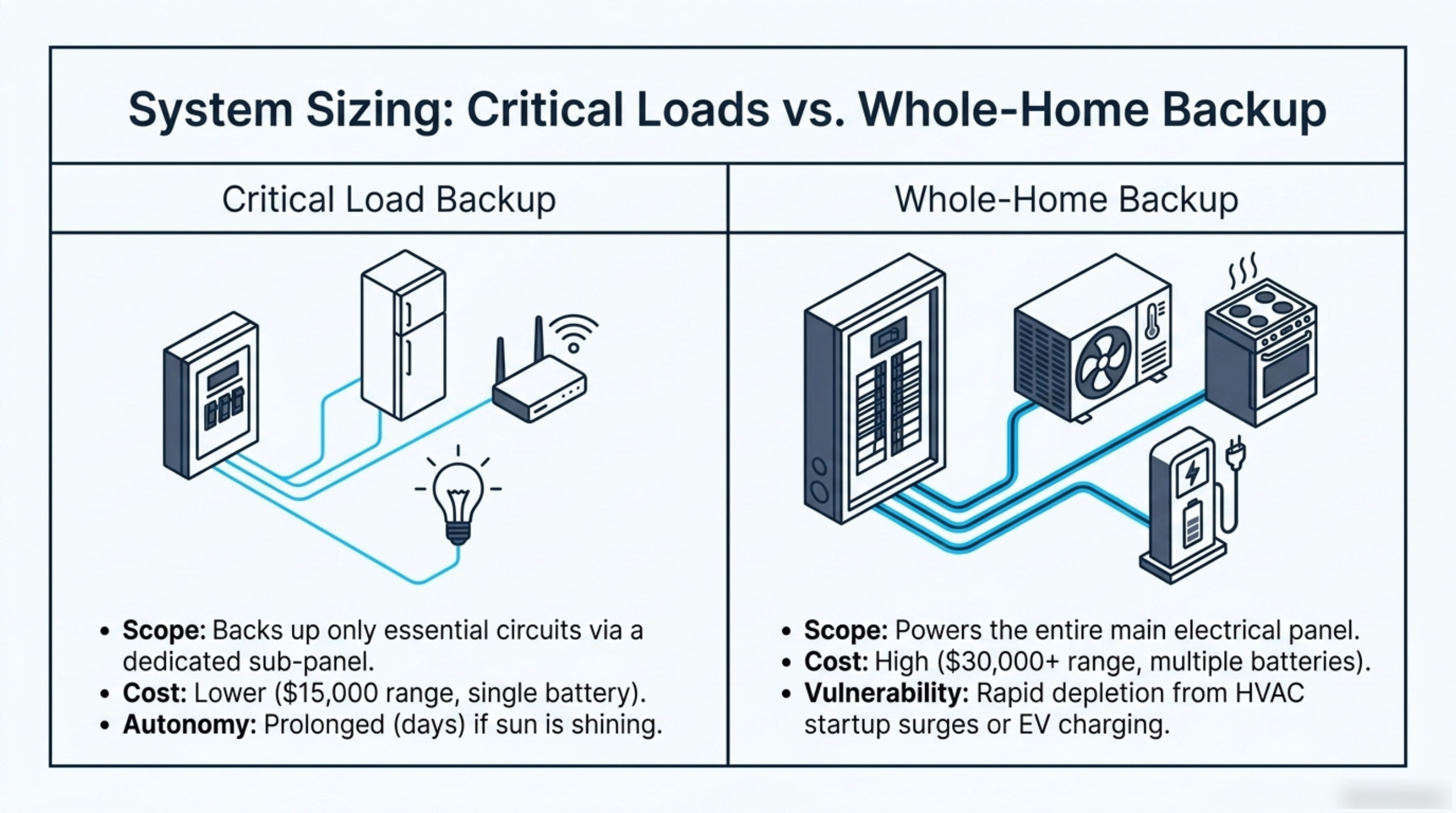
The two approaches sit at different ends of the same trade. Critical load backup carries less and lasts longer. Whole-home backup carries everything and depletes faster. Neither is a better product; they are answers to different questions, and the deck lays out the differences on scope, cost, autonomy and vulnerability.
The short version
- Critical load backup powers only essential circuits through a dedicated sub-panel, and lands in the lower cost band near $15,000 with a single battery.
- Whole-home backup powers the entire main electrical panel, and runs $30,000 or more because it needs multiple batteries.
- Critical load backup can sustain autonomy for days if the sun is shining.
- Whole-home backup is vulnerable to rapid depletion from HVAC startup surges or EV charging.
Two ways to size a battery
The cleanest way to read the comparison is to follow a single number all the way through. A critical load installation backs up a defined subset of circuits through a dedicated sub-panel, which keeps the required storage modest and the cost near the $15,000 range with a single battery. A whole-home installation powers the entire main electrical panel, which requires multiple batteries and runs $30,000 or more.
| Dimension | Critical load backup | Whole-home backup |
|---|---|---|
| Scope | Essential circuits only, via a dedicated sub-panel | The entire main electrical panel |
| Cost | Lower — around the $15,000 range, single battery | High — $30,000+ range, multiple batteries |
| Autonomy | Prolonged (days) if the sun is shining | Not the deck’s stated strength |
| Vulnerability | Not the weakness the deck names — a short circuit list depletes slowly | Rapid depletion from HVAC startup surges or EV charging |
| Best fit | Outage endurance on a defined circuit list | Whole-house continuity with no circuit exemptions |
One asymmetry in that table deserves emphasis. The deck attaches the vulnerability note to whole-home backup alone: HVAC startup surges and EV charging. That is not because a critical load installation is immune to them, but because its circuit list is small enough that they sit outside the backed-up load. Scope and load behaviour are the two variables that decide how long a battery actually lasts.
Critical load backup: the sub-panel approach
The strength of critical load backup is that it makes the sizing question answerable. Instead of asking how much battery it takes to run everything, a homeowner asks which circuits matter: refrigeration, lighting, communications, a well pump or furnace blower, medical equipment. Those circuits are wired to a dedicated sub-panel, and the battery is sized for that list alone.
The benefit is a smaller battery and a lower cost, and it comes with a real advantage the slide names directly. The deck credits critical load backup with prolonged autonomy — days — as long as the sun is shining. That is the renewable upside working as intended: a modest battery paired with daytime recharging can stretch far beyond what its nameplate capacity alone would suggest, because the array keeps refilling it each day.
The trade-off is the circuit list itself. Everything outside the sub-panel goes dark during an outage, and the list has to be drawn honestly at design time rather than guessed at. A homeowner who later wants the air conditioning to run during an outage has changed the scope of the project, not just its settings.
Whole-home backup: powering the entire panel
Whole-home backup removes the circuit list altogether. The battery carries the entire main electrical panel, which means the house behaves during an outage exactly as it does on a normal evening. That convenience is what the price buys: multiple batteries, more capacity, and an installation sized around the home's full load rather than a subset of it.
It is worth being clear about what whole-home backup is not. It is not a longer outage solution than critical load backup — the deck does not claim prolonged autonomy for it, and the reason follows from the arithmetic. The same load that makes the installation convenient is the load that empties it. A larger battery carrying a larger load does not automatically buy more hours.
Why HVAC and EV charging change the calculation
The vulnerability the slide pins to whole-home backup is worth unpacking, because it is where most real-world sizing mistakes happen. HVAC startup surges are brief and large. An air conditioner compressor draws far more current in the seconds it starts than while it runs, and a battery sized against running load alone will trip when the compressor kicks on. Electric vehicle charging is the opposite problem: a moderate but sustained load that quietly consumes an entire battery overnight.
Neither is an argument against storage. Both are arguments for sizing against the actual loads the system will see, including the ones that only appear in short bursts. That is why the deck lists them as the vulnerability rather than as a cost: they are what turns an adequately sized battery into an inadequate one.
Matching the choice to the goal
Read together, the two columns resolve into a simple decision. A homeowner whose priority is keeping selected circuits running through a long winter outage, with cost as a constraint, is in the critical load column, where a single battery near the $15,000 range and daily solar recharging can carry essential loads for days. A homeowner who wants the whole house to behave normally during an outage, and who is prepared for multiple batteries and a $30,000-plus installation, is in the other column.
If you want this sized against your own roof rather than in the abstract, call (928) 698-6192 or request free quotes through the form on this page. Every provider we match is licensed and insured in Arizona, and there is never any obligation to move forward.
Frequently Asked Questions
Can I start with critical load backup and expand to whole-home later?
Expansion is a design question rather than a limitation, and it is far easier when the original installation was built to accept additional capacity — the same battery-ready principle that applies to the inverter and the DC side of the array.
Why can critical load backup last days while whole-home backup does not?
Because autonomy is a function of load as much as capacity. A small battery carrying a short list of circuits depletes slowly, and the array refills it each day. Carrying the whole panel drains the same storage much faster.
Does an EV charger have to be left off the backup list?
It does not have to be, but the load has to be planned for. Sustained charging will empty a residential battery overnight, so keeping the charger on the backed-up side changes the capacity the system needs, and changes the cost with it.