Tariff Optimisation: Using Your Battery to Beat Evening Peak Rates
A solar array without storage sells its best production at the worst possible moment. Arizona's biggest solar days are also the days when the grid is drowning in midday solar power, and compensation for what you export during those hours has been moving steadily toward avoided-cost territory rather than a one-for-one offset. Meanwhile the power you buy back when the sun is down is priced for a grid that is straining to meet demand.
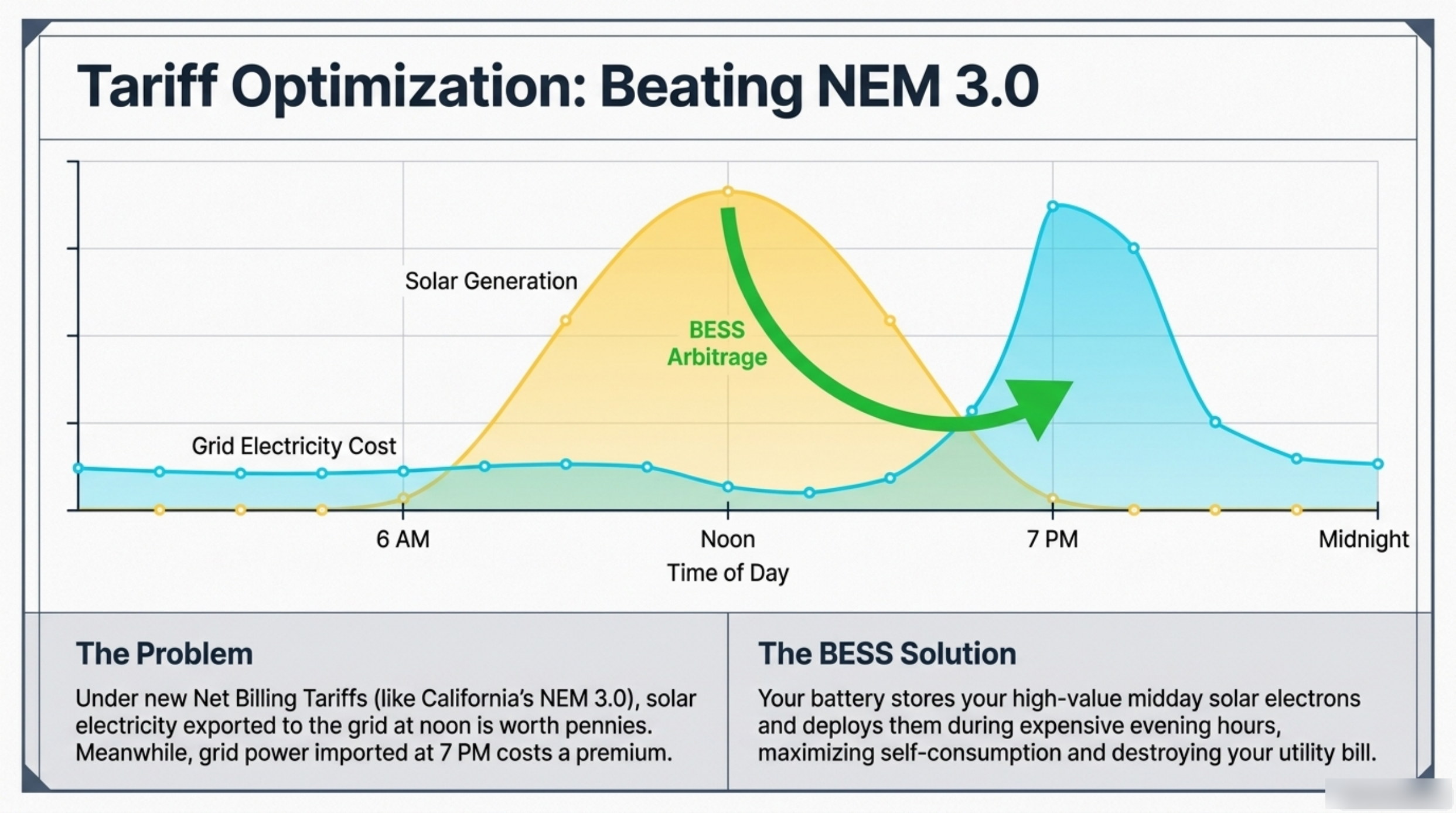
The Blueprint for Energy Independence deck draws that mismatch on a single axis: solar generation, grid electricity cost, and battery arbitrage plotted across a day from 6 AM through noon to 7 PM and midnight. The chart is the argument for storage in one picture. What follows is how the mechanics work, what to check in your own usage, and how to size a battery for the evening window rather than for a number on a brochure.
The short version
- Under net-billing export rules, the solar electricity you send to the grid at noon is worth pennies.
- The grid power you import at 7 PM is billed at a premium because that is when the whole system is under stress.
- A battery stores your high-value midday solar electrons and deploys them during those expensive evening hours.
- The goal is not more production. It is more self-consumption, which is the one number the tariff cannot discount.
- Correct battery sizing for the 7 PM to midnight window matters more than buying the largest unit on the pallet.
The Daily Shape of the Problem
Four moments on the deck's chart tell the whole story, and they map onto how a Flagstaff household actually behaves.
| Time of day | What the chart shows | What it means for your bill |
|---|---|---|
| 6 AM | Morning ramp, minimal solar generation | House load comes from the grid, so morning habits set the baseline |
| Noon | Peak solar generation, exported power worth pennies | Surplus exports earn very little, so the value is in not exporting |
| 7 PM | Grid electricity cost spikes to a premium | Every kilowatt-hour served from a battery is a peak-priced hour avoided |
| Midnight | Cost and generation both fall back to baseline | Overnight load has no arbitrage value, so overnight habits are separate work |
Why the Midday Export Is the Weakest Link
Under new net-billing tariffs, the deck states the problem plainly: solar electricity exported to the grid at noon is worth pennies. Net billing is not net metering. Net metering let an exported kilowatt-hour cancel an imported kilowatt-hour almost one for one, which meant the timing of your production did not matter. Net billing gives exports a credit based on what the utility would otherwise have paid for that power, and in the middle of a sunny day, with solar flooding the grid, that number is small.
The same tariff structure cuts the other way in the evening. Grid power imported at 7 PM costs a premium, because that is the hour when the system is tightest and the most expensive generation is running. So a solar-only home produces its most valuable electricity at the moment the grid values it least, and buys electricity at the moment the grid values it most. Nothing about the array is wrong. The mismatch is purely about timing.
How the Battery Fixes It
The deck's solution is unglamorous and effective. A battery stores your high-value midday solar electrons and deploys them during the expensive evening hours, maximizing self-consumption. Self-consumption is the key phrase. A kilowatt-hour you generate and use in the house is a kilowatt-hour you never sell cheap and never buy dear. It sidesteps the tariff entirely.
That is why arbitrage is not a niche trick for rate optimisers. It is the default operating mode for any solar-plus-storage home in this region, and it works without you touching anything. The inverter decides what to do with midday production: serve the house first, charge the battery second, and export only what remains. Then in the evening, the battery serves the house and the meter stops turning at the premium rate.
Read the chart about home batteries next, which explains what the storage unit does minute by minute and what the warranty expects of it. And if your roof is your main concern rather than your meter, the solar worth analysis for Flagstaff puts the same numbers in the context of total cost of ownership.
Sizing for the Evening, Not for the Brochure
Arbitrage economics depend far more on usable evening capacity than on raw kilowatt-hours on a spec sheet. A unit that is oversized relative to your evening load costs more, takes more space, and still cannot sell its extra capacity back at a useful rate. A unit sized to your real 7 PM to midnight consumption captures most of the value at a fraction of the price.
To size correctly, you need three numbers: how much electricity your home uses between 7 PM and midnight, how much of that can be shifted out of the peak window by changing habits, and how much of your midday production is left over after charging. That third number decides whether the battery fills up on an average day or spends most of the summer cycling and most of the winter idle. The Solar Savings Calculator in our tools hub walks through the arithmetic, and your own interval data from the utility is the honest input.
One more consideration belongs here: winter. A Flagstaff home has long heating seasons and short December days, and a battery sized only on July behaviour will not cover the same evening load in January. Sizing to the winter evening load and accepting surplus capacity in summer is usually the more sensible compromise than the reverse.
What to Check Before You Commit
Ask how the quoted equipment decides when to charge and discharge, and whether that logic is tied to your rate plan rather than to a fixed schedule. Ask for the usable capacity, not the nameplate figure, because a battery that holds 98% state of charge on the app is not the same as a battery that can deliver all of it to your panel. And ask whether the installer will help you read your first two utility bills against the projected savings, because a claim that never gets checked is not a design.
Our matching service connects Flagstaff homeowners with licensed, insured Arizona installers who will put those answers in writing. Call (928) 698-6192 for a free, no-obligation comparison, and bring your last twelve months of usage with you.
Frequently Asked Questions
What is the difference between net metering and net billing?
Net metering credits an exported kilowatt-hour close to the retail rate, so timing is almost irrelevant. Net billing credits exports at a lower avoided-cost value, which makes midday exports worth only pennies. That single change is why storage stopped being optional for homeowners who want to capture full value from their own production.
Do I need a battery if I am on a favourable rate plan?
You need one if your goal is to serve evening load from your own generation. Without storage, evening consumption comes from the grid at premium pricing no matter how much your array produced at noon. With storage, the same array covers the expensive window, and the improvement shows up directly in the usage portion of your bill.
How much battery capacity is enough?
Enough to cover your typical 7 PM to midnight consumption, measured in usable kilowatt-hours rather than advertised capacity, with a margin for cold weather. Sizing beyond that point adds cost without adding peak-hour value, because there is no higher-priced period left in the day for the extra capacity to serve.