Battery O&M and the Fine Print: BMS Monitoring, 10-Year Warranties and Truck Rolls
A home battery is sold as a product and maintained as a service. The Blueprint for Energy Independence deck makes that distinction explicit: storage requires almost zero physical maintenance, but it relies entirely on software for thermal management and cell balancing, and as the system ages, the paperwork governing repairs matters as much as the hardware. Most owners never look at that paperwork until they need it, which is exactly when it is too late to negotiate.
This article follows the deck's operations and maintenance slide from the inside out: what the battery management system is doing right now, what a ten-year product and performance warranty actually promises, and where labour charges sit in the fine print of a repair that feels like it should be free.
The short version
- A battery needs almost no physical maintenance, but it depends on its battery management system for thermal management and cell balancing.
- Ten-year product and performance warranties are the norm on the batteries, and the two cover different things.
- Labour is the fine print. As systems age, repairs can incur labour fees, sometimes around $200 for a truck roll, even when hardware replacement is covered.
- Your installer's labour policy is a vetting question, not a minor clause, because it decides what year eight actually costs.
- Digital vigilance beats DIY tinkering: watch the monitoring data, not the casing.
Digital Vigilance: What the BMS Is Doing
The deck's O&M slide describes a system that requires almost zero physical maintenance and relies instead on battery management system software. That software performs two functions continuously, and both are invisible to the homeowner by design.
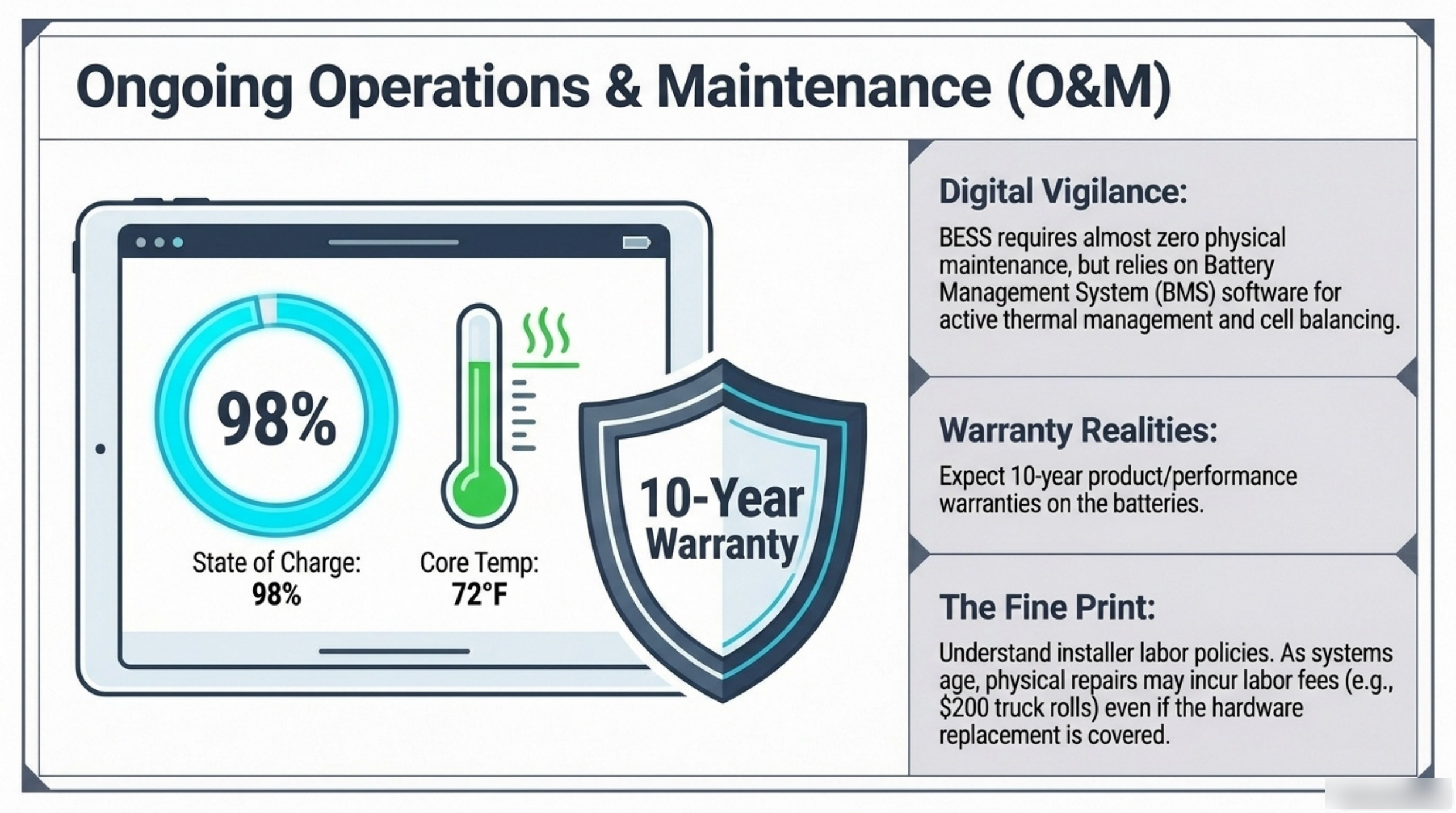
The first is active thermal management. Chemical reactions inside a battery run faster when hot and slower when cold, and both extremes matter. In Flagstaff, the cold end of the range is the year-round concern: a unit in an unconditioned garage sees temperatures that a system designed in a milder climate never planned for, and the management system responds by adjusting charge and discharge rates to keep the cells inside their working window. You can watch this on the app. A healthy operating snapshot from the deck shows state of charge at 98% with a core temperature of 72 degrees Fahrenheit, which is the middle of the comfortable band.
The second function is cell balancing. No two cells age at exactly the same rate, and a pack is limited by its weakest cell. Balancing moves charge between cells so that the pack delivers its rated capacity for as long as possible. When balancing stops working properly, the symptom is not a dead battery but a shrinking one, which is why the performance warranty exists separately from the product warranty.
Warranty Realities: Two Covers, Not One
The deck's expectation is a ten-year product and performance warranty on the batteries. Those two halves do different jobs and you should be able to explain both.
| Warranty half | What it covers | The catch to read |
|---|---|---|
| Product warranty, typically 10 years | The hardware: a defective component or a failure in the enclosure, the electronics or the cells | Void if the installation sits outside the manufacturer’s specification |
| Performance warranty, typically 10 years | Output: a defined share of original capacity | A pack can pass the product test and fail this one |
Both are typically written for ten years, and both have conditions. Capacity is guaranteed at a stated temperature and duty cycle. Extreme cycling, unauthorised modification, and installation outside the manufacturer's specification can void either one. That is one reason the installer's licensing and installation standards matter: a warranty you invalidated at commissioning is a warranty you do not have.
The Fine Print: Labour, Truck Rolls and Year Eight
This is the clause the deck flags, and it is the one homeowners miss. When a battery does need attention, the hardware may be replaced under warranty while the visit itself is billed. A truck roll to diagnose and swap a component can run around $200, and those fees land on the owner even though the part was covered.
Where the deck is most pointed is the phrase "as systems age". Policies differ widely, from a labour allowance covering the whole warranty term to charges from the first visit, and none of those differences appear in a headline price. Warranty terms also often shorten or migrate as equipment approaches the end of coverage, and a battery that was hands-off in year two may need attention in year eight. Budgeting for a small annual maintenance allowance from the start is the honest way to treat that, rather than pretending the ten-year warranty means ten years of zero cost.
What This Means for Total Cost of Ownership
Storage is marketed on capital cost and savings, and both are real. Operations is the third column that gets omitted. Almost zero physical maintenance is genuinely good news, and it is a real advantage of a sealed lithium iron phosphate unit over any mechanical system in the house. The residual costs are labour events, and their frequency depends on how well the system was designed and installed in the first place.
That connection is the practical takeaway. A well-designed installation with correct clearances, a clean electrical interface, and a properly commissioned battery management system has fewer reasons to be visited. An installation with shortcuts has more. The labour clause you signed decides who pays when those shortcuts surface. If the battery's chemistry, warranty and monitoring behaviour are the subject you want to understand next, our home battery guide and the LiFePO4 versus solid-state comparison cover the hardware side in detail.
Monitoring Without Micromanaging
Total hands-off is the right posture for most owners most of the time. Two habits are worth keeping. First, check the monitoring app occasionally for state of charge and temperature patterns, especially through the first winter, because an unusual core temperature in cold weather is the earliest sign that placement or thermal management needs a look. Second, keep the commissioning paperwork, the warranty documents, and the labour policy in one place, because the day you need them is the day you will not want to search for them.
Beyond that, the system should be as boring as a water heater: battery management software handles the thermal and balancing work continuously. Our article on virtual power plant earnings explains how the same dispatch that keeps the battery healthy can also generate revenue, and the storage tools in our hub help you check whether a quoted capacity is genuinely usable.
Frequently Asked Questions
Do home batteries really need no maintenance?
They need almost no physical maintenance. No fluid changes, no filters, no mechanical parts in routine motion. What they do need is a functioning battery management system performing thermal management and cell balancing, and an owner who reviews the monitoring data periodically. That is why the work is software-side and why the failures worth catching are usually visible in data first.
Does the ten-year warranty cover the cost of a repair visit?
Not necessarily, and this is the part most homeowners discover late. Hardware replacement and the labour to install it are often covered separately, and labour may be billed even when the part is free. A truck roll can cost around $200. Ask your installer for their written labour policy for warranty repairs before you sign.
What should I do if the battery stops discharging fully?
Check the monitoring data first. A shrinking usable capacity points to cell imbalance or a performance issue rather than a dead unit, and it is exactly what the performance warranty exists to address. Contact the installer with the data and the commissioning date, and ask which warranty half applies before scheduling a visit so you know what the labour charge will be.
To get a storage design and a warranty policy you can review side by side, our matching service connects Flagstaff homeowners with licensed, insured Arizona installers who quote in writing. Call (928) 698-6192 for a free, no-obligation comparison, and ask for the labour terms in the same document as the hardware list.