The Modern Energy Architecture: Bifacial Panels, Hybrid Inverters and Battery-Ready Design
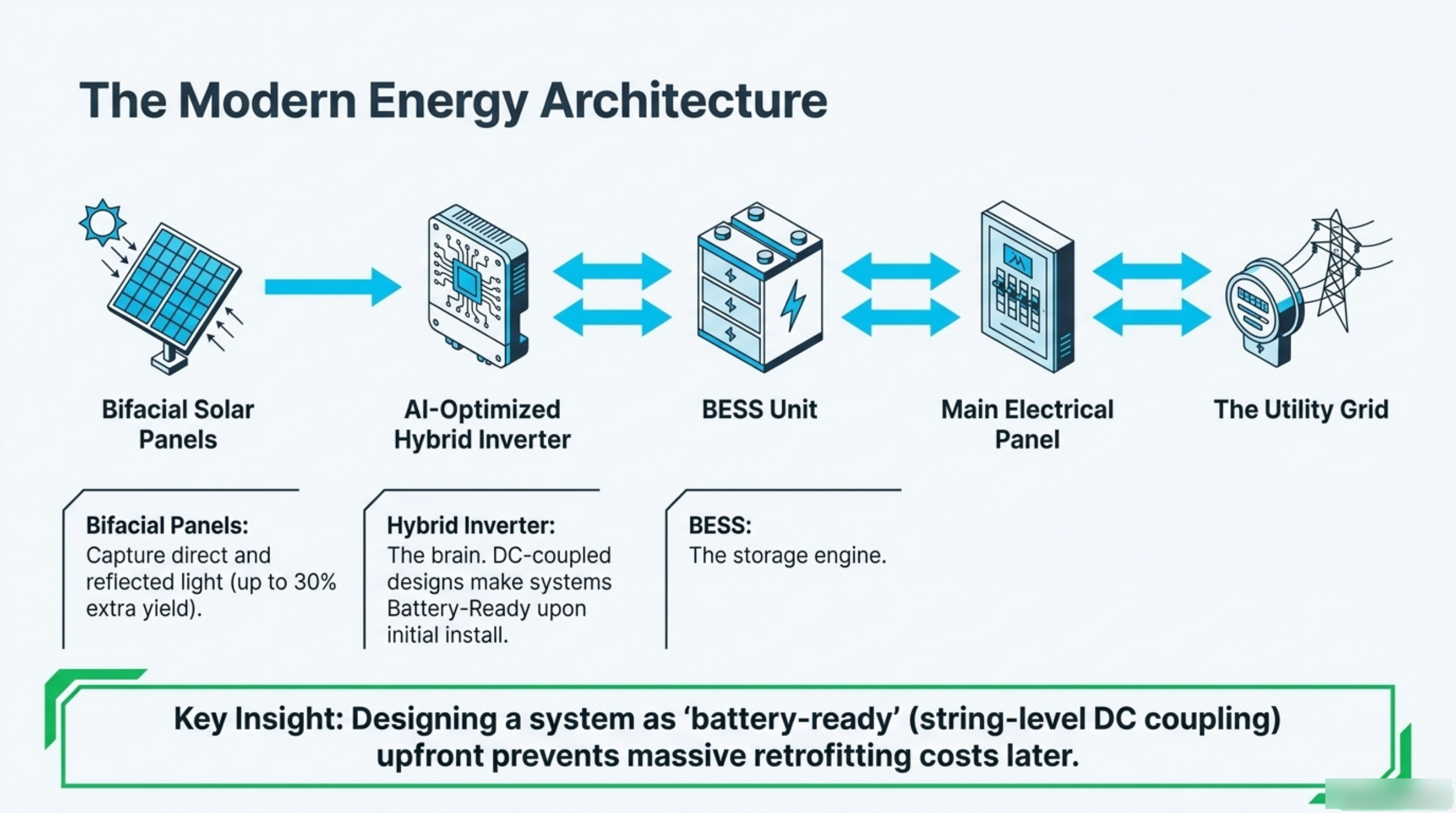
Ask what a solar system consists of and most people will describe one thing: panels. The diagram this article is built around answers differently. It lays out five labelled parts of what the deck calls the modern energy architecture — bifacial solar panels, an AI-optimised hybrid inverter, a battery energy storage unit, the main electrical panel and the utility grid — and gives each one a job description. The arrangement of those five parts, rather than the quality of any single one, is what determines whether a home ends up with a system that can accept storage or one that has to be opened up again to get it.
That is the argument the slide makes, and it is worth building on because it reframes what a homeowner is actually buying. Not a product, but an architecture: a set of deliberate connections between generation, conversion, storage and the grid, decided at design time.
The short version
- A modern residential system has five named parts: bifacial panels, an AI-optimised hybrid inverter, a BESS unit, the main electrical panel and the utility grid.
- Bifacial panels capture direct and reflected light, which the deck puts at up to 30% extra yield.
- The hybrid inverter is the brain of the system; its DC-coupled design is what makes the system battery-ready at initial install.
- Designing battery-ready upfront with string-level DC coupling prevents large retrofitting costs later.
Five components, five jobs
The diagram's value is that it assigns a distinct role to each element, which makes it possible to see which ones are structural and which ones are swappable. The panels generate. The inverter converts and manages. The storage unit holds. The main panel distributes. The grid provides the reference the system synchronises to when it is operating in parallel.
| Component | Role in the architecture | What the deck says |
|---|---|---|
| Bifacial solar panels | Generation | Capture direct and reflected light, for up to 30% extra yield |
| AI-optimised hybrid inverter | Conversion and control | The brain of the system; DC-coupled design makes it battery-ready at initial install |
| BESS unit | Storage | The storage engine |
| Main electrical panel | Distribution | The point where the system meets the home |
| Utility grid | Reference and backup supply | What the system synchronises to and draws on in parallel |
Notice where the intelligence sits. Not in the panels, which are passive, and not in the battery, which is a reservoir. The inverter is the component that decides, moment to moment, where the electricity goes. That is why the slide calls it the brain, and why the next section of this article starts and ends there.
Bifacial panels: harvesting the light twice
Bifacial modules are not a different kind of solar technology so much as a different way of collecting the same sunlight. A conventional panel produces from its front face. A bifacial panel produces from the front and from its rear, picking up light that has bounced off the surface beneath it. The slide puts the upside at up to 30% extra yield, and the operative words are "up to": the gain depends on how much light actually reaches the back of the module, which in turn depends on the roof surface and the mounting height.
For a Flagstaff roof, that makes bifacial output a design question rather than a specification. A dark membrane roof and a high-tilt rack arrangement give the rear face something to work with. A tight, flush mount over dark shingles gives it very little. The honest way to read the 30% figure is as the ceiling of a range, not a per-panel guarantee.
The hybrid inverter is the brain of the system
The slide describes the inverter as the brain and the battery as the storage engine, and the distinction matters. A conventional string inverter has one job: convert DC from the panels to AC for the house. A hybrid inverter does that and manages a battery on the same DC bus, which is what makes the storage unit an integrated part of the system rather than a separate AC-coupled box bolted onto it.
This is where the phrase "battery-ready upon initial install" comes from. Because the inverter is DC-coupled and the connection point already exists, adding storage is a matter of connecting a battery to a system that was built expecting one — not rebuilding the electrical core of the installation to accommodate it.
The battery-ready decision: string-level DC coupling
The key insight on the slide is about timing rather than equipment. Designing a system as battery-ready at string level, meaning the DC coupling happens where the panels' strings are combined, is a decision made once, at design, and it costs comparatively little at that point. The same connection created later has to be inserted into a finished installation, which means opening up the electrical work, revisiting the permit, and paying the labour twice.
That is the whole force of the argument. Nothing about the battery itself changes. What changes is when the decision gets made, and the deck's conclusion is unambiguous: deciding upfront prevents massive retrofitting costs later.
Why retrofit costs what it does
A retrofit is not simply a matter of hanging a battery on the wall. The electrical pathway between the array and the inverter has to be revisited, the inverter may have to be replaced if it was not built to manage storage, the main panel may need work to accommodate the new circuit, and the design and permitting work is repeated on a system that has already been signed off once. Each of those steps is a line item, and together they are the reason the same physical equipment costs so much more the second time around.
The site's calculators hub includes storage-sizing and amortisation models if you want to compare capacity against cost before you talk to anyone.
If you want this sized against your own roof rather than in the abstract, call (928) 698-6192 or request free quotes through the form on this page. Every provider we match is licensed and insured in Arizona, and there is never any obligation to move forward.
Frequently Asked Questions
What does DC coupling actually mean in plain terms?
It means the battery connects to the system on the direct-current side, alongside the panels, rather than converting to household alternating current first and then converting back. Fewer conversion steps generally means less energy lost in the process and a simpler overall system.
Does a battery-ready design cost more if I never add a battery?
The approach is to size the inverter and the DC-side connections so storage can be added, which carries a modest premium rather than a second system's worth of cost. The premium buys optionality; whether that is worth it depends on how likely you think storage is in the next decade.
Are bifacial panels worth specifying on a Flagstaff roof?
They can be, but the gain is site-specific. The rear face needs reflected light to produce anything meaningful, so the roof surface, mounting height and tilt all matter. Treat the up-to-30% figure as the top of a range and ask for the modelling behind any number you are quoted.